
Mysterious “Ox Alpha” Model Is Actually Zhipu GLM-5.3 Flash
Zhipu officially released and open-sourced GLM-5.3 Flash in late August 2026. The model had previously caused a stir in overseas communities under the anonymous test name “Ox Alpha” (Niulai). Key points:
- Release date: late August 2026, open-sourced simultaneously
- New version: the first natively multimodal model in the GLM-5 series (Flash edition), 320B total parameters, 18B activated parameters
- Pricing: 1/10 the price of GLM-5.3; limited-time discount at 1/40 of Claude Opus 4.8 and 1/20 of GLM-5.2
- Availability: integrated into the ZCode open platform, open API, weights fully open on Hugging Face
- Hardware support: deployed on domestic chips, supports 1M-context long tasks
The true identity of the overseas viral “Ox Alpha” model revealed

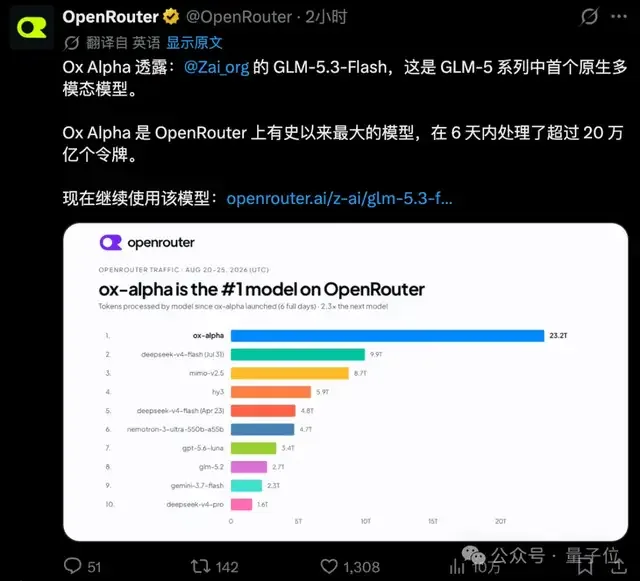
Before Zhipu officially claimed it, the anonymous test version “Ox Alpha” had quietly gone viral overseas:
- Shot to the top of OpenRouter on its first day, setting a new single-day token usage record
- Ended DeepSeek’s 56-day streak at the top on OpenCode
- Developers around the world used it to complete a range of difficult tasks, including 3D engine modeling, video subtitle generation, and commentary on original film footage
Zhipu’s own tests show that the 320B GLM-5.3 Flash comprehensively outperforms the previous-generation flagship GLM-5.2 at 753B; on the latest AA leaderboard, it ties Claude Opus 4.8 with a score of 57. This contrast highlights its architectural efficiency advantage—after the model is slimmed down, its single-task capability doesn’t fall but rises.
| Metric | GLM-5.3 Flash | GLM-5.2 | Claude Opus 4.8 |
|---|---|---|---|
| Total parameters | 320B | 753B | Undisclosed |
| AA score | 57 | Undisclosed | 57 |
| Pricing (relative) | 1 | ~10x | ~40x |
| Multimodal | Native support | Not supported | Native support |
| Domestic chip support | Yes | Not specified | No |
Architectural innovation: linear + sparse attention drives efficient inference

GLM-5.3 Flash’s post-slimming momentum comes from three technical breakthroughs:
- Hybrid attention mechanism: linear attention captures local information, while sparse attention retrieves global context through a lightweight indexer, reducing attention computation by 3.01x and shrinking KV Cache by 4.44x
- Decoupled inference architecture: three-layer Encode-Prefill-Decode decoupling supports independent scaling and adapts to the resource scheduling characteristics of domestic chips
- Visual feedback loop: a data synthesis pipeline built specifically for Visual Coding enables the model to “write, watch, and revise” while performing tasks such as UI reproduction and 3D modeling
Combined with 30T tokens of multimodal pretraining data and native multimodal encoding optimization, the model achieves a 3x improvement in end-to-end service performance on domestic chips, with per-token cost comparable to mainstream Nvidia GPUs.
Deployment scenario recommendations
Recommended for immediate trial:
- Small and midsize model vendors and independent developers: open-source weights lower the deployment barrier, making it suitable for high-frequency, lightweight scenarios such as multimodal content generation, intelligent customer service, and educational video processing
- Teams seeking domestic alternatives: scenarios in the domestic chip ecosystem (such as Ascend and Cambricon) that need to balance performance and cost
Recommended to wait and see:
- Enterprise users who need mature Agent workflows: the current version focuses on single-task completion, and complex multi-step Agent orchestration has yet to show clear advantages
- Applications dependent on extreme long context (>1M): although it supports 1M context, the stability of real-world long-range reasoning still needs public long-term stress testing
Final thoughts
The release of GLM-5.3 Flash marks a new phase for domestic large models as they shift from a “parameter race” to “full-stack efficiency optimization”: using lower resource consumption to deliver globally leading performance on domestic chips. As cutting-edge model prices move from “luxury goods” toward “daily necessities,” truly powerful models will no longer be defined by compute scale, but by effective task completion rate per unit cost.