
Key announcements at a glance
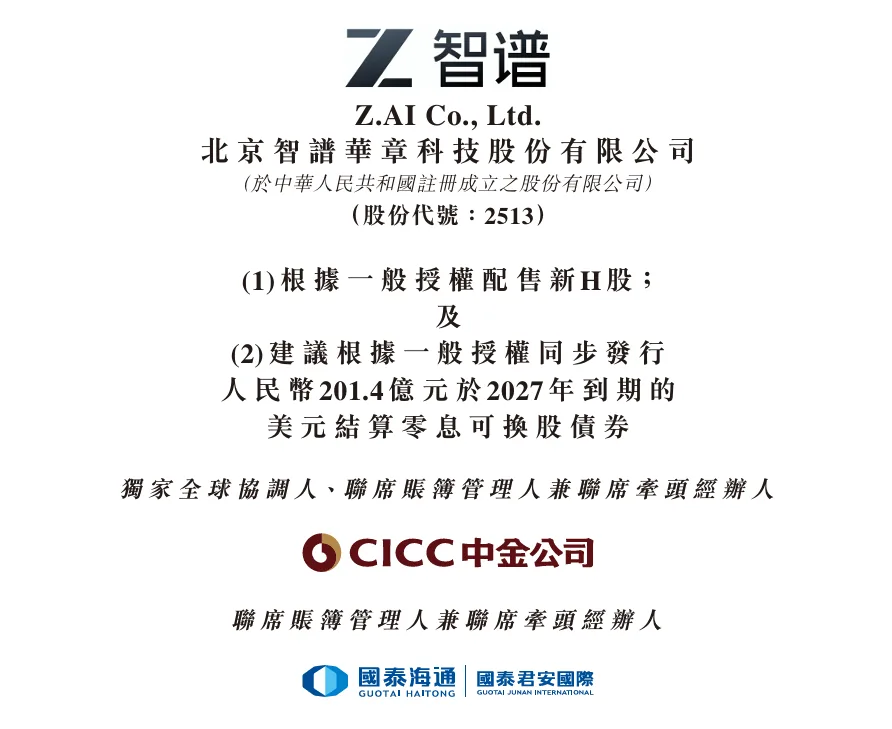
On September 13, 2026, Zhipu AI announced the completion of a ~$5 billion (approximately RMB 33.5 billion) fundraising, comprising:
- Equity placement: ~$2 billion (RMB 13.4 billion), with 21,965,000 new H-shares priced at HK$714.00 per share;
- Zero-coupon convertible bonds: ~$3 billion (RMB 20.1 billion), issued at 100.5% of principal, initial conversion price HK$892.50 (25% premium over placement price);
- Timeline: Financing closed in mid-September 2026; funds to be deployed over the medium-to-long term;
- Model progress: GLM-5.3, released in August 2026, scored 45 points on the Artifical Analysis intelligence leaderboard—the highest among Chinese models.
Fund allocation and strategic focus
60% of net proceeds will target next-gen GLM foundation models and the complete self-training system—the clearest technical bet in this round.
The term “complete self-training” refers to training where the next-generation model learns not only from human-annotated data, but also within a virtual environment built by the previous model, gradually forming a Recursive Self-Improvement (RSI) loop. This体系 explores three key domains:
- Automated generation and curation of training data;
- Build-out of executable, verifiable task environments;
- Enhanced long-horizon reasoning and self-validation capabilities.
Beyond model R&D, remaining funds will be allocated as follows:
- ~15% for business expansion, strategic investments, and potential M&A;
- ~25% for capital structure optimization and working capital.
This pacing aligns closely with prior rounds: the January 2026 HKEX IPO raised ~HK$4.9 billion (fully deployed as of August 31); the July 2026 placement raised HK$31.4 billion (~11.1% deployed as of August 31), leaving roughly HK$20.4 billion undeployed—a portion feedinginto this round.
Notable counterpoint: Despite the massive $5 billion raise, Zhipu generated RMB 954 million in revenue H1 2026 (+399% YoY), with MaaS/API contributing RMB 825 million (+2,736% YoY). The company is demonstrating a rare ability to simultaneously scale investment and cash-flow—commercial traction is outpacing raise size.
Financial and product metrics comparison
| Metric | Value | YoY change | Notes |
|---|---|---|---|
| H1 2026 revenue | RMB 954M | +399% | Exceeds full-year 2025 revenue |
| MaaS/API revenue | RMB 825M | +2,736% | 86.5% of H1 revenue |
| Annualized monthly revenue (ARR) | $1.6B (end-Aug) | +60% | vs. early July |
| GLM release cadence | GLM-5.3 (Aug) | 2-month cycle | Feb→Apr→Jun→Aug consecutive upgrades |
| Artifical Analysis score | 45 (GLM-5.3) | — | Highest among Chinese models |
| H-share placement price | HK$714.00 | — | Current placement |
| Convertible bond conversion price | HK$892.50 | +25% premium | Above placement price |
Actionable advice for readers
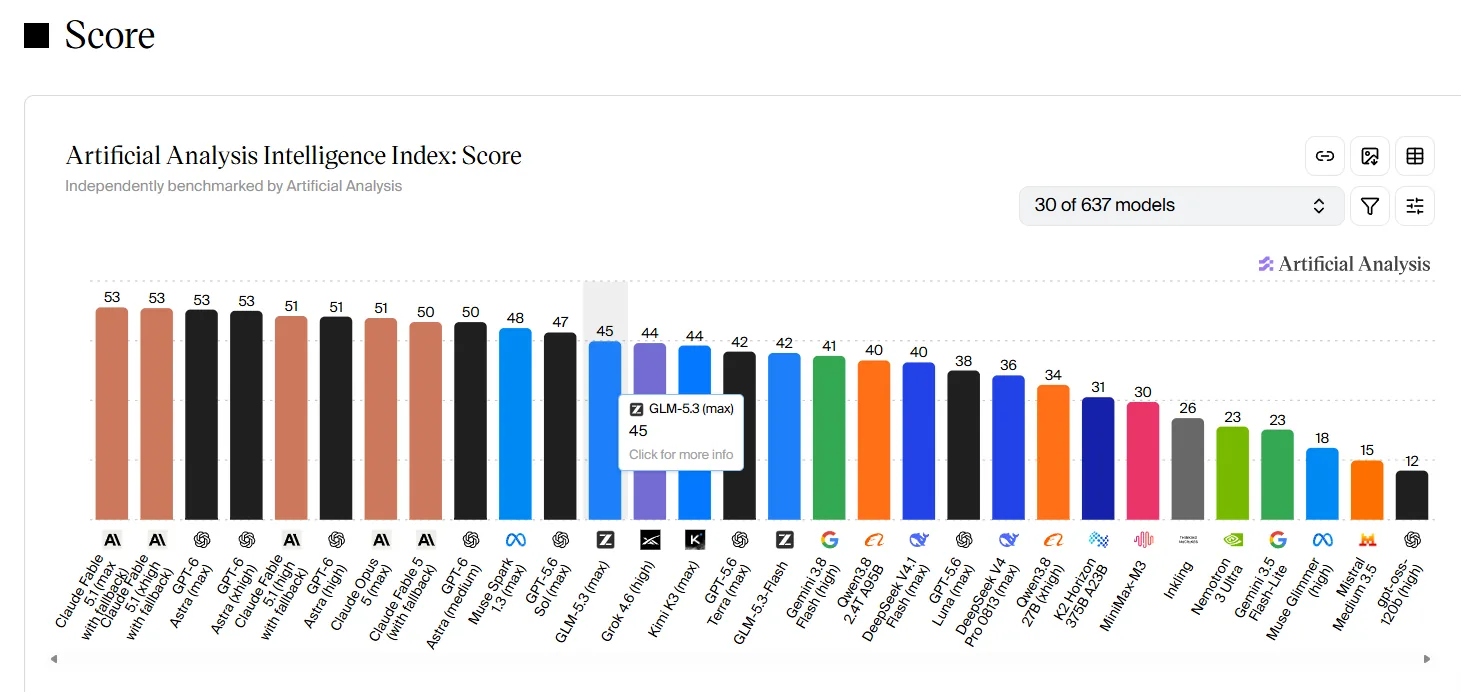
Who should adopt now: Developers and enterprises seeking the highest-performing Chinese foundation model with rapid iteration momentum should consider GLM-5.3’s API—the score of 45 indicates production-grade capability in long-form reasoning and programming tasks. Particularly suited for scenarios requiring国产AI stack integration.
Who should wait: Organizations demanding full offline deployment or stringent data sovereignty guarantees should monitor Zhipu’s国产 chip adaptation progress. This round explicitly commits to国产 chip support and operator optimization, but real-world ecosystem readiness remains to be demonstrated.
In closing
The Chinese generative AI race is evolving from raw model benchmarking to a three-dimensional competition: capital depth,算力 scale, and commercial efficiency. Zhipu’s $5B war chest paired with its RSI roadmap signals a new phase where execution velocity—not just parameter count—drives competitive advantage.