
1. What Happened

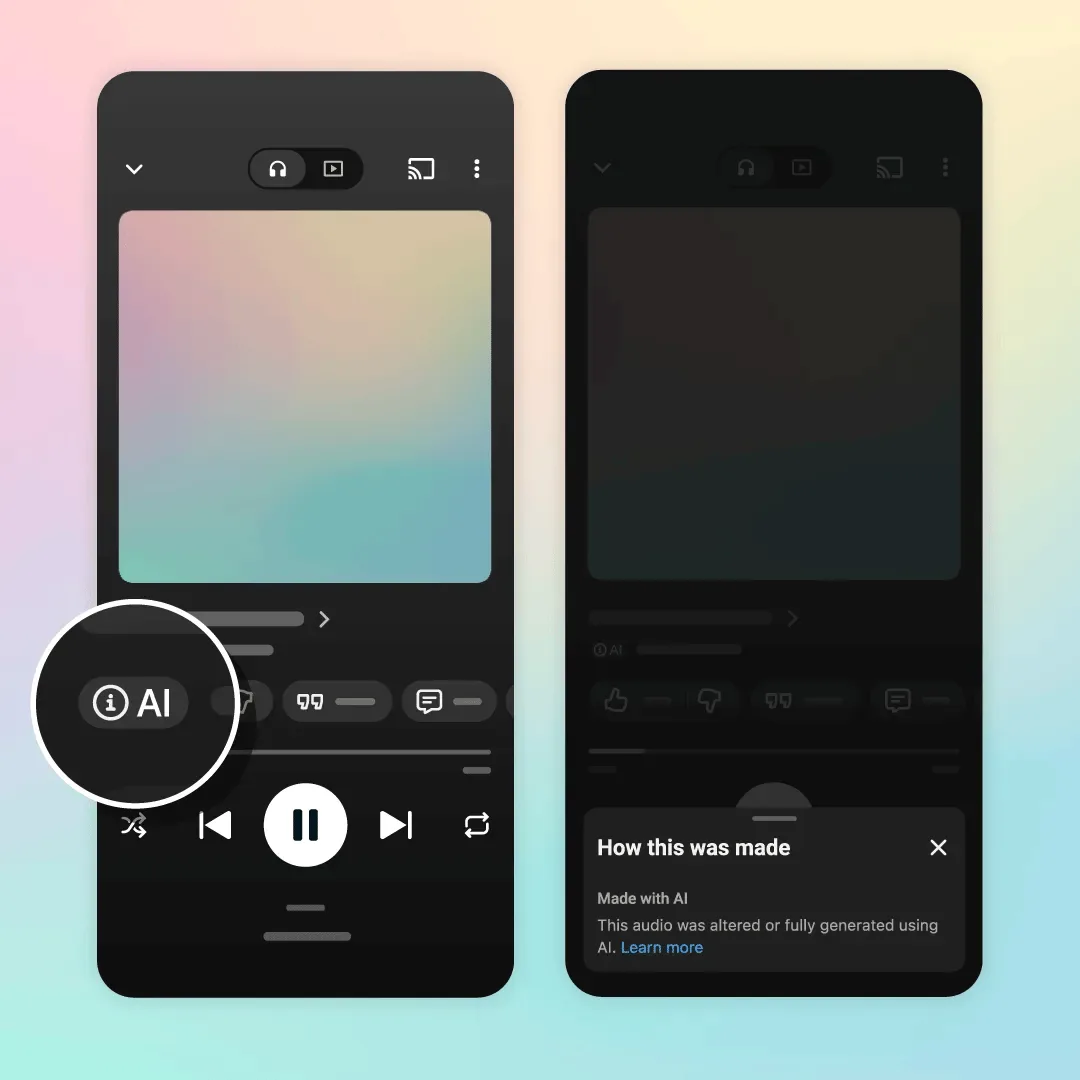
YouTube Music announced on Wednesday the launch of a new AI labeling system to improve transparency for songs made with generative AI (technology that uses algorithms to automatically produce content). Going forward, tracks made with AI will show a label on the player page, and clicking it reveals exactly which part of the process AI was involved in.
Hard facts:
- Publisher and timing: YouTube Music announced the rollout on Wednesday
- Coverage: YouTube Music player pages, with simultaneous expansion to the main YouTube app
- Identification method: Collaboration with multiple music partners, plus proprietary detection tools
- Classification categories: Partners must declare one of three: Fully Gen AI, Partly Gen AI, or No Gen AI
- Impact on revenue: None; AI involvement alone does not disqualify a track from monetization
The company has not announced a phased rollout schedule or detailed regional differences.
2. Auto-Tune Doesn’t Count as AI: The Most Counterintuitive Divide
The boundaries between the three categories are worth a closer look. “Fully Gen AI” means the entire song is generated by AI; “Partly Gen AI” means the creator used AI-generated elements but overdubbed live elements such as human performance or vocals; and songs processed with pitch-correction tools like Auto-Tune (a tuning tool that pulls off-key vocals back into tune) are classified as “No Gen AI.”
This is the most counterintuitive point in the announcement: In the public imagination, pitch correction is the very symbol of “technology intervening in the human voice,” yet YouTube does not count it as generative AI. The label measures whether content was generated, not whether software was used in the production process.
The contrast also lies in the choice of approach. Facing the same flood of AI music, YouTube chose disclosure over restriction: it does not keep songs out of recommendations just because AI was involved, nor does it cut off revenue. Deezer, meanwhile, disclosed in July that its platform receives nearly 90,000 fully AI-generated tracks per day—a scale that explains why every company must offer a solution, though the solutions differ.
3. How Peers Compare
| Platform | Approach | Distribution and revenue handling |
|---|---|---|
| YouTube Music | Three-tier labels; player pages show AI’s specific role, and labels extend to the main app | No restrictions; no impact on monetization |
| Deezer | Labels AI-generated music detected on the platform; is developing user filtering options | Excluded from algorithmic recommendations and editorial playlists; fraudulent streams do not pay royalties |
| TIDAL | Labels recordings identified as fully AI-generated | Users can turn it off; not counted toward royalty attribution |
| Spotify | Already has AI labels and a music spam filter | Not specified in source material |
| Apple Music | Plans to launch a “Made With AI” label later this year | Not specified in source material |
YouTube is also running its own AI music experiments: the Dream Track tool lets selected creators generate backing tracks and uses AI versions of participating artists’ voices. Labeling AI music while also offering AI generation tools—this stance is a key to understanding why it favors the disclosure route.
4. Who Should Use It Now, and Who Should Wait
- Use it now: Listeners who care whether what they’re hearing was made by a human, and independent musicians who need to declare AI usage to platforms. The three-tier classification provides relatively clear declaration categories, and those using Auto-Tune don’t need to worry about being mislabeled.
- Better to wait: Listeners who want to completely block AI music. YouTube only labels; it has no filter switch. To keep AI music out of sight, the exclusion mechanisms of Deezer and TIDAL are closer to the need. In addition, label