
Bottom line up front: of 208 so-called “tech enterprises,” 76 have zero insured employees — over a third; the two with the fewest — Langzhiwei Food and Ruicheng Footwear — each have only 2 people on social insurance; the county’s single largest employer, Jinxin Electronics, has 382, accounting for nearly a third of all confirmed insured employees across the 208. Another 103 enterprises couldn’t be found anywhere online, and I’ve honestly recorded those as “gaps” rather than counting them as zero.
In the previous article (Digging Up Every Tech Enterprise in a County), I pieced together a full roster of 208 small-tech and high-tech enterprises in Xinning County from seven years and hundreds of government PDFs. The list was assembled, but one question remained unsolved: among these “tech enterprises,” how many people actually work there?
Social insurance enrollment figures in enterprise annual reports are the most honest metric — they don’t care how much registered capital a company claims or whether it holds a high-tech certificate. They track only one thing: how many people the company has actually, out-of-pocket enrolled in social insurance this year.
The Numbers at a Glance
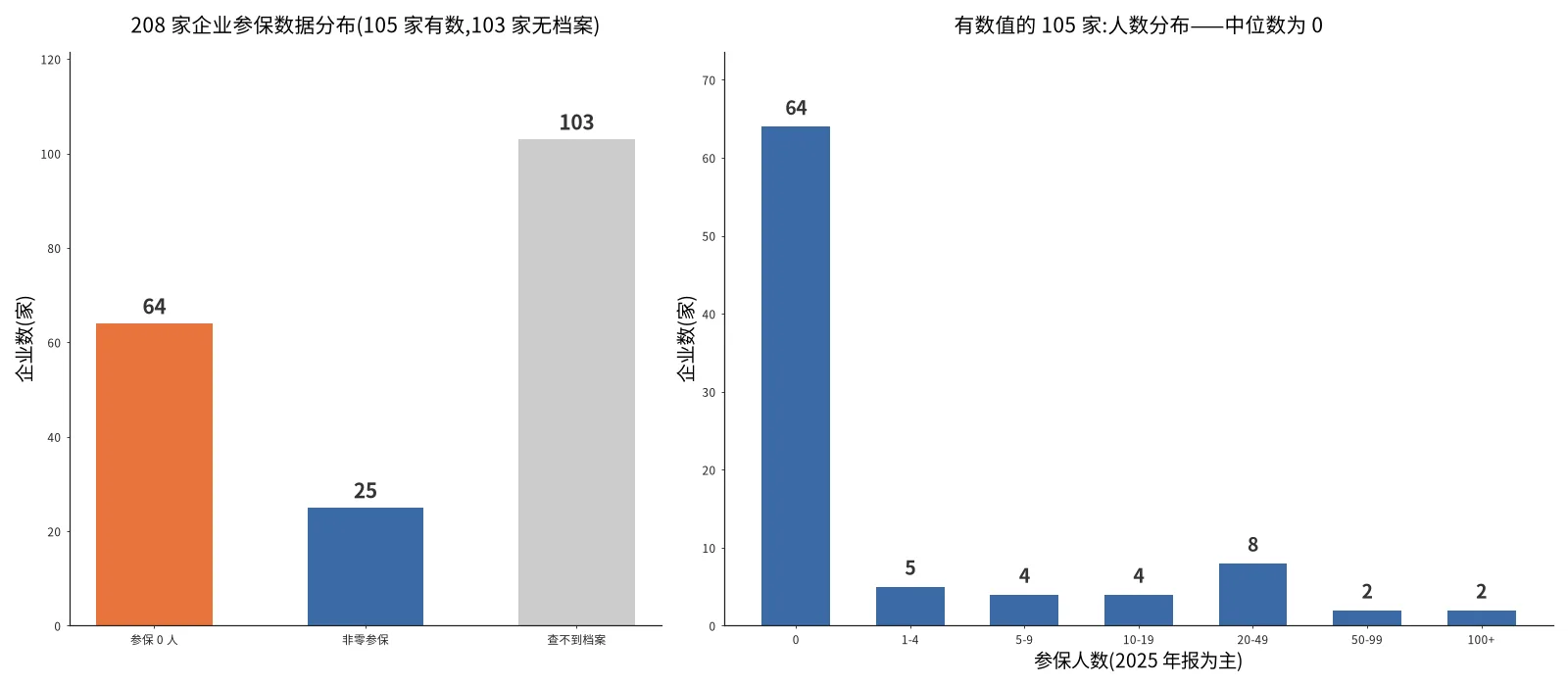
| Category | Count |
|---|---|
| 208 firms with confirmed enrollment figures | 105 |
| — of those, with zero insured employees | 76 |
| — with non-zero enrollment | 25 |
| — not found anywhere online | 103 |
The median enrollment among the 105 traceable firms is 0. Excluding the zeroes, the median among the remaining 25 is only 14.
The Lowest
Langzhiwei Food (now renamed Hunan Langzhiwei Technology Co., Ltd.) and Ruicheng Footwear, each with 2 employees.
Both survived adversarial verification — re-checked through independent channels separate from the original sources, with unified social credit codes, legal representatives, and registered addresses all cross-locked to confirm no mix-ups with similarly named duplicates. Here’s a near miss: Xinning County has both “Langzhiwei Food” and “Langwei Food” — names differing by one character, both food companies, one with 2 insured and the other with 0. I scanned the entire table for near-duplicate names and found roughly half a dozen more such pairs: four electronics firms — Jinxin, Xinxin, Jinjing, Jinrui — and a trio — Langyun, Xinyun, Xinyang. In every case, verification required matching the social credit code character by character, not relying on company names alone.
Ruicheng Footwear was founded only in June 2025, so 2 employees out of the gate is normal. Langzhiwei, founded in 2023, has been producing soy products for three years with just 2 insured — that is the real workforce scale of the vast majority of county-level small-tech enterprises.
The Highest
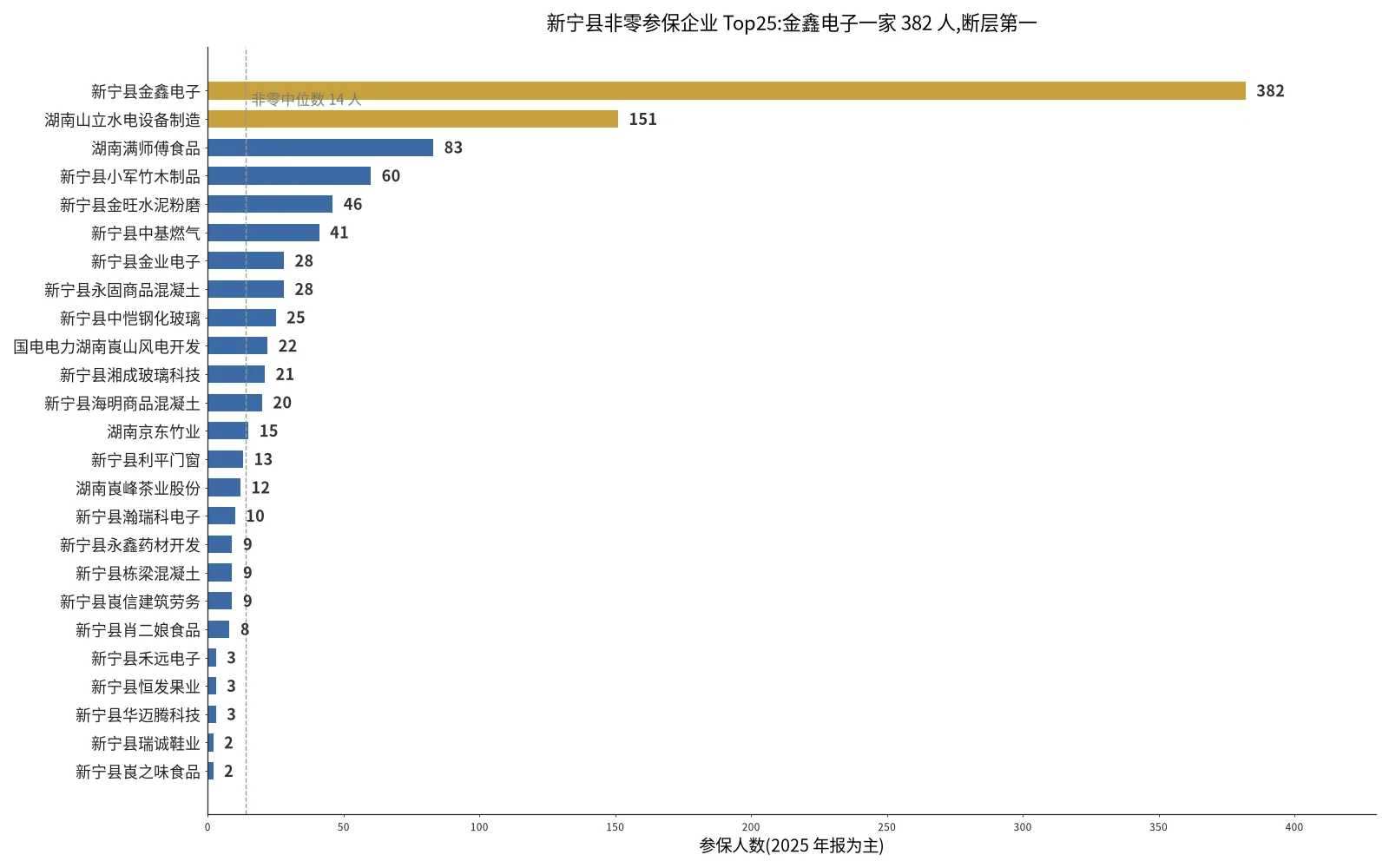
Jinxin Electronics, 382 employees, in a league of its own. This vibration motor / stepper motor (smartphone motor) manufacturer counts Huawei, OPPO, VIVO, Lenovo, and Transsion among its clients. It claims to be one of the top three smartphone motor production bases in China, with a market share exceeding 10%, and reported sales of over 200 million yuan in 2022. Its single enrollment figure alone accounts for 29.8% of all confirmed insured employees across the county’s 208 firms.
Runner-up Shanli Hydropower: 151 employees (an old state-owned enterprise restructured in 1958, producing hydroelectric generator sets). Third: Master Man Food: 83 employees (soy products — more on this below). The top three account for 55.5%; the top ten, 80.6%. This county has no “tiered” tech enterprise landscape — just one large factory surrounded by a string of small workshops.
Five Counter-Intuitive Findings
1. Even High-Tech Enterprises Can Have Zero Insured Employees
Langyun Electronics, Xianglong Fruit Industry, Shundi Tea, and Jinling Wangjia Food — four high-tech enterprises whose social insurance enrollment was zero across all three years (2023, 2024, 2025).
The data isn’t wrong — the institutional definition is: the high-tech enterprise certification (Guokefafire [2016] No. 32) requires only that “technical personnel account for ≥10% of total employees in the given year,” with no absolute minimum headcount, and “total employees” can include dispatched labor, part-timers, and temporary hires — a completely separate accounting from social insurance enrollment. Jinling Wangjia’s high-tech certification expired in 2025 and is under reapplication. Seven years on the small-tech roster with enrollment perpetually at zero, it most closely resembles a “qualification-maintaining quasi-shell.”
So when evaluating a county’s high-tech enterprise count, the title alone is only a necessary condition. To understand real operations, enrollment figures are far more honest than certificates.
2. “Paper Small-Tech Enterprises”: Traces of the 2023 Enrollment Surge
The 78 enterprises that appeared only at the 2023 peak of the seven-year curve above and never renewed:
- With non-zero enrollment: 1 (Jingdong Bamboo Industry, 15 people — and no, they have no relationship with the JD.com Group)
- No records found anywhere (not even enterprise information platforms bothered to list them): 49
- Already deregistered: 5
2023 was the year Hunan pushed its “doubling plan” for tech enterprises, with counties批量 seeking intermediaries to handle applications. Enrollment brought immediate benefits — R&D super-deductions, loan interest subsidies — and the following year, a mass exodus. The model of enrolling purely to meet quota targets is now fully exposed in the social insurance data. Layering the 208 firms by substance: roughly 32 (15%) have real operations and social insurance-covered employment; about 90 (43%) are paper-only.
3. Concrete Plants Are the County’s Most “Honest Enrollers”
Xinwang: 35; Yonggu: 28; Haiming: 20 — the three concrete plants’ enrollment figures far exceed those of the county’s agricultural small-tech enterprises. The reason isn’t romantic: qualification approval involves scrutiny, year-round continuous production is mandatory, clients are predominantly government and state-owned enterprises, and compliant invoices are required. This industry simply can’t operate on casual labor. By contrast, the policy-favored agricultural small-tech enterprises (navel oranges, tea, aquaculture) are nearly all at zero enrollment — seasonal workers, cooperative farmers, cash wages. The targets of subsidy disbursement and actual standardized employment are misaligned.
4. Hiring and Social Insurance Enrollment Are Not the Same Thing
Quanhui Electronics advertises for 20 production workers year-round, yet has 0 insured. Xiao Xianghong’s clothing factory (founded by a Shenzhen returnee), employs 380+, yet the declaring entity has 0 insured. Jinxin Electronics’ website states “approximately 900 employees,” yet social insurance enrollment is only 382. The bulk of county-level manufacturing employment runs through labor dispatch, piece-rate, and non-full-time arrangements — none of which flow into the enterprise’s social insurance enrollment figures. Reading county-level economic health from enrollment data reveals only the “formalized employment” layer, not total employment.
5. Registered Capital Lies; Enrollment Numbers Don’t
Wanshi Building Materials: registered capital 20 million yuan, enrollment 0; Jiujiuxiang Tea: 50 million yuan, enrollment 0; Huixin Building Materials: 30 million yuan, enrollment 0. Registered capital is a subscribed figure — you can write whatever you want. Across the county, there’s a dozen-plus enterprises with the pattern of “large registered capital + zero enrollment + on the small-tech roster” — most likely shells for subsidy collection, or dormant shells from earlier rounds.
Niche but Valuable Details
Master Man’s “Top 50 Soy Products” claim doesn’t hold up. The media calls it a “China Soy Products Industry Top 50” enterprise. I cross-checked the China Soy Products Industry Association’s official lists for both 2024 and 2025 — only Xiangxiangzui and Lanting from Hunan appeared; Master Man was absent. “Top 50” is a media paraphrase, not a verified ranking. But this company’s enrollment trajectory is honest: 163 employees in 2023 → 128 in 2024 → 83 in 2025, a 49% decline over three years. The 3A-level scenic industrial park’s root-carving museum (its crown jewel, 66.6 meters long, once holding a world record) is genuine, at least.
Yuanbo Agriculture’s “AI Transformation” Is a Shell. This agricultural company changed its name to “Hunan Jinshiyun Intelligent Technology” in December 2024, swapped its business scope for a full AI toolkit, and jumped its registered capital from 100,000 to 10.03 million yuan — yet paid-in capital is zero, enrollment has been zero for three years, and it has no website, no patents, no job postings, and 18 change records across three years. Beneath the agricultural-to-AI veneer, this looks more like a shell resource changing hands.
A Discredited “High-Tech Enterprise Record.” During data collection, an agent reported that Hanjing Electronics appeared on the 2023 high-tech enterprise filing list. I downloaded all eight batches of the official filing PDFs from the innocom website and performed character-by-character searches — zero hits. This was a hallucination from a search engine’s synthesized summary. Every questionable figure in the full text went through this same verification gate, including correcting Master Man’s “128 employees” (from Baidu Baike) to the 2025 annual report figure of 83, and Shanli Hydropower’s outdated “201–300 employees” description to the social insurance figure of 151.
Methodology: What Made This Harder Than Last Time
The challenge last time was “official PDFs scattered everywhere.” This time, it was anti-scraping measures on business data platforms. Qichacha and Tianyancha detail pages are essentially blocked; Aiqicha works intermittently. I ultimately打通 three channels:
- Shuidi Credit (shuidi.cn) company pages — a three-year enrollment sequence embedded in the page’s internal JSON — the most reliable primary channel;
- Aiqicha mobile API, returning annual report data without login;
- Yellow page snapshots (yellowurl.cn) — functional but generally lagging by 1–2 reporting cycles, used only for corroboration.
The anti-mix-up rule is ironclad: source pages must contain “Xinning County” or a social credit code beginning with 91430528, and the company name must match character for character. Search engine synthesized summaries have an extremely high cross-contamination rate — there were hallucinated data points assigning a Xinning small factory’s figures to a Shenzhen listed company (271 employees) and a Ningbo firm (4,100 employees), all discarded.
The entire process ran 3 workflows + 2 supplementary collection agents, covering 35 sub-tasks and approximately 3,800 tool calls. Extreme cases (the fewest, the most, and high-risk near-duplicate name groups) were all adversarially verified through independent channels: 6 of 12 confirmed, 3 values corrected, 3 confirmed but with source annotations revised. The zero for zero-enrollment high-tech enterprises is zero as verified across three years of annual reports.
Final Thoughts
Last time I dug up the roster; this time I counted heads. Together, they paint a complete picture of Xinning County: behind 208 “tech enterprises,” verifiable social insurance-covered employment totals roughly 1,300 people — in a county of 600,000. One electronics factory alone accounts for a third; none of the top ten are in emerging industries — food, cement, concrete, bamboo and wood: slapping a “tech” label onto traditional industries is the primary morphology of this county’s so-called “technological content.”
The application criteria for small-tech and high-tech enterprises aren’t wrong, and the policy benefits are real. It’s just that when these rosters get reported as “208 tech enterprises,” Langzhiwei with 2 insured and Jinxin with 382 sit in the same number.
(All data as of 2026-09-17; the full table of 208 firms, with per-firm enrollment figures, source URLs, and notes, is stored locally alongside three companion reports; the 103 missing firms are recorded as a coverage gap, noted honestly, and not presented as a complete enumeration.)