TL;DR: As of September 16, 2026, 208 tech enterprises in Xinning County, Hunan are verifiable from public official sources — 207 science-technology SMEs (SKE, 科技型中小企业), 32 high-and-new technology enterprises (HNTE, 高新技术企业), with 31 holding both. 126 companies were individually verified against the original government documents; all passed, zero misattributions, zero fabrications. The full data chain (231 official attachments → parsing → dedup → verification → six-sheet Excel) stays in my private repo; this post gives you the method and the numbers.
Why do this at all
How much “tech” does one county actually hold? Nobody can usually answer that — not because the data doesn’t exist, but because it’s scattered across seven years, dozens of batches, and hundreds of government announcements and PDF attachments. Nobody wants to stitch it together.
SKE status is granted in multiple batches per year; HNTE certification is announced in batches too. The lists live on the Hunan Provincial Science & Technology Department site and the national HNTE management portal. Any single batch might show five Xinning companies. Flatten every batch from 2020 to 2026, deduplicate, cross-reference — and only then does the real picture emerge.
So I ran it as a data engineering project: parallel multi-channel retrieval of official sources → actually download every PDF/Excel attachment → parse → strictly filter for Xinning (while fending off its evil twin Xinshao County) → dedup by unified social credit code and company name → build a master table → adversarial per-company verification → reports. 56 parallel subtasks, 2,347 tool calls in total.
The numbers first
| Metric | Count |
|---|---|
| Companies after dedup | 208 |
| SKE (incl. dual) | 207 |
| HNTE (incl. dual) | 32 |
| SKE + HNTE dual | 31 |
| HNTE-only | 1 |
| Individually verified against source docs | 126 |
| Official source attachments archived | 231 |
Exactly one company is HNTE-only: SPIC’s Hunan Langshan Wind Power — a central SOE subsidiary that has no shortage of credentials and doesn’t need the SKE track. Very on-brand.
The seven-year SKE curve
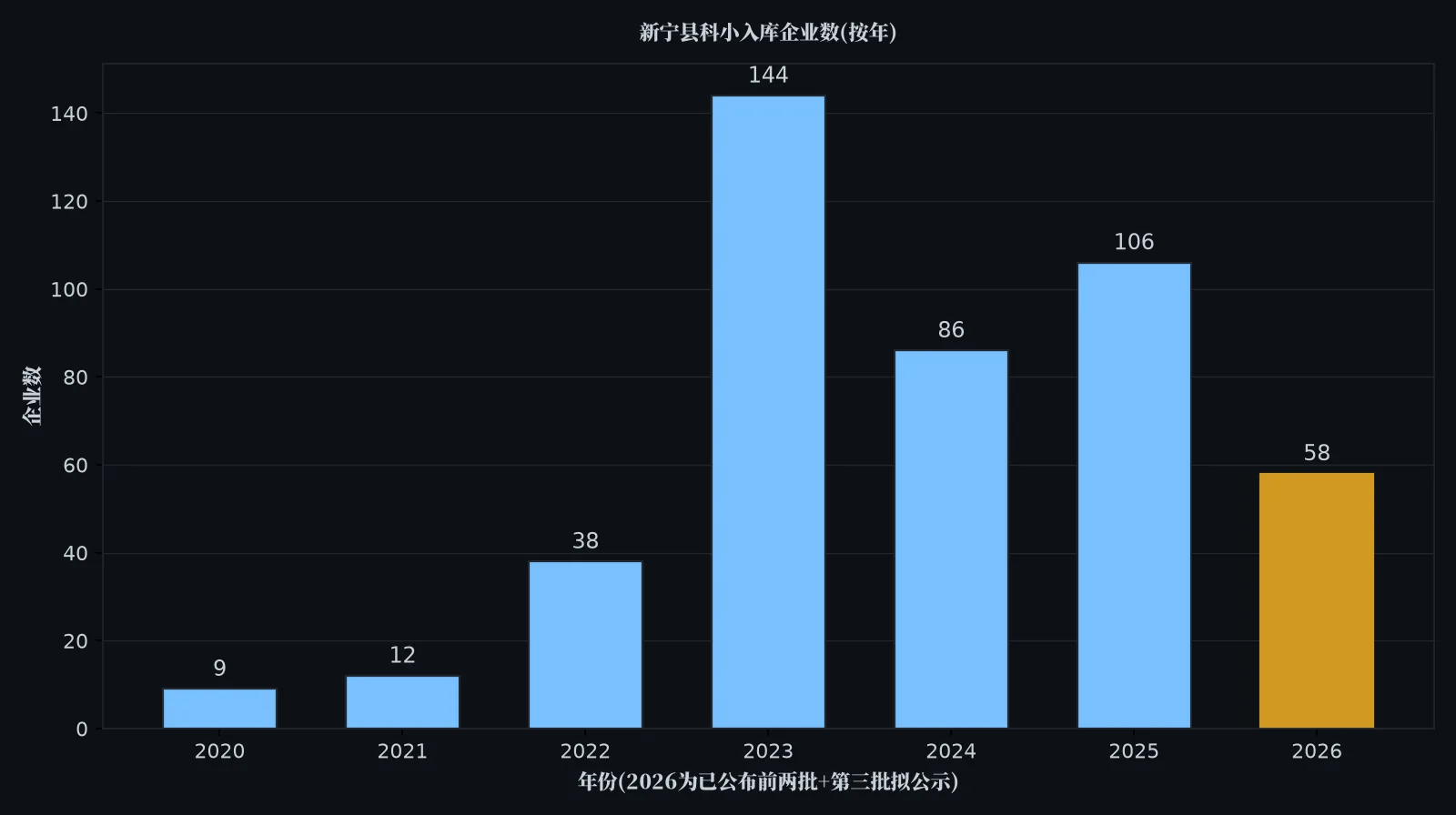
The curve tells a story:
- 2023 was the breakout: 144 companies, 3.8× the 2022 count (38). Hunan’s SKE evaluation program scaled up massively that year (nine batches published), and county-level officials clearly pushed hard.
- 2024 dropped to 86, 2025 back to 106: that’s not companies disappearing — SKE status must be renewed annually, so missing one year drops you from that year’s list. 2024/2025 washed out the 2023 surge; what remained is the base.
- The 58 for 2026 only covers published Batch 1, Batch 2, plus 3 companies in Batch 3’s draft announcement. Hunan published 4 batches in 2025 — expect two more rounds before the year ends.
The die-hards
43 companies appeared in the SKE list all three years 2024–2026 — in a county this size, that’s the backbone of its tech sector. Another 39 appeared in two of the last three years.
The multi-year streaks are the ones worth naming: companies like Xinning Wuliuqi Clothing & Trading (in the list every year since 2024) are small, but they complete the SKE evaluation process annually — which means R&D expense bookkeeping and IP management are routine operations. That’s the entry ticket to most subsidies and loan-interest discounts.
How solid are the HNTE credentials in 2026?
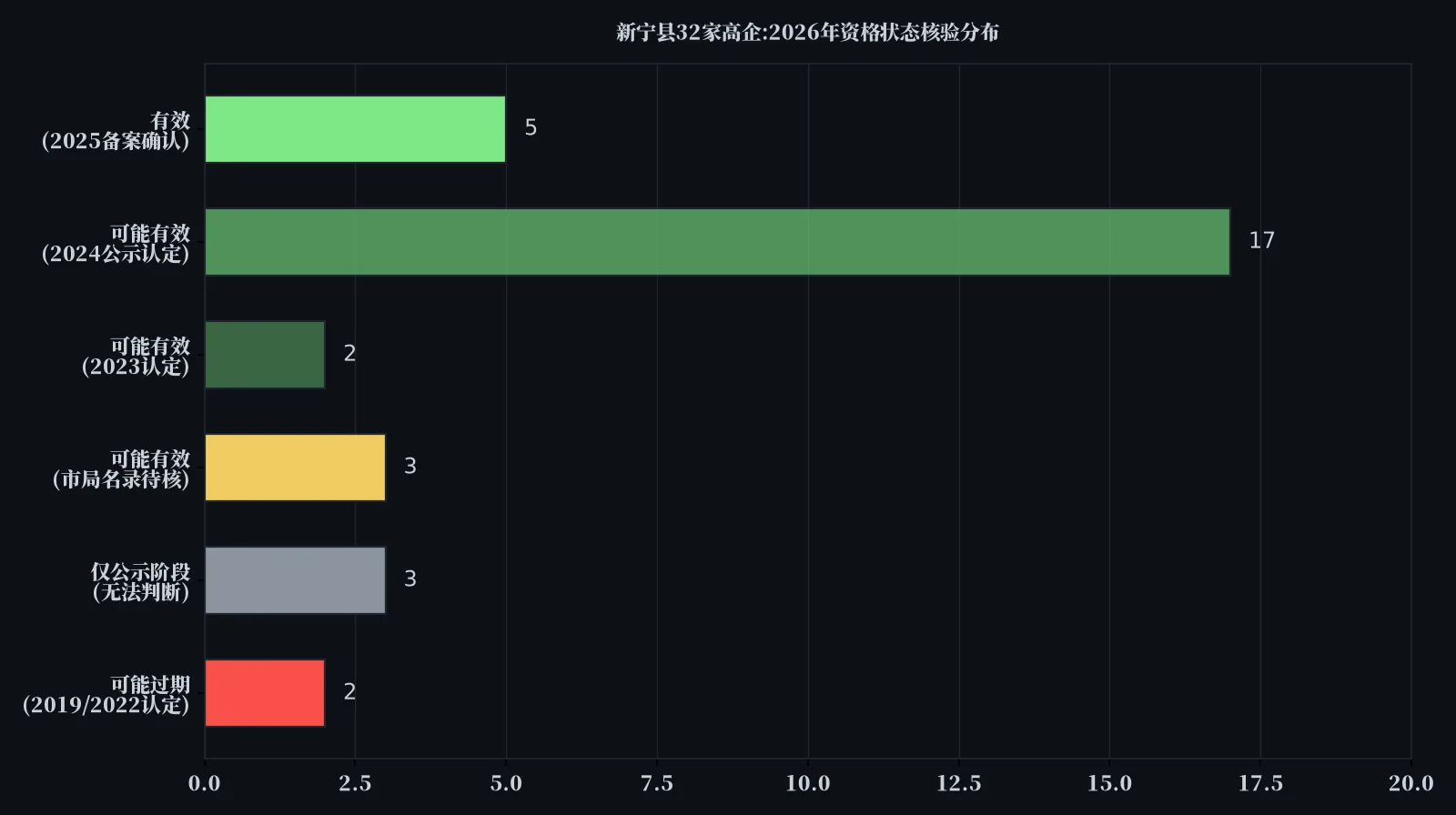
HNTE credentials last three years, then require recertification. Verifying each of the 32 against their certification year:
- Confirmed valid: 5 — certified in the 2025 filing announcements with verifiable GR20254300xxxx-level certificate numbers (Hengfa Fruit, Xinxin Electronics, Haiming Concrete, Xiaoerniang Food, Zhongkai Tempered Glass — 2025 was Xinning’s big HNTE year; the announcement→filing→supplementary-filing chain checks out end-to-end).
- Likely valid: 19 — 17 from the 2024 filing announcement lists (2024 certification covers 2026), 2 from 2023.
- Likely expired: 2 — certified 2019/2022 with no recertification record found.
- Undeterminable: 3, pending verification: 3 — only draft-stage lists or municipal-directory tags, no formal filing record retrieved.
Two near-misses worth recording: of the 13 companies the Shaoyang municipal directory tags as “HNTE”, 3 (Xiaojun Bamboo & Wood, Jinlong Building Materials, Shanli Hydropower) appear in no provincial certification or filing list whatsoever. The directory tags intermediate states like “applying for HNTE” — trust it blindly and you’d count applicants as certified. A single source, even an official one, isn’t enough.
The harvest wasn’t smooth: pitfalls hit
This was never “just search for it.” The memorable obstacles:
Pitfall 1: The national portal 502s. innocom.gov.cn was unreachable throughout the collection window. The way out is verified republications — but then verify the republished content line by line. For the 2025 Batch 2 formal filing announcement (856 companies), I ran all 856/856 rows through a double filter (per-row regex + whitespace-stripped full-text search): Xinning 0, Xinshao 0. A verified zero, not a “didn’t find.”
Pitfall 2: Xinning vs. Xinshao, one character apart. Both counties belong to Shaoyang; company names differ by two characters. Filtering must key off the administrative division code 430528 (Xinning), never literal name matching. Every record keeps its attribution evidence (source line number + code position) for re-auditing.
Pitfall 3: The SKE registration number is a gift. Its format is year + division code + sequence (e.g. 2024430528A0017752); the middle segment encodes the county. More reliable than addresses, and it lets us safely continue the history of companies that renamed themselves.
Pitfall 4: The 2026 HNTE list doesn’t exist yet. Scanned all 25 pages of the provincial announcement board, pulled the live innocom Hunan filing list — three-way confirmation: 2026 has only the certification work notice and two renaming announcements (0 Xinning companies among 103 renames). Following the 2025 rhythm (notice in May, publication in December), the first 2026 list should land at year-end. “Not yet published” and “not found” must be kept distinct — conflating them is how reports mislead.
Method: an auditable data chain
How do you guarantee “no fabrication”? Every number travels this chain:
Raw attachments (231 PDFs/Excel/HTML archives) → parsed text (each with location: filename + line/page) → filtered records (each with attribution evidence) → master table (one row per company, history in arrays) → adversarial verification (per company: grep the original for the name, check the county code, check the batch) → mechanical check (85 companies carry unified social credit codes; each code searched against the full 42M-character corpus: 85/85 hits, 0 anomalies).
The single most valuable rule in adversarial verification: default to “this record is wrong.” The verifier’s job is to refute, not confirm — miss the source text, mismatch the county code, mismatch the batch, any one kills the record. 126 passed, 0 rejected; the remaining 82 aren’t suspect, they just weren’t in the verification sample — flagged “pending” for the next round.
Coverage gaps are recorded honestly: 2020/2021 SKE only mid-to-late batches; 2022 Batches 4/6 announcements never retrieved; some 2020–2021 HNTE batches only in draft-stage versions. The full gap list lives in the report — no pretending to be complete.
Closing thought
A county of 700,000 people, seven years, 207 SKEs, 32 HNTEs, 31 dual-credential — that’s the real penetration rate of China’s SME tech policy at the county level. And the dig itself proved something: the public data is sufficient to assemble the full picture. What’s missing is only the willingness to do the dumb work of downloading, parsing, and verifying a few hundred PDFs — or, a workflow that does the dumb work for you.
(All data as of 2026-09-16; the full six-sheet Excel/CSV/JSON and the 480-line verification report live in a private repo, with source URLs attached throughout the data files.)