
On October 15, Xiaomi Also Open-Sourced “Direction”
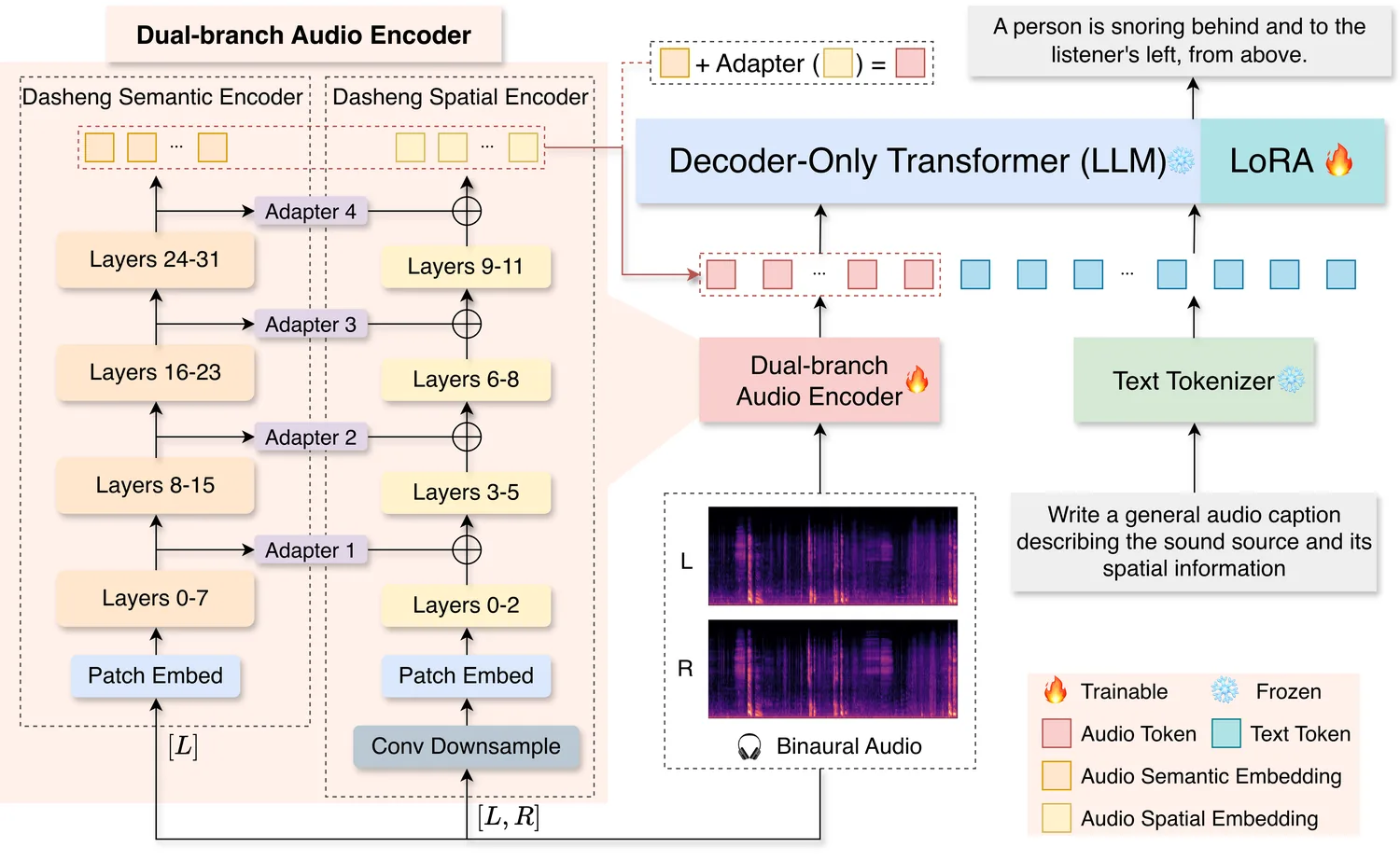
On October 15, Xiaomi announced the open-sourcing of MiDashengLM-Spatial, a new member of the Dasheng series, with model weights and inference code fully released under the Apache 2.0 license. According to Xiaomi, this gives its large audio-understanding model “a pair of ears”—the model not only knows what is in the sound, but also knows which direction it comes from and how it is distributed in space.
Key facts at a glance:
- Release date: October 15 (reported by ITHome on October 16)
- New version: MiDashengLM-Spatial, based on MiDashengLM-7B
- What’s open: Complete model weights + inference code
- License: Apache 2.0 (commercial use allowed; copyright and license notices must be retained)
- Price: Free
- Availability: Downloadable at release; official binaural audio demos released alongside
This is a “capability-stacking” open-source release: it does not replace the base model; instead, it adds a module for handling spatial information on top of the original model that can understand content.
Binaural, Frame-by-Frame, Hierarchical Conditioning
At its core is the new spatial audio encoder Spatial-Dasheng, which can detect and localize overlapping sound events frame by frame. A “frame” can be thought of as a very short slice of time; frame-by-frame localization means the model must distinguish multiple sounds arriving from different directions at the same moment. The accompanying HSSC module (Hierarchical Semantic-to-Spatial Conditioning) passes intermediate representations from the semantic branch hierarchically to the corresponding layers of the spatial branch, allowing spatial modeling to borrow semantic context while keeping the two branches’ respective functional roles separate. Xiaomi says that, to its knowledge, this is the first open-source end-to-end audio-language model that supports both general audio understanding and spatial perception within a single architecture.
On the training side, Xiaomi built a scalable synthetic data pipeline for spatial scenes: it constructed 1 million spatial audio scenes totaling about 13,000 hours, covering environmental sounds, speech, and music; each scene was paired with a spatial description, and there are also 6 million fact-checked question-answer pairs.
There are two notable contrasts here. First, 1 million scenes spread across about 13,000 hours means each scene averages less than a minute, while the number of QA pairs is six times the number of scenes—the data clearly centers on “massive short scenes + dense annotations,” not long audio. Second, the official claim emphasizes that adding spatial perception does “not sacrifice” the original general audio understanding capability, whereas in multimodal models, adding a new modality often degrades old capabilities; that is precisely the hardest point to guarantee.
For context, over the past two years Xiaomi has released and open-sourced the audio foundation model Xiaomi Dasheng and the large audio understanding model MiDashengLM-7B, and the related technology has been deployed in more than 30 applications across smart home, car cockpits, and other scenarios.
The Three Steps of the Dasheng Series in One Table
| Model | Positioning | Key capabilities | Openness |
|---|---|---|---|
| Xiaomi Dasheng | Audio foundation model | Unified perception and understanding of speech, environmental sounds, and music | Open-sourced |
| MiDashengLM-7B | Large audio understanding model | Understands audio content | Open-sourced |
| MiDashengLM-Spatial | Adds spatial perception on top of the 7B base | Content understanding + sound source direction and spatial distribution | Apache 2.0; weights and inference code fully public |
(The table is based only on information listed in the source material; the license type for the first two models is not specified in the source material.)
An “audio foundation model” can be understood as the underlying network that first compresses audio into general representations; a “large understanding model” is a version built on top of it that is language-aligned and can answer questions. MiDashengLM-Spatial sits at the third level of this chain: more capabilities, same base.
Who Should Use It, and Who Can Wait
Those who can try it right away: teams working on smart home, car cockpits, robotics, AR/VR audio, as well as meeting notes and field-recording analysis. Apache 2.0 is relatively commercial-friendly; weights and inference code are both provided, so the cost of trial and error is low. The official demo recommends headphones, because the spatial effect depends on binaural signals, and the benefits available on mono devices are limited.
Those who can wait: teams that only do mono general audio understanding (transcription, classification, event detection) can already cover that with MiDashengLM-7B and do not need to migrate their entire pipeline for spatial capability. In addition, the source material only provides conclusions that spatial perception is robust and generalizes from simulation to reality; it does not disclose specific hardware, latency, or benchmark comparison data. For product-level decisions, waiting for third-party reproduction is more prudent.
Final Thoughts
Open-sourcing an audio-language model that “can hear direction” is more meaningful than topping another single-modality leaderboard, because it turns spatial hearing from a custom experiment in a paper into downloadable weights. Xiaomi explicitly separates the semantic and spatial branches and then connects them hierarchically, which is more pragmatic engineering-wise than brute-forcing a larger model. What will truly determine whether this path succeeds is how well it generalizes in real rooms and on real devices.