
The Language Gap in AI Coding: Why Rust Remains a Persistent Challenge
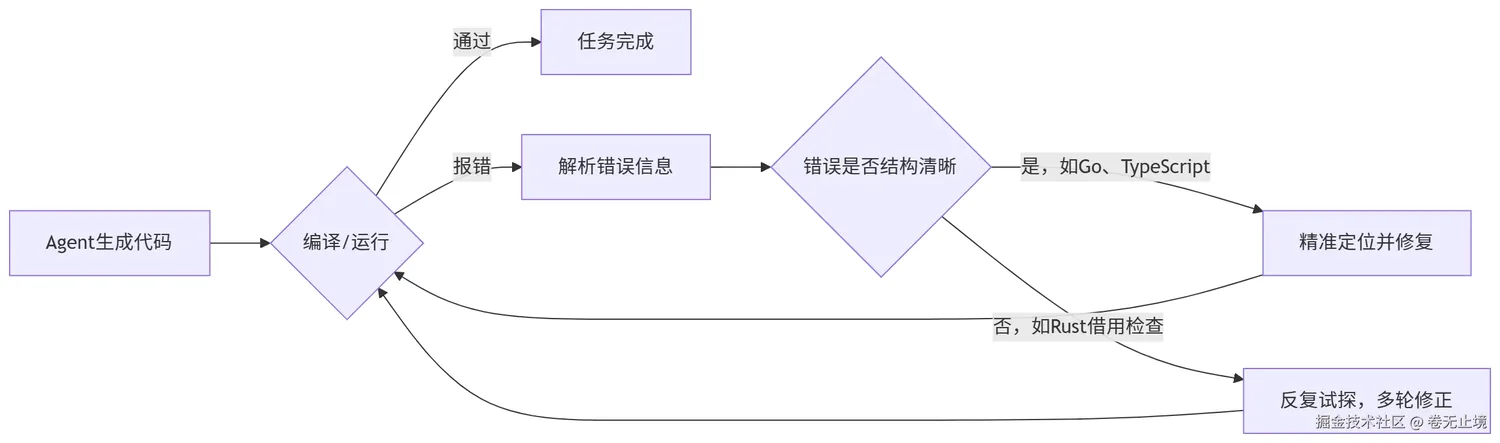
Recent benchmark data confirms that mainstream AI coding assistants—including Cursor, Claude Code, and GitHub Copilot—significantly underperform when generating Rust code. This is not an anecdotal experience but a systemic issue rooted in training data distribution, language syntax characteristics, and compilation feedback mechanisms.
Tencent’s AutoCodeBench benchmark tests real-world coding tasks across 20 programming languages, revealing a stark contrast: the same model achieves roughly half the code completion rate on Rust compared to Python. The HumanEval-XL multilingual extension further validates this: pass@1 scores—the probability of generating passing code on the first attempt—vary dramatically across languages, confirming that language choice critically determines AI output quality.
Three Core Variables Shaping AI Coding Performance
Technical analysis shows AI agent code generation operates on a loop of “massive corpus pattern matching” and “compilation/runtime feedback-driven iteration.” Three variables jointly determine a language’s AI-friendliness:
- Training corpus volume: Python and JavaScript repositories vastly outnumber Rust on GitHub, giving models more idiomatic examples tolearn from
- Syntax determinism and error tolerance: Dynamic languages like Python allow type errors that only cause logical defects (not immediate failure), providing AI with room to iterate; Rust’s strong typing and strict ownership checks cause immediate compilation rejection for any logical flaw
- Feedback signal clarity: Go and TypeScript offer structured, precisely located errors ideal for AI correction loops; Rust’s borrow checker errors often involve complex lifetime and ownership relationships across multiple lines, making root-cause localization difficult
This efficiency gap creates clear language tiers: Python, JavaScript, Go, and TypeScript form the top tier; Elixir’s surprising inclusion—driven by pattern-matching syntax reducing semantic ambiguity—outperforms traditional enterprise languages like Java and C#; Rust, C, and C++ collectively fall into the “high-difficulty zone.”
Rust’s Specific Dilemma: The Double-Edged Sword of Memory Safety
Rust is widely acknowledged as the AI assistant’s “Achilles’ heel,” stemming from its ownership and lifetime system—a feature that enforces memory safety at compile time (eliminating runtime garbage collection overhead) but substantially raises static verification complexity.
The core tension: logically correct code still fails compilation if the borrowing relationship chain contains any flaw. Worse, despite Rust’s reputation for the “most developer-friendly compiler messages,” lifetime-related errors often propagate across function signatures, struct definitions, and call chains, causing AI to fall into “fix-here, break-there” cycles. C and C++ face similar issues: manual memory management combined with undefined behavior means compiled code may still fail at runtime.
Language Capability Map and Practical Recommendations
Synthesizing AutoCodeBench, HumanEval series, and user feedback, current AI coding capabilities fall into tiers:
| Tier | Representative Languages | AI-Friendly Traits |
|---|---|---|
| Top Tier | Python, JavaScript, Go, TypeScript | Abundant corpus + error tolerance + clear diagnostics |
| Emerging Tier | Elixir, Ruby | Functional syntax with high determinism, fewer semantic errors |
| High Challenge | Rust, C, C++ | Compiler zero tolerance, requires deep semantic reasoning |
Practical advice:
- Ready for direct deployment: Scripting, data analysis, backend APIs using Python, JavaScript, or Go—AI output quality is consistently reliable
- Still requires human oversight: Systems programming, embedded development, high-performance backend components where memory safety is critical—Rust code warrants manual code review
Final Thoughts
The AI coding capability landscape is evolving alongside more sophisticated multilingual benchmark methodologies. While ability gaps across languages persist for individual models, this recognition is driving industry players to build more nuance-rich evaluation frameworks—the Rust bottleneck represents exactly where AI must transition from “syntax imitator” to “semantic reasoner” for meaningful progress.