
The 1,000 USDT in your OKX account is an IOU: not a single on-chain address belongs to you. As of 2026-09, gas for an Ethereum mainnet swap has fallen to $0.01-1, while 77% of the cost of large orders is price impact. The bulk of 2025’s $83.85M in phishing losses came from malicious signatures that cost zero gas and looked free. This article is not about coin prices. It is about mechanisms.
First, the research method, so you can reproduce it: this material comes from a 103-minute parallel research run, with 46 AI sub-agents organized into 16 research clusters querying official documentation simultaneously (ethereum.org, solana.com/docs, the EIP specs, and the official docs and attestations of Uniswap, Jupiter, CoW, and Tether), plus 6 adversarial verification clusters whose sole job was to overturn the other clusters’ conclusions. The full 23-chapter, roughly 160,000-word report is archived in a private repository. This is the condensed version, and it follows a single thread: how a CEX user who only knows OKX turns the on-chain infrastructure stack from a string of black boxes into a map that can be debugged layer by layer.
Your starting point is actually quite solid: you read candlesticks, place limit orders, understand funding rates, and know how the 0.1% fee is charged. But there is one question you have probably never seriously considered: after you hit “withdraw,” what exactly does the coin go through before it “arrives” in your wallet? The CEX experience is so good that it folds the entire on-chain infrastructure into a deposit/withdraw button. The cost of that folding is that your mental model of your own assets stops at the exchange’s database.
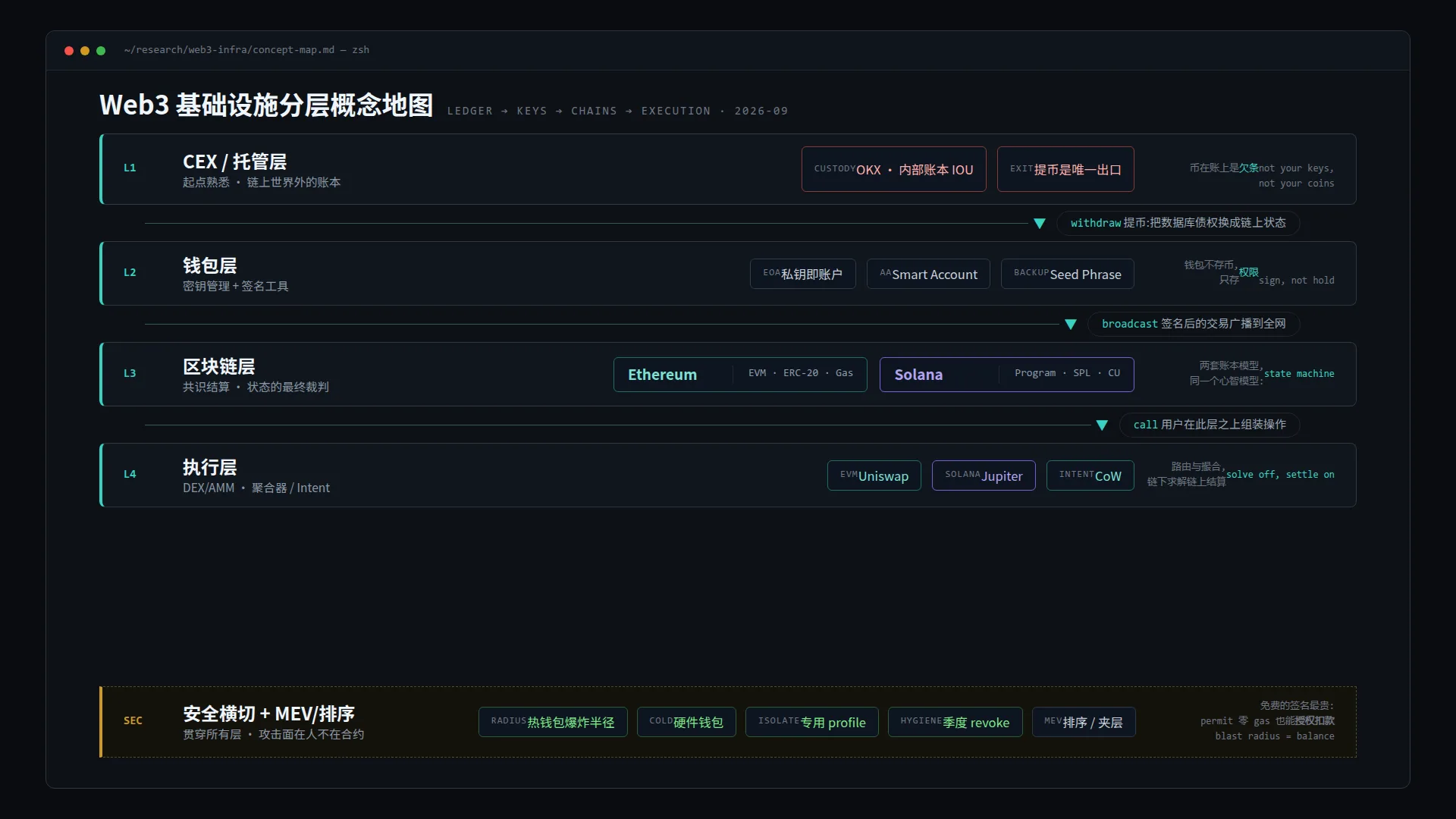
The 1,000 USDT in OKX, and the 1,000 USDT on-chain
The core difference between the two kinds of “existence” fits in one sentence: the 1,000 USDT in OKX is a line in the exchange’s internal ledger, a claim on the exchange (legally, an IOU). The 1,000 USDT in an on-chain wallet is the state of an address on a blockchain: whoever holds that address’s private key can have the entire network’s consensus settle the asset directly, with no intermediary’s approval required.
It becomes an IOU the moment you deposit. Kraken’s official documentation is blunt about it: deposited funds are aggregated into company-level hot and cold wallet pools, commingled with every other user’s assets, with no segregation. When you “buy” 1,000 USDT on OKX, nothing happens on-chain; a row in a database increments by 1,000. Transfer it to another OKX user, and still nothing happens on-chain. That is why internal CEX transfers are instant and free: they are database operations from start to finish.
| Dimension | Exchange balance (custodial) | On-chain self-custody |
|---|---|---|
| Who holds the private key | The exchange | You |
| What the asset actually is | A ledger row (a claim) | A blockchain account state |
| Where settlement happens | The exchange’s database | Blockchain consensus |
| Transferring to someone else | Instant, free, never touches the chain | On-chain transaction, pay gas, wait for confirmations |
| Unilateral freeze | Possible (risk control / KYC / court order) | Impossible; no one has the authority |
| Recourse on error | Support desk can reverse it | Irreversible; there is no support desk |
Withdrawal is the only exit, and the exit hides a brutal detail: the moment a withdrawal is submitted, your IOU disappears. During the window before the on-chain transfer confirms (roughly 30 minutes to 2 hours for major coins), you hold neither on-chain assets nor a ledger balance.
FTX provided the terminal demonstration of this model. After its collapse in November 2022, the court ruled that customer digital assets were property of the bankruptcy estate, and customers lined up as unsecured creditors (Sidley analysis). FTX’s fifth distribution round (as of 2026-07) totaled roughly $900M at a recovery rate of about 105%-120%, but the payout is denominated in the dollar value of coins on the 2022-11-11 petition date. BTC has roughly tripled since then; what you get back is the dollar purchasing power of the petition date, and the opportunity cost is zeroed out. “A ledger balance is unpriced credit exposure” — the phrasing from this Texas Law Review article — is the foundation of the first layer of understanding.
The proof-of-reserves (PoR) movement that followed deserves clear-eyed limits. As of 2026-08, OKX has published 46 monthly reports, with $22.96B in major assets and a 111% BTC reserve ratio. It can prove that at the snapshot moment, on-chain balances were at least equal to total user liabilities, and your balance is verifiable in the merkle tree. It cannot prove exclusive private key control, detect hidden staking, prevent post-snapshot movements, or cover off-chain liabilities, which are entirely out of scope. PoR is a point-in-time balance sheet: use it as a health indicator, not an insurance policy.
There is also a structural fact: the exit narrows exactly when you need it most. During the February 2026 market selloff, Binance and Bybit temporarily suspended BTC withdrawals, restoring them hours later. Market panic, withdrawal surges, and exit delays have historically always arrived at the same moment. So the conclusion of layer one is simple: move “exchange balance” out of the mental account labeled “cash” and into “accounts receivable from this exchange.” What stays and what gets withdrawn should be a deliberate decision.
Keys, one line in a mapping, and two chains
In the on-chain world, the word “wallet” means something entirely different: assets live on-chain; the wallet manages only the keys. Ethereum’s official documentation puts it this way: what you hold is a cryptographic credential capable of moving the assets. Losing your phone equals losing a browser. Losing your seed phrase equals losing the account.
A private key is a 256-bit random number. From it, a public key is derived one-way, then hashed, and the last 20 bytes become the address. The seed phrase (12 or 24 English words) is the human-transcribable form of that random number: a fixed list of 2,048 words, each word encoding 11 bits. One seed phrase manages unlimited addresses via standard derivation paths, which is why switching wallet software costs nothing: MetaMask to Rabby, the address stays the same, and the account follows the keys. The analogy: the wallet is the browser, the account is the email inbox. You switch browsers without switching email accounts.
So what exactly is USDT on Ethereum? One line in a mapping. Tether is a contract deployed at 0xdAC17F... (Etherscan), and its storage maintains balances: mapping(address => uint256). Your “balance” is that one line of data. Ethereum itself does not know what USDT is; it is a global state machine, and USDT is a program plus a ledger running at one contract address. ERC-20 is an interface convention (EIP-20), roughly what HTTP is to websites: the browser does not need to know how each site is implemented internally, as long as they all respond to GET.
This line in a mapping forces two mechanisms on you. First, a swap takes two transactions: approve authorizes the router to spend at most a certain amount of your tokens, then the router calls transferFrom to pull the tokens into the pool. On-chain there is no “push money to someone” API, only “authorize someone to pull.” Many front-ends default to infinite approvals (saving the gas of approving each time). The cost is that an approval is persistent state that does not expire when the transaction ends; what a phishing site tricks you into signing may be a permanent spending authorization. Clean them out periodically with revoke.cash — think of it as an annual inspection for your permissions. Second, whoever owns the contract owns the ledger: the USDT contract has a built-in blacklist, and cumulative freezes now exceed $4.4B. You can self-custody the private key. You cannot self-custody the contract logic.
Move to Solana, and the same vocabulary all needs retranslating. An Ethereum contract is an account where code and state live together: writing one storage slot costs roughly 20,000 gas, paid forever, and deployment freezes the code. Solana forcibly separates code from state: a Program is stateless, and all business data lives in separate data accounts “owned” by the program (official docs). This is like an operating system’s executables and file system: the program is just a ruleset for reading and writing files. Practical consequences follow: before receiving a new token for the first time, you must create a token account (an ATA) and post a deposit of about 0.00089 SOL, refundable when the account is closed; failed transactions still pay fees; fee competition is local — your transaction writes accounts A and B, someone else’s writes C and D, and you are not competing with each other, so the runtime can execute both in parallel.
| Dimension | Ethereum | Solana |
|---|---|---|
| Contract form | Code and state together; frozen at deployment | Stateless programs, data in separate accounts, natively upgradeable |
| Token model | ERC-20: one contract per token, balance is a mapping | SPL: Mint account plus one token account per holder |
| Cost of receiving tokens | Zero (one more line in the contract) | Create an ATA first, deposit about 0.00089 SOL (SIMD-0437, a 90% cut, in progress) |
| Fee market | EIP-1559 global gas market; congestion hits everyone | Base fee + CU + priority fee; local fee market, affects only those writing the same hot accounts |
| Replay protection | Account nonce increments; transactions can queue indefinitely | Recent blockhash, discarded after roughly a 45-second window |
| Failed transaction | Fee still charged | Fee still charged (the two chains agree on this) |
The two chains use incompatible address curves; there is no such thing as one address that controls funds on both. That is why the unassuming network dropdown on the withdrawal page is a fork in the road: pick the wrong chain and the address scheme, the gas asset, and the available DeFi all go wrong with it. The old rule for first attempts: send a small amount, confirm arrival, then move real size.
Price is computed: pools, five line items, and intents
CEX prices come from order-book matching. The AMM answer is more counterintuitive: price comes from a formula. Uniswap v2 has a single rule: the product of the two reserves in the pool is constant before and after a trade (whitepaper). A numeric example: a pool holds 10 ETH and 20,000 USDC, a marginal price of 2,000. You buy 1 ETH; the USDC reserve must rise to about 22,222 for the product to hold, so you actually pay about 2,222, roughly 11% above the “current price.” The further you push the point along the curve, the higher your unit cost; buy just 0.01 ETH and the fill sits almost at 2,000. This is price impact, determined by pool depth, and it is a cost entirely separate from fees.
The true cost structure of on-chain trading in 2026 has diverged sharply from the old narrative. As of 2026-09, the Ethereum mainnet block gas limit has been coordinately raised to 60M, the base fee has stayed below 1 gwei (measured around 0.055), and a swap’s gas is on the order of $0.01-1. Gas is nearly free. The other toll gates have not budged. A study that measured 530,000 Uniswap transactions (arXiv:2309.13648) draws the line: for orders under $1,000, more than 98% of the cost is gas; for orders above $100,000, 77% of the cost is price impact plus slippage. In one sentence: small orders pay the network; large orders pay the weight of their own shadow.
| Concept | What it is | Where the money goes | Can you control it |
|---|---|---|---|
| Gas | gasUsed × (baseFee + tip) | baseFee is burned, tip goes to the validator | Partially; near zero as of 2026-09 |
| Slippage tolerance | The upper bound of acceptable drift between quote and on-chain fill | Nobody collects it, but MEV treats it as a bounty cap | Fully controllable |
| Price impact | The cost of pushing the pool price along the curve | Stays in the pool, harvested by arbitrageurs and LPs | Only dilutable: split orders, deeper pools, aggregation |
| Pool fee | Fee tiers from 0.05% to 1% | Split between LPs and the protocol | Fixed when you pick the pool |
| MEV sandwiching | The portion bitten off within your tolerance | The searcher / builder / validator chain | Tighten tolerance, use private RPC |
The most dangerous line in that table: slippage tolerance is a bounty cap for MEV. A 1,000 USDT order with 0.5% tolerance means a sandwich attacker can take at most about $5 from you (Uniswap’s own example is harsher: 10,000 USDC at 6% tolerance means a worst-case loss of about 600 USDC). Set it too loose and you feed the bots; set it too tight and normal volatility reverts the whole transaction, and gas on a revert is still charged.
A single-pool quote is almost never optimal, because the same pair is scattered across dozens of pools. Aggregators do two things for you: order splitting (one large order enters multiple pools simultaneously, diluting impact) and multi-hop (USDC → USDT → SOL in two legs can be cheaper than the direct route). In 2026 this layer is being replaced by intent systems: you sign only a statement — “spend at most X to receive at least Y” — and execution is outsourced to a competing network. CoW Swap uses batch auctions with a uniform clearing price: one price per batch, so order-placement arbitrage has no mechanism to exploit (official mechanism docs); annual volume $79.1B (Dune, as of 2026-09). UniswapX uses Dutch auctions: fills made from a filler’s own inventory are structurally immune to sandwiching (official announcement). 1inch Fusion has resolvers front the gas, so a wallet holding only USDT can complete its first swap — a real unlock for someone fresh out of a CEX. Jupiter on Solana is stacking the same machinery: aggregating 30-plus DEXs, layering in market-maker RFQ quotes (mainstream pairs are often 5-20bps better than on-chain routing, roughly $100M daily) plus private execution. The landscape is shifting too: Jupiter’s share held above 90% for a long time, then dropped below 50% for the first time in 2026-08. That number is exactly the right excuse to get a second quote.
Ordering has rent: the 0.8% that got sandwiched
Take apart a transaction with real structure: quoted 1,000 USDC for ETH, expected 0.25, received 0.248. The missing 0.002 ETH (about $8, 0.8% of principal) goes: pool fee 0.3%, about $3 (split between LPs and the protocol); price impact about $2.5 (stays in the pool, harvested by later arbitrage); sandwich bite within tolerance about $2.5 (split along the searcher / builder / validator chain); gas paid separately, already a rounding error.
This leads to the on-chain fact CEX users most easily miss: your position in a block is itself something that can be bought and sold. A transaction you sign enters the public mempool, which broadcasts your intent to every bot in the world; searchers find ordering opportunities and submit bundles, builders assemble transactions into complete blocks, and validators pick the highest bidder to propose (ethereum.org). Roughly 80% of DeFi flow already bypasses the public mempool through private channels; the top three builders hold about 92% combined, with Titan alone building about half of all blocks and taking 80-85% of builder surplus (as of 2026-09). This is a professional market earning hundreds of millions of dollars a year.
Ordinary users are always the prey in this market. The defense checklist, in priority order: first, switch your RPC — point your wallet at Flashbots Protect or MEV Blocker (backrun profits, 90% returned to the user), so your transaction never enters the public mempool and the observation window simply disappears; this is a change-one-URL-level fix. Second, tighten slippage to 0.1-0.5%. Third, route large orders through intent-based batch-auction products. Two illusions to break: low slippage is not safety — sophisticated bots can sandwich you on someone else’s transaction. Stablecoin pairs are precisely the hunting ground: one study of 95,000 samples found 38% of sandwich attacks target low-volatility pools. Solana has no public mempool; transactions go directly to the leader, but Jito turned the ordering rent into an explicit market: tips are about 3.39% of Solana’s total staking rewards. When staking, choose a Jito-supporting validator — those 3 points are the state rent you were owed anyway.
The same USDT, four defensive layers, and $10/$50/$100
“USDT” on Ethereum, Tron, and Solana is a different contract on each. The precise answer: Tether natively deploys multiple independent tokens chain by chain, all sharing the same reserve credit. What circulates as USDT really comes in three layers: official native (exposed only to Tether’s credit), USDT0 (a LayerZero-authorized wrapper, adding bridge risk), and third-party bridged wrappers (legacy). There is one way to tell them apart: check the contract address against the official supported-protocols list, character by character. Symbols can be filled in arbitrarily; addresses cannot. For moving stablecoins across chains, if burn-and-mint is available (Circle’s CCTP: burn on the source chain, natively mint on the destination chain, no bridge in the loop), use it instead of a wrapped bridge. Bridges are the most frequently exploited on-chain infrastructure; Ronin’s $624M in 2022 set the precedent.
The word “stable” in stablecoin also needs dismantling: all differences between stablecoins reduce to one question — when you swap one token for one dollar, where does that dollar come from? Fiat-collateralized (USDT/USDC: reserves plus a redemption channel), crypto-collateralized (USDS: overcollateralization plus a liquidation machine), algorithmic (UST: the May 2022 death spiral, $40B+ evaporated, the market’s vote paid in tuition), and delta-neutral synthetic (USDe: during the October 2025 flash event, CEX quotes hit $0.65 while DEX quotes held near $1 — the centralized order books died first). The essence of a peg is redemption capacity, and your redemption channel is always the secondary market: direct redemption from Tether starts at $100K. Diversify across models. USDT plus USDC is a single risk class (the fiat banking system).
The security baseline as of 2026-09: phishing drainer losses for full-year 2025 came to $83.85M, down 83% year over year; address-poisoning losses that same year rose to $1.6B. The attack surface is shifting from code to the human UI layer: contracts keep getting harder to hack, and people keep getting easier to fool. The most expensive signature is free: permit-type offline signatures cost zero gas, never touch the chain, and yet can authorize someone to spend on-chain for you. The largest single 2025 case, $6.5M, was a malicious permit (Revoke.cash analysis); among 2025 phishing losses above $1M, permit/Permit2-type signatures accounted for 38%. The defense is a four-layer structure: a small hot wallet caps the blast radius (maximum loss = the balance itself); a hardware wallet guards the key’s confidentiality (mind the boundary: connected through a third-party hot wallet it becomes blind signing, and the device screen shows only a hash); a dedicated browser profile with bookmarked destinations isolates phishing sites and poisoned extensions; and a quarterly revoke audit as the backstop — approvals never expire, and the only person who can expire them is you. When verifying an address, check the middle characters; matching first and last characters is exactly the poisoning trick. The $50M USDT misdirected in December 2025 fell to the habit of copying an address out of transaction history.
A mental model never truly becomes yours until your hands have touched it. The entire infrastructure stack can be walked through at three tiers: $10/$50/$100. The core principle: this money is tuition; mistakes eat money proportionally; a pit you stepped into at the $10 level will not wait for the $10,000 level to introduce itself. Tier one, $10: withdraw to a brand-new hot wallet (MetaMask or Phantom, seed phrase copied on paper), see the money with your own eyes on Etherscan, make one minimal 2 USDT swap, and read the transaction page: status, gas breakdown, the two opposing transfers under Token Transfers, and the Event Logs. Tier two, $50: one round each on EVM and Solana; run the full approve-to-revoke loop by hand; compare the outcomes of two slippage settings; count the ComputeBudget instructions inside one Jupiter swap. Tier three, $100: cold-signing on a hardware wallet, attributing a two-sided quote between an aggregator and a single DEX, and bridging a small amount once (one hash on each chain; a bridge is, in essence, two transactions plus a messaging layer). The combined maximum loss across all three tiers is about $65: a certain, capped small loss in exchange for eliminating an uncertain large one.
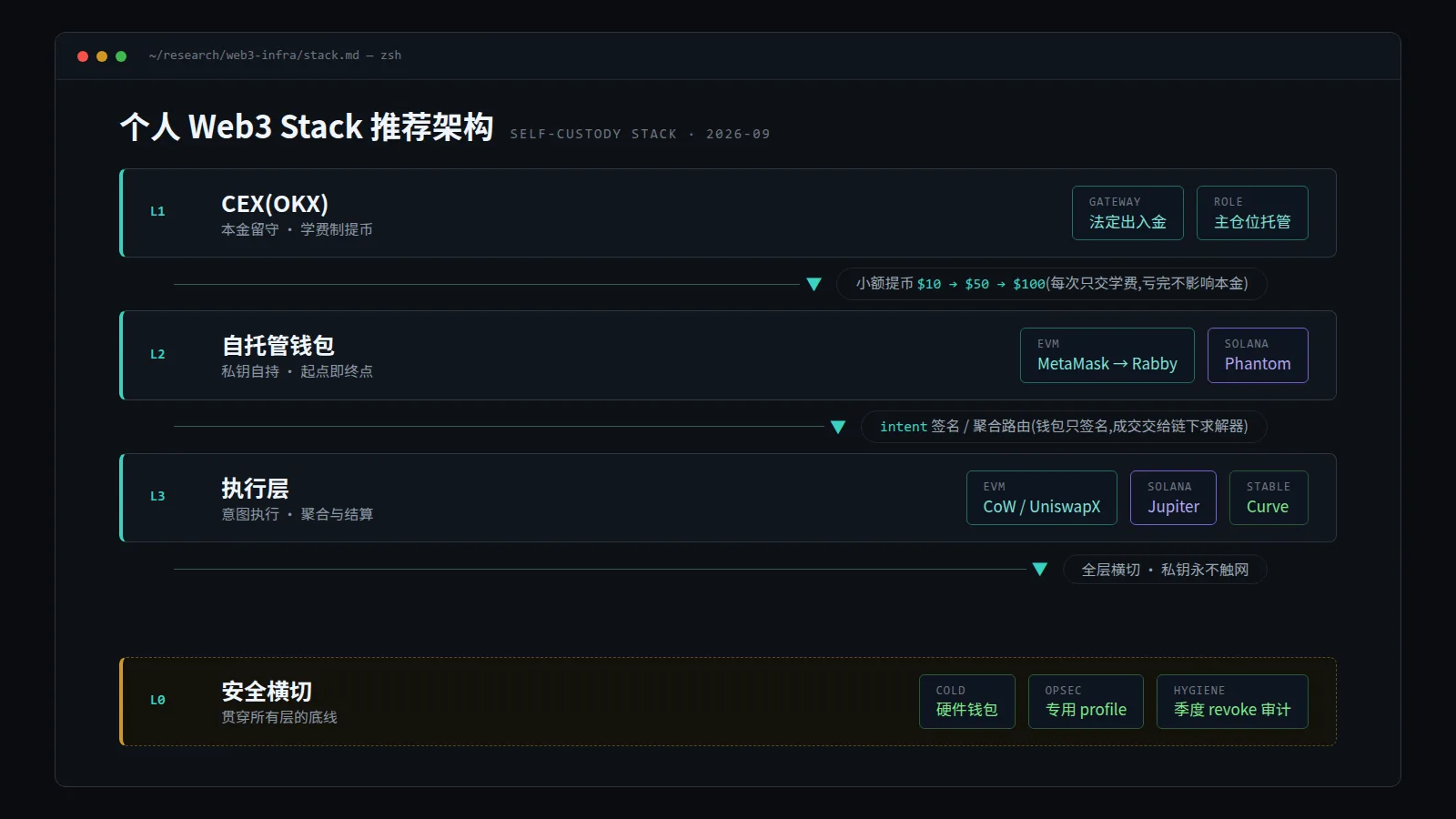
The default combination for the full personal stack: OKX holds the principal and the fiat rails (an 840/160 split). Start with MetaMask or Phantom; switch to Rabby when DeFi usage gets heavy (pre-trade simulation, built-in approval management); add a Ledger or Trezor as size grows; move to a Safe 2-of-3 multisig at the next order of magnitude or for shared control. Execution: CoW/UniswapX on EVM, Jupiter on Solana, and two-front-end price checks on large orders. Approval audits quarterly. Each layer’s upgrade signal is something you can feel: when a single signature makes your palm sweat, that is the hardware wallet’s signal. No prophet required. On anything involving yield, this article breaks down exactly three things: where the yield comes from, where the risk comes from, and what the market mechanism is. The judgment is left to you.
The learning path runs eight levels, from the L0 foundation to L7 contract research. If the destination is on-chain data research, prioritize the data, execution, and statistics spine, and keep the DeFi application layer and contract auditing as dictionaries. This map has a shelf life of about one quarter, but the layered model, the price-checking habit, and the only-lose-what-you-can-afford principle do not expire. One concrete anchor looking forward: as of 2026-09, EIP-7702 has about 58.38 million active delegated accounts and 248 million cumulative authorizations (BundleBear). The EOA you create today will most likely become a smart account within three years. The full 23-chapter, roughly 160,000-word report is archived in a private repository. This article is its map.