Late on the evening of December 9, 2021, the Alibaba Cloud Security team publicly disclosed a remote code execution vulnerability in the Java logging library Log4j (CVE-2021-44228), forcing nearly half the internet’s engineers to scramble out of bed on a weekend to patch things up. “Log4Shell” thus became the most notorious vulnerability storm of the past decade: Check Point’s monitoring showed that over 48% of enterprise networks worldwide were targeted with exploitation attempts (primarily scanning and probing) within days of disclosure; cumulative attack attempts exceeded 800,000 within 72 hours, spawning more than 60 distinct exploitation variants.
After the storm subsided, the news cycle began overflowing with terms like 0day, 1day, nday, CVE, and CNVD. This article was inspired by a popular-science post on the Zhihu Column (“A One-Stop Guide to 0day, 1day, nday, CVE, CNVD, and Other ‘Secret Languages’ of the Vulnerability World”). The original’s framework is worth reading, but after a line-by-line verification, several figures and attributions in it proved inaccurate. Building on that framework, this piece offers a “fact check + supplementation” — every key figure has been re-verified against public sources.
I. 0day, 1day, nday: Three “Clock Readings” of the Same Vulnerability
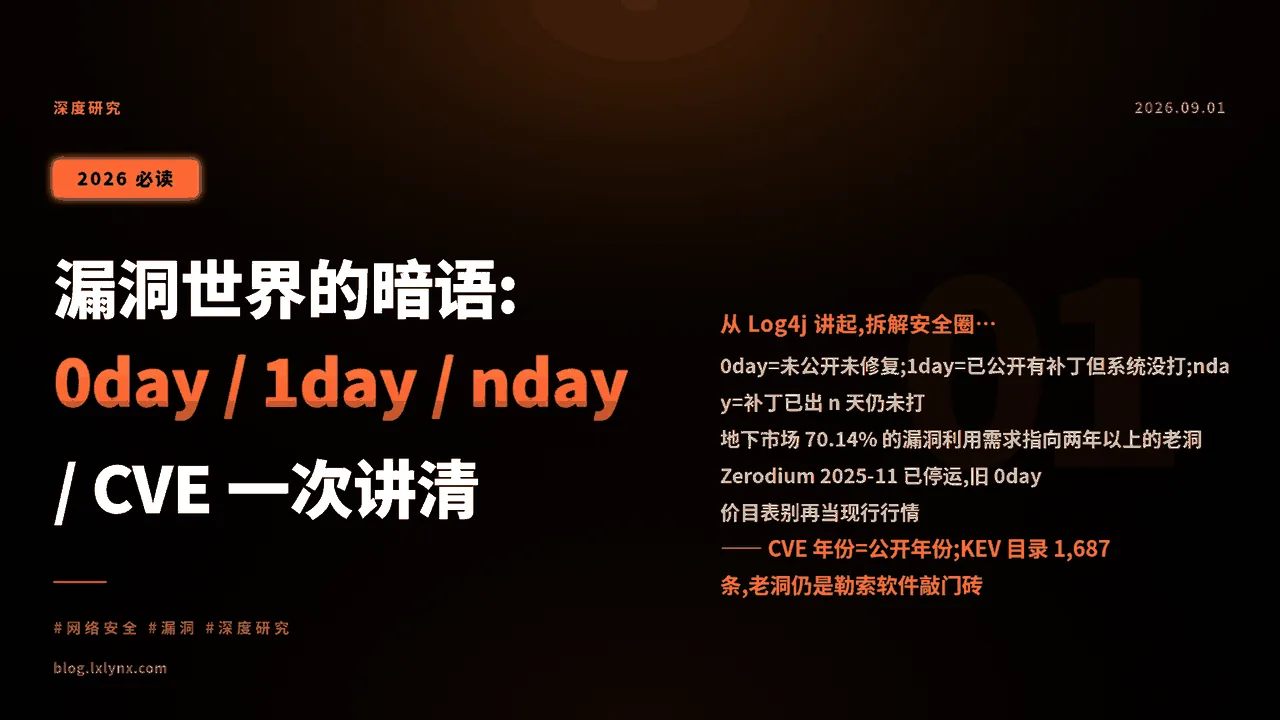
These three terms do not describe three different vulnerabilities — they describe the same vulnerability at different points in time. There are only two dividing lines: whether the vendor knows about it, and whether a patch has been released.
- 0day (zero-day vulnerability): A vulnerability the vendor is unaware of and therefore has no patch for. When an attacker strikes at this stage, victims are defenseless — which is precisely why it commands the highest price. The “zero days” refers to the defender’s available preparation time being zero. Note that there’s a spectrum: truly extreme 0days are exceedingly rare, and many vulnerabilities traded under the “0day” label don’t actually meet that standard.
- 1day: The vulnerability has been made public and the vendor has already released a patch — but your system still hasn’t been patched. This term describes the remediation status of a system, not “the first day after disclosure” — a common misunderstanding online that defines it as “a vulnerability exploited within the first day of public disclosure.”
- nday: The patch has been out for n days and the host remains unpatched. n can be 30, 300, or even 3000. The security industry lacks a formally aligned definition for nday comparable to 1day/0day; it’s more often used as a blanket term for “known unpatched vulnerabilities.”
With this framework in mind, the following data point becomes meaningful: Google Threat Analysis Group’s (TAG) 2024 observations found that, on average, it takes only 16 days from vulnerability disclosure to first observed in-the-wild exploitation; and an earlier automated study (Ellis & Fenske, 2021) found that the median time for attackers to write automated exploit code after obtaining a patch is just 22 seconds — once a patch drops, the exploitation countdown is measured in minutes. The critical variable in offense-defense is never who “knows” first, but who patches first.
II. A Closed 0day Price List, and the Market Sentiment It Left Behind
Any discussion of 0day pricing inevitably circles back to one company: Zerodium. Known for publishing explicit bug-bounty prices, its widely cited public price list — in effect until its 2021 sunset — listed Android full-chain zero-click RCE at up to $2.5 million, iOS zero-click with persistence at up to $2 million, and WhatsApp/iMessage zero-click at up to $1.5 million, with most lower-tier vulnerabilities quoted between $2,500 and $2.5 million.
Two caveats apply when citing this price list. First, prices fluctuate wildly with market conditions: the more targets the research community focuses on, the harder (and cheaper) the vulnerabilities become to find — Zerodium lowered its iOS vulnerability prices as early as 2019. Second, and more importantly: Zerodium announced its shutdown in November 2025, so any citation treating it as a “current market rate” should be taken with a grain of salt. The vulnerability-acquisition market has been turbulent: after Zerodium’s exit, other well-known bounty programs such as Operation Zero have also progressively moved into archive status.
There is also a striking price gap between legitimate and underground markets. Trend Micro’s Zero Day Initiative (ZDI), which acquires and transparently discloses vulnerabilities, offers roughly $100K–$150K for virtualization vulnerabilities like those in VMware ESXi; on underground forums, the asking price for comparable older vulnerabilities exceeds $1 million — nearly a tenfold gap between the legitimate and the underground market for the same class of vulnerability.
III. The Real High-Frequency Threat: “Old Holes” Older Than Two Years
Far more than the elusive 0day, attackers’ day-to-day operations rely on nday. Trend Micro’s H1 2026 report on underground-market vulnerability-exploit transactions found that as high as 70.14% of requested exploits targeted vulnerabilities older than two years; among listed exploits for sale, 68.18% corresponded to entries in CISA’s Known Exploited Vulnerabilities (KEV) catalog.
Exposure-surface scanning tells the same story: search engines like Shodan still turn up over 270,000 devices with SMBGhost (CVE-2020-0796) listening ports exposed, and 88,652 hosts affected by Heartbleed (a 2014 vulnerability!).
The original article’s direction using “EternalBlue” as its example was not wrong (MS17-010, disclosed in 2017 and still frequently cited), but this framing has lacked dedicated statistics from frontline vendors in recent years. The harder evidence lies in the KEV catalog itself: among the 2025 entries added by CISA, 94 were vulnerabilities from 2020 or earlier, and at least 24 of those were actively exploited by ransomware in the year they were disclosed; the oldest entry still being exploited in the catalog dates to 2002 (Windows privilege-escalation vulnerability CVE-2002-0367, known to have been used by ransomware). To be fair, Qianxin’s H1 2025 report did present an apparently contrary figure: KEV entries by vulnerability year peaked in 2022 and have declined for three consecutive years, suggesting “the stock of unpatched vulnerabilities is converging.” This does not contradict the “245 new entries in 2025, a record” figure — one statistic is keyed by vulnerability year, the other by year of catalog addition; the two different denominators converge on the same conclusion: in real-world attacks, the most active threats are always old vulnerabilities whose exposure surface remains unshrunk.
IV. CVE: The “ID Card” Strained by AI-Era Vulnerability Production
CVE (Common Vulnerabilities and Exposures) assigns each publicly disclosed vulnerability a globally unique number, formatted as CVE-Year-Sequence. A widely circulated misconception is that “Year = year of discovery” — in fact, the year represents when the identifier was reserved or publicly disclosed, and has nothing to do with when the vulnerability was found. Using CVE-2021-44228 as an example, “2021” means it was made public in December 2021 (not 2024, a common typo). The identifier itself carries no severity assessment; it exists only for “registration.” Risk judgment relies on NVD scores and KEV endorsements.
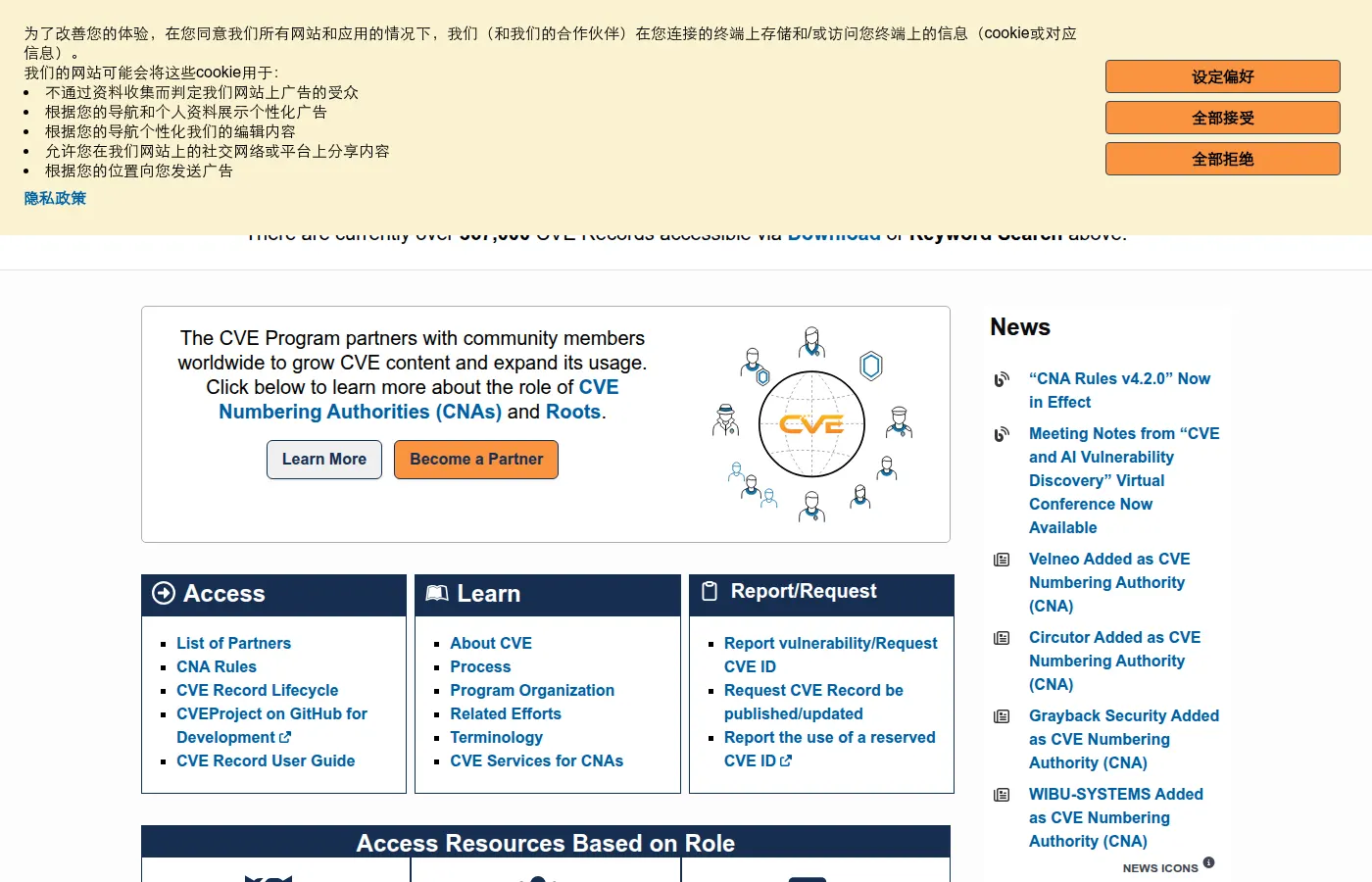
Identifiers are issued by CNA (CVE Numbering Authorities) organizations, including vendors, security companies, and national institutions. After a 2016 reform, the number of CNAs expanded rapidly, reaching 543 as of August 2026. This was accompanied by explosive growth in identifier output: approximately 50,000 new CVE records were published in 2025; CVE’s official forecast puts the 2026 median at about 59,000, with an upper bound of 118,000. The driver of this growth is AI: after GitHub began operating as a CNA in 2025, it contributed over 7,000 records in its first year; in 2026, OpenAI and Anthropic joined the CNA pilot program, making models responsible for vulnerabilities in their own code.
The output surge has overwhelmed the middle layers of this pipeline. In April 2025, a renewal dispute between MITRE (the CVE system’s operating body) and the U.S. Cybersecurity and Infrastructure Security Agency (CISA) nearly triggered a “cliff-edge crisis.” The larger chain reaction hit the NVD (National Vulnerability Database, operated by a NIST-affiliated organization): for years, the NVD enriched every CVE record with CVSS scores, affected-product CPEs, and other metadata, but starting April 15, 2026, it shifted to a targeted-enrichment strategy — prioritizing enrichment for high-severity and in-the-wild exploited entries, while marking all other records as “Not Scheduled,” no longer guaranteeing timely analysis. Under double pressure from operations budgets and staffing, the industry has even begun discussing pluralistic governance models such as CVE Foundation, GCVE, and EUVD. The CVE “ID card” remains authoritative, but the service ecosystem behind it is overstretched — a fact everyone citing CVE figures should keep in mind: a number assigned ≠ a score given ≠ a response priority defined.
V. Five Major Vulnerability Databases: A “Reference + Myth-Busting” Checklist
- CVE: The international “ID card” — registration only, no scoring. Covered above.
- NVD (operated by NIST/CSRC): The CVE’s “annotator” and query portal, providing CVSS scores, CPE matching, and reference links. Since April 2026, its enrichment scope has contracted (see previous section).
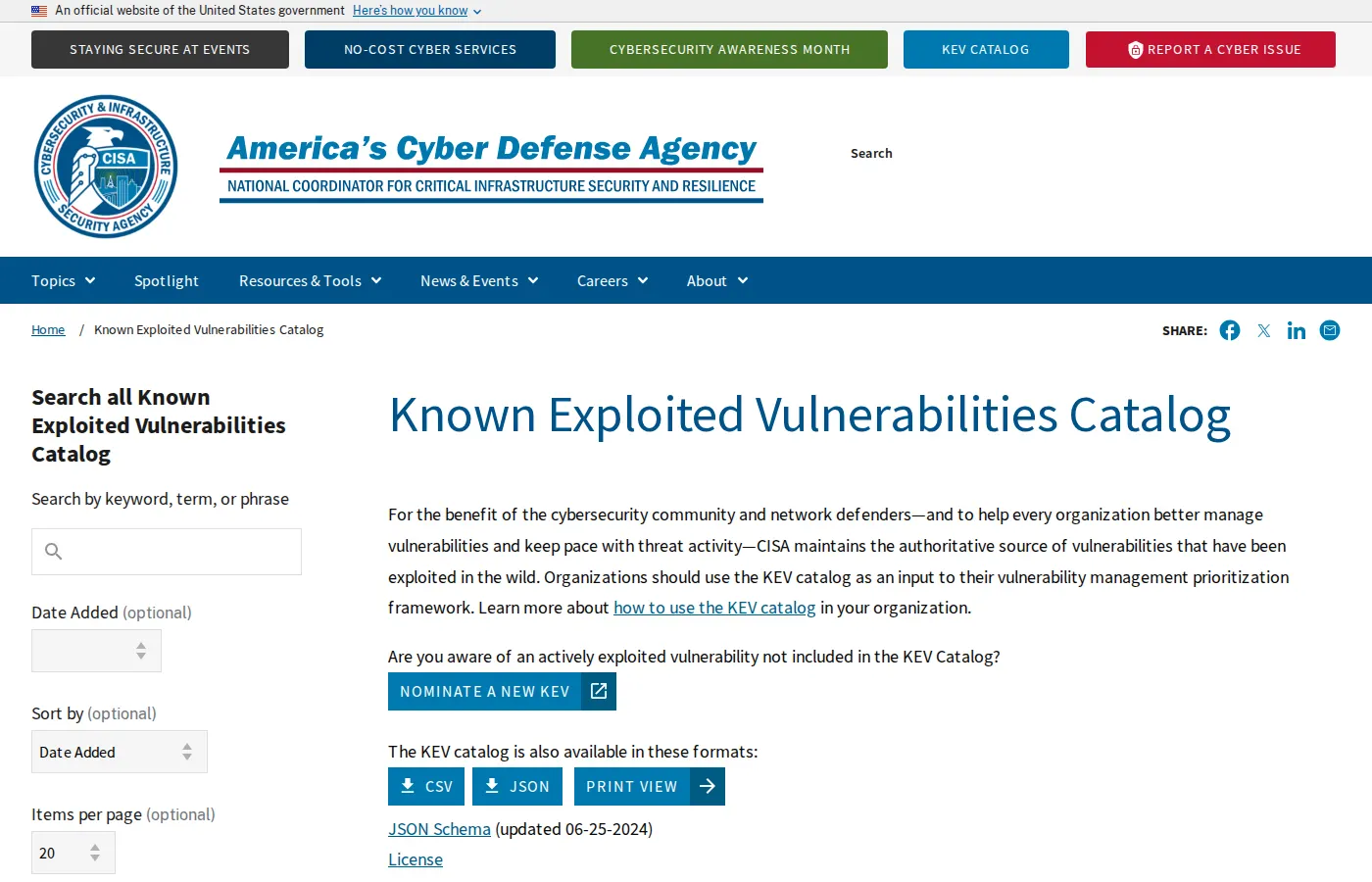
- KEV (maintained by CISA): The “Known Exploited Vulnerabilities” catalog — it includes only vulnerabilities with evidence of real-world exploitation, making it the most practical patch-priority checklist available. As of August 31, 2026, it contained 1,687 entries; 245 were added in 2025 alone, a historic record. The standard practice for security teams is: KEV-listed + exposure-surface hit = patch immediately.
- CNVD (China National Vulnerability Database): A joint initiative by the National Internet Emergency Response Team (CNCERT/CC), telecom operators, security vendors, and software enterprises. Started around 2001, it serves as China’s infrastructure for collecting and publishing vulnerability information and coordinating emergency response, with vulnerabilities classified into high/medium/low severity tiers.
- CNNVD (China National Vulnerability Database): Built and operated by the China Information Technology Security Evaluation Center, it officially launched on October 18, 2009, and implements a four-tier risk assessment. The original article claimed it was “led and managed by the Ministry of Public Security” — this does not match the official public description. This is the most commonly confused attribution between China’s two national vulnerability databases. Both databases maintain their own numbering systems and map to CVE, and neither is a CNA: China’s roughly 24 CNAs today are almost exclusively vendors (e.g., Huawei), not regulatory bodies.

Quick memory aid: For “what is it,” check CVE/NVD; for “what’s actually been exploited,” check KEV; for domestic notifications and emergency response, use CNVD and CNNVD.
VI. If You Remember Only Three Things, Remember These
- Prioritize by remediation status — don’t be intimidated by jargon. The real day-to-day threat is nday, not 0day. Cross-check your exposure surface against the KEV catalog, and prioritize vulnerabilities listed there.
- The patch window is measured in days, and its size depends on you. On average, it takes 16 days from disclosure to in-the-wild exploitation, but once the patch is in hand, attackers roll out automated exploitation in seconds. For perspective, roughly 30% of affected Log4j instances were still unpatched three months after disclosure — patch delays are the norm, not the exception.
- Old vulnerabilities will come back when you’ve forgotten them. EternalBlue has been public for nearly a decade; yet a 2002 vulnerability still sits in the KEV catalog, actively exploited by ransomware. Regularly using exposure-surface scanning tools (such as the Shodan self-check perspective) to see what you actually expose on the public internet is the lowest-cost self-defense available.
Corrections and Sources
Compared with the original article and public materials, this piece corrects the following widely circulated claims, to facilitate reader cross-verification:
- “30% of enterprise networks worldwide were attacked within 72 hours of disclosure” — the 30% figure actually comes from Qualys’s statistic that “approximately 30% of instances remained unpatched three months later”; Check Point’s figure is that over 48% of enterprise networks were subjected to exploitation attempts (primarily scanning and probing), with cumulative attempts exceeding 800,000 in 72 hours.
- “CNNVD is led and managed by the Ministry of Public Security” — the official description states it is operated by the China Information Technology Security Evaluation Center.
- “1day refers to patches released within the first day after disclosure” — 1day describes the state of “disclosed, patched, but unpatched on the system,” with no relation to a day count.
- CVE identifier “Year = year of discovery” — the rule is the year of reservation or public disclosure (and the original article incorrectly wrote the year for CVE-2021-44228 as 2024).
- “Approximately 40% of servers worldwide have unpatched nday vulnerabilities” (cited from a Qianxin report) — this figure could not be traced to any publicly available Qianxin report; caution is advised when citing it.
Data sources: CVE.org, NVD, CISA KEV, Check Point Research, Google TAG, Trend Micro (ZDI) H1 2026 Vulnerability Exploit Transaction Report, Qualys, Shodan, and the official introductions on the CNNVD/CNVD websites. If you maintain servers, “go through the KEV catalog and patch what’s listed” is the single most important next step after reading this article.
This article originated from the Zhihu Column post “A One-Stop Guide to 0day, 1day, nday, CVE, CNVD, and Other ‘Secret Languages’ of the Vulnerability World”. All key figures herein have been independently re-verified; where they conflict with the “common sense” you may hold, the cited sources take precedence.
Appendix: Comparison of Two Illustration Styles. The cover of this article adopts a new dark-terminal-style custom card (see the cover image at the top); the image below uses the LynxPipe pipeline’s infographic-card style. Same title and key points, different visual language — the two styles are presented side by side here as a reference comparison.