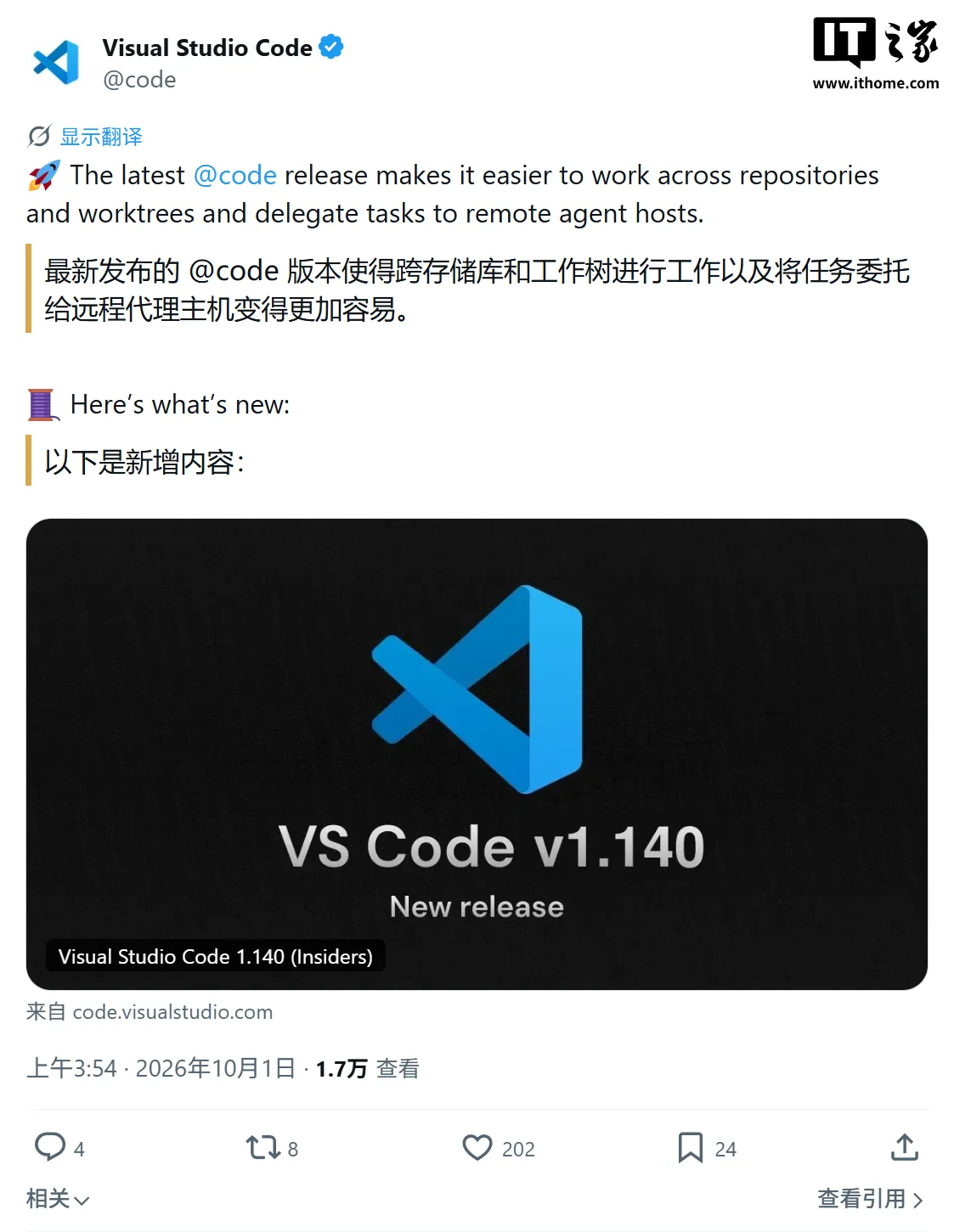
Microsoft released Visual Studio Code 1.140 stable version on September 30, 2026, with this update centering on deepening and expanding GitHub Copilot Agent workflows to enhance developers’ multi-task efficiency and remote collaboration capabilities. Key facts:
- Release date: September 30, 2026 (reported by IT之家 on October 1)
- Version: 1.140 stable
- Availability: Publicly downloadable now
- Licensing: Open source under MIT license, free for all users
Multi-Folder Sessions: A New Paradigm for Isolated Concurrent Development
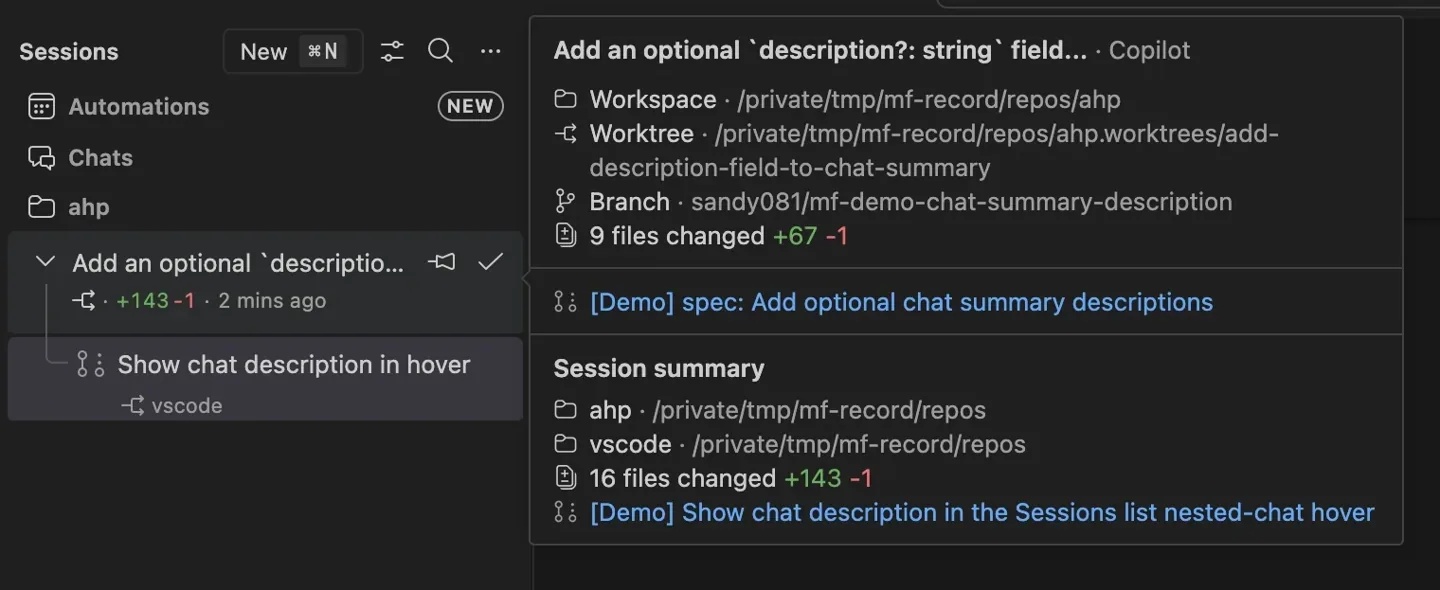
The experimentally released multi-folder session feature is arguably the most operationally significant innovation in version 1.140. Within a single GitHub Copilot Agent session, developers can launch multiple independent chat conversations, each bound to a different code repository or Git worktree. This design enables Workspace-level isolation: terminal sessions, local task configurations, commit histories, Pull Request status, and merge conflict information remain mutually isolated—significantly reducing unintended cross-contamination during parallel task workflows.
For instance, when a developer works simultaneously on feature development (Session A) and bug fixes (Session B), with Session A bound to the feature branch and Session B bound to the hotfix branch, modifications to the same file in each session will not unexpectedly synchronize across sessions, substantially lowering human-error risk.
Copilot Harness: Unifying Agent Behavior Across Interfaces
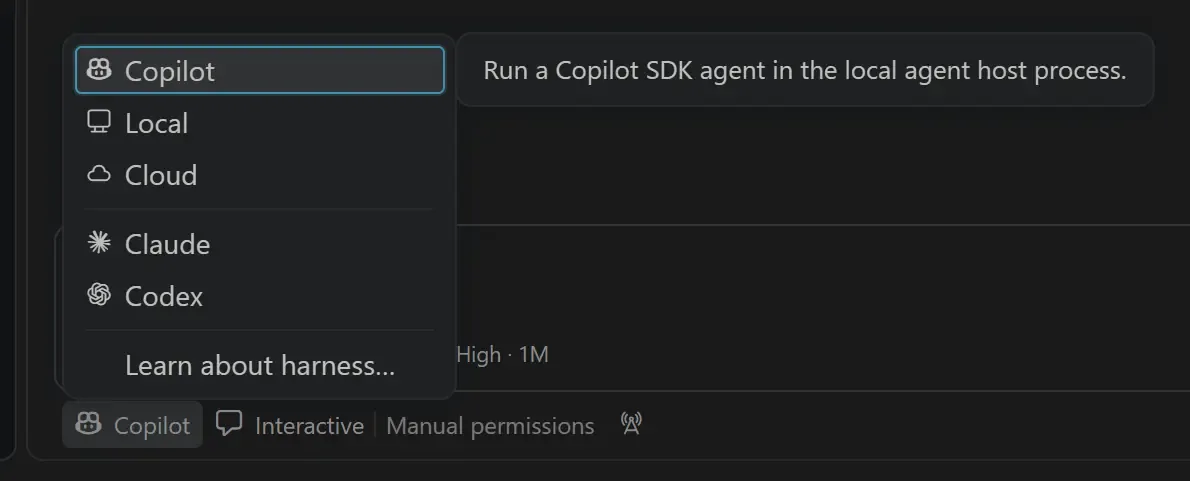
This update continues strengthening the Copilot harness architecture, powered by the Copilot SDK and executing over the Agent Host Protocol (AHP) in dedicated processes. AHP is a standardized communication protocol designed to ensure consistent Agent behavior across different(entry points): VS Code extension, standalone Copilot app, and Copilot CLI. This change means regardless of whether developers initiate Agent requests via command line, IDE, or web interface, the underlying execution logic remains identical—laying groundwork for cross-platform collaboration and automated integration.
Notably, while Copilot harness itself is not new, version 1.140 is the first to deeply integrate it with remote task scheduling, enabling seamless switching between local and remote execution.
HydraFusion and Remote Task Delegation: New尝试 in Intelligent Model Orchestration
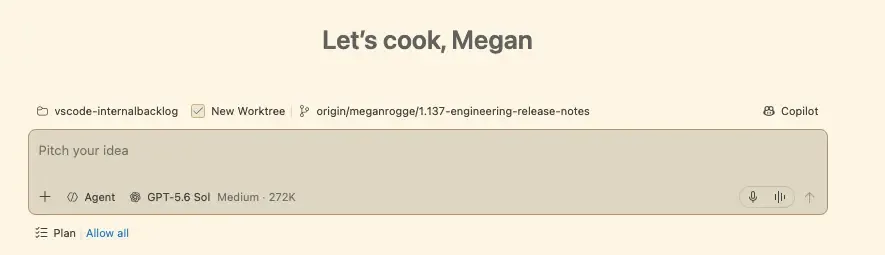
HydraFusion, released as a research preview, introduces model orchestration capabilities. It intelligently assesses task requirements and dynamically selects appropriate models (e.g., lightweight models for simple refactoring, heavy-duty models for complex design), supporting model-to-model “critique-revise” cycles. Its design goal is achieving trade-offs among code quality, inference speed, and API costs—a persistent engineering challenge in current Agent deployments.
Remote task delegation extends Copilot’s execution boundaries. The updated Agent features host discovery, proactively scanning for remote hosts in local networks or cloud environments, then selecting optimal execution nodes based on OS compatibility, available RAM, CPU cores, and real-time load metrics. This means compute-intensive tasks like compilation or testing can be automatically offloaded to build servers, preserving local development responsiveness.
| Feature | Local Execution | Remote Execution (new in this update) |
|---|---|---|
| Host Discovery | Manual configuration | Automatic scanning and evaluation |
| Resource Adaptation | Fixed configuration | Dynamic hardware matching |
| Isolation Level | Process-level | Double isolation: session + host |
Practical Guidance: Match Tools to Scenarios, Manage Expectations
- Ready to adopt now: Mid-to-large teams juggling multiple code branches; organizations with existing remote build infrastructure (e.g., Jenkins, GitHub Actions servers); workflows heavily reliant on refactoring/coding requiring robust session isolation.
- Wait for stability: HydraFusion remains a research preview and is not production-ready; remote task delegation may face obstacles in strictly air-gapped environments where auto host discovery requires explicit network trust configuration.
In Conclusion
Copilot Agent’s evolution from standalone Q&A tool to collaborative production system is becoming unmistakable. This update prioritizes Engineering resilience over raw model improvements—perhaps this systematic focus on multi-instance orchestration carries more long-term significance than any single feature.