
Core Event Summary

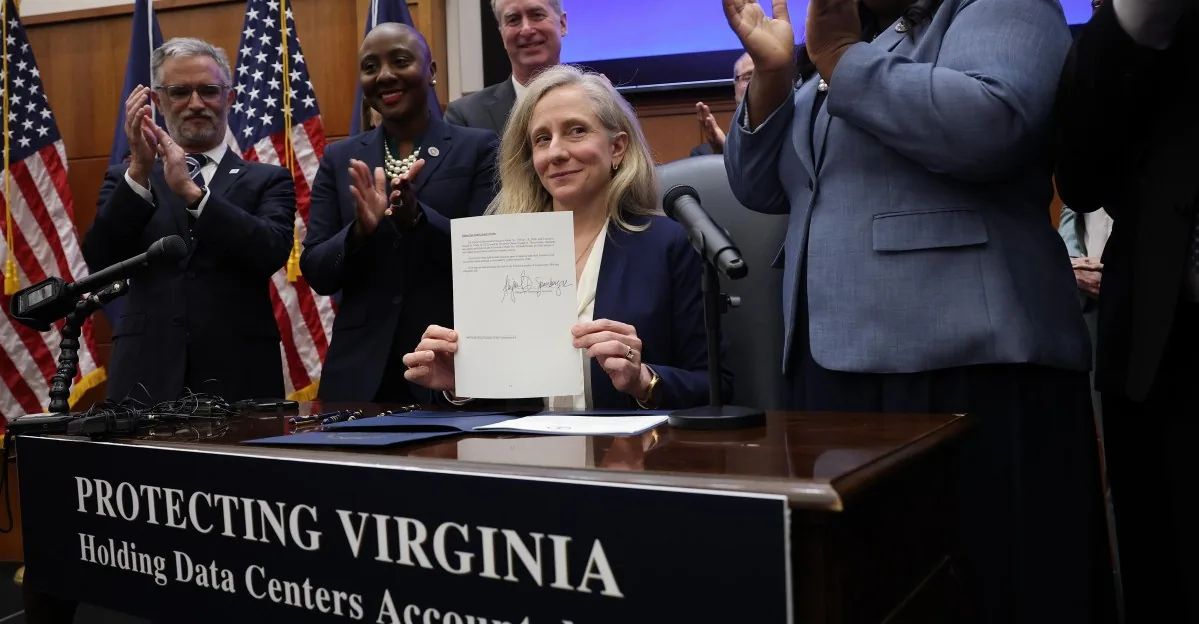
Virginia governor signed an executive order reshaping the state’s approach to data center development and artificial intelligence governance. The order represents Virginia’s formal response to rapid data center expansion and emerging AI-related risks.
Key factual highlights:
- Executive Order Number: EO 22
- Core provisions: prohibits executive branch officials from signing NDAs for data center projects; mandates expedited noise regulations; requires review of backup-generation systems
- New entity: AI task force to evaluate workforce displacement and data privacy risks
- Supporting framework: Data Center Accountability Framework launched concurrently
Policy Adjustments in Detail
Executive Order 22 contains several specific regulatory measures. Most notably, it prohibits executive branch officials from signing nondisclosure agreements related to data center projects—aimed at increasing transparency so local governments and communities can meaningfully participate in decision-making.
The order also requires environmental agencies to expedite noise regulation development for data centers and mandates reviews of backup-generation operations. Many data centers rely on diesel generators for emergency power, raising concerns about air quality and noise pollution.
A surprising contrast emerges: Virginia’s Loudoun County, long dubbed the “world’s data center capital,” operated under a “by-right approval” system for years, permitting developers to construct facilities without additional local permits. This permissive approach contributed to massive data center growth but also strained local infrastructure and energy grids. The current reversal—where the governor now adopts restrictive measures—signifies a sharp policy pivot from unfettered expansion to controlled development.
The Accountability Framework Principles

The concurrently released Data Center Accountability Framework outlines four key policy shifts:
- Elimination of “by-right approval”:ending simplified审批 processes like those in Loudoun County
- Reduction of state subsidies:scaling back financial incentives for data center construction
- Environmental guardrails establishment:setting clear regulatory standards
- Resident energy cost protection:preventing data center growth from inflating electricity prices
Notably, while environmental groups publicly endorsed the order, critics including the Piedmont Environmental Council pointed out limitations—their leadership noted the measures focus on new projects while leaving existing and in-pipeline facilities unaddressed, meaning ongoing community impacts from completed installations remain outside the scope of regulation.
AI Task Force Mandate and Limits
The newly created AI task force will assess workforce displacement risks, evaluate privacy protection gaps, and determine how existing laws can address AI-related harms. Crucially, the task force is not tasked with drafting new legislation but rather evaluating “how existing law can be applied” to AI challenges—reflecting a cautiously incremental policy approach.
Virginia joins other states in taking executive action. On the same day, California governor issued his own order convening AI safety experts. New York’s governor and Texas’s governor have each previously used executive authority to slow data center proliferation. This pattern confirms that state governments are becoming the primary architects of AI and data center policy as federal action stalls.
Reader Guidance
- If you’re a Virginia-based developer: longer approval timelines are likely; factor in enhanced community engagement and environmental compliance costs earlier
- If you care about local infrastructure: monitor task force reports on AI’s employment impact—they could influence long-term career decisions
- If you represent community or environmental groups: the order strengthens local voices in permitting; engage proactively in public hearings
- If you’re investing in data center infrastructure: track the accelerated noise standard rollout—new rules may alter operational cost projections
Final Note
Virginia’s policy reversal marks a shift toward localized, granular governance of data center development in the U.S. As federal AI legislation limps forward, states are filling the vacuum with executive power—a bottom-up experiment revealing both thoughtful local HR and the absence of national strategic coordination.