
Hindsight: The AI Memory System Scaling GitHub Trending
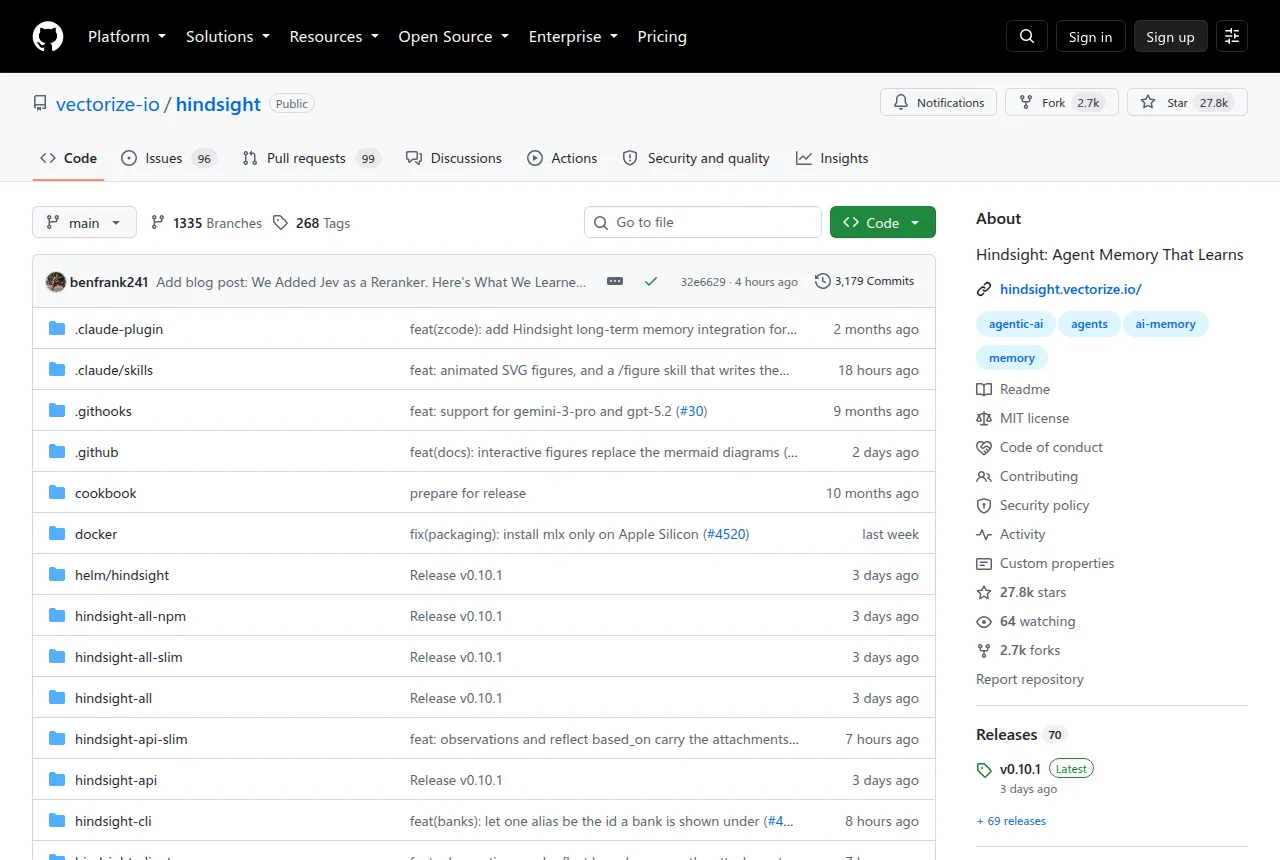
A project called Hindsight quietly topped GitHub’s trending list today. It isn’t just another vector database — it’s tackling the most fundamental limitation of large language models: their fleeting memory. Hindsight aims to make AI remember not just conversation history, but truly “learn” things.
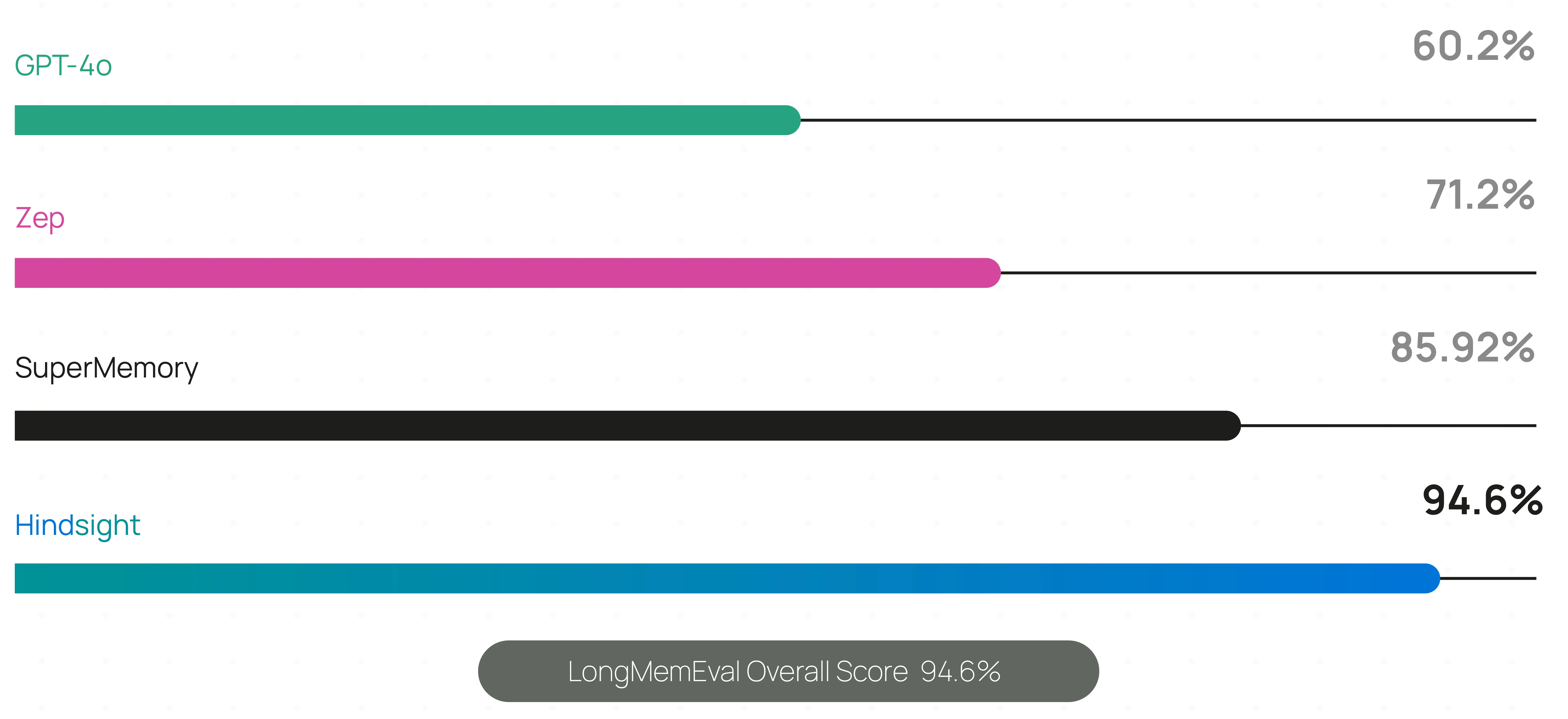
According to its README, the project gained 1,668 stars in the past day, reaching a cumulative 27,808 stars. The project claims state-of-the-art performance on the LongMemEval long-term memory benchmark, with multiple organizations independently reproducing its results. If you’re tired of re-teaching ChatGPT your enterprise knowledge every time you restart, Hindsight might offer a different solution.
Core Features: Three Memory Operations
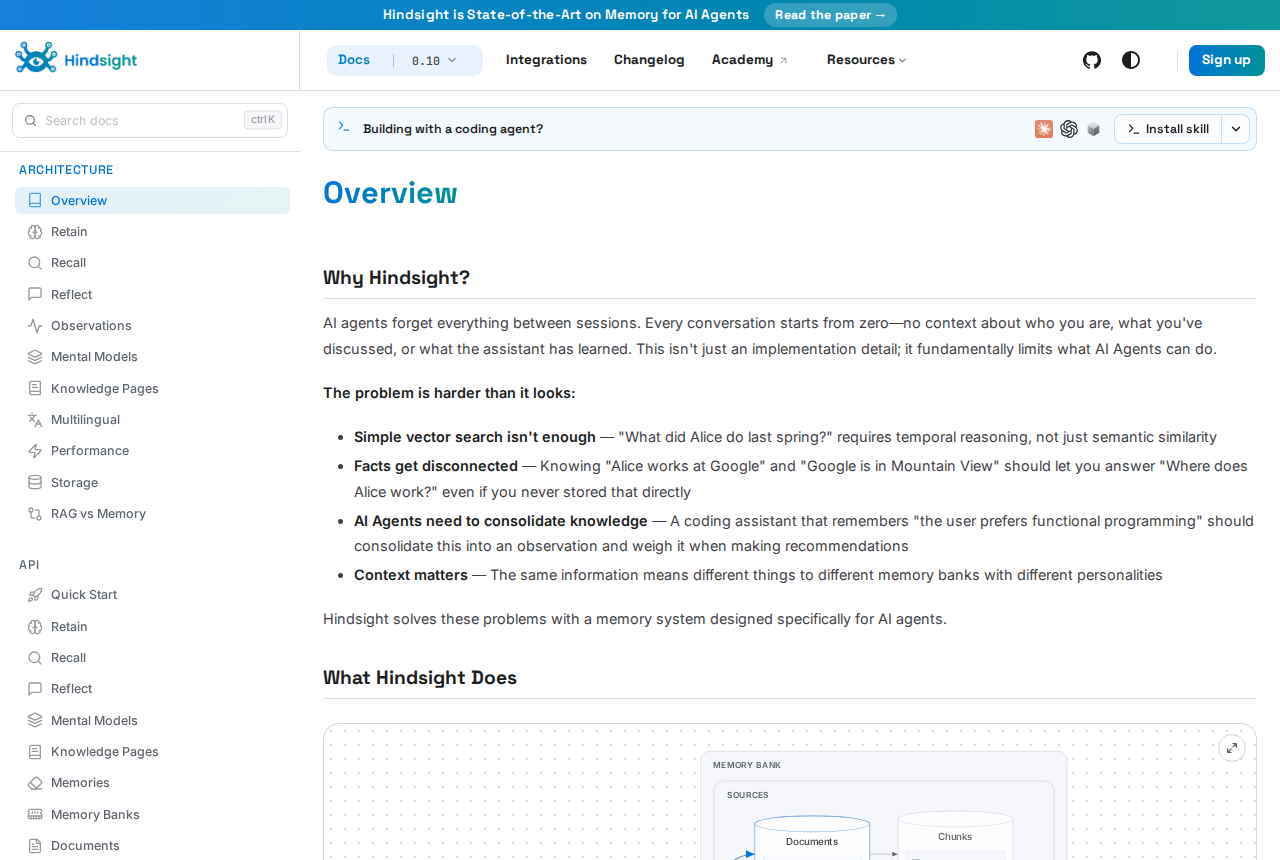
Hindsight moves away from the traditional RAG “retrieve-and-inject” pattern, proposing a three-step approach closer to human cognition:
- Retain: Store observed information without immediately vectorizing it
- Recall: Dynamically retrieve relevant memories based on a question
- Reflect: Generate disposition-aware responses by combining existing knowledge

This design allows the system to maintain consistency across long-running tasks. For example, if you know that “Alice is a software engineer at Google,” and days later someone asks “What does Alice do?”, the system doesn’t re-search from scratch — it retrieves the Mental Model it built earlier and classifies Alice under the “Engineer” category.
The official diagrams illustrate a typical workflow: users send memory snippets through a simple API, and the system automatically constructs knowledge pages. When answering questions, it assembles all relevant clues into coherent responses.
Getting Started in Five Minutes
Installation follows two paths. For production deployments, Docker is recommended:
| |
Once started, Docker exposes a visual UI on port 9999 and a REST API service on port 8888. Developers who don’t need a server can use the Python embedded mode directly:
| |
Fewer than ten lines of code and your local AI can remember key information. Hindsight supports 25+ LLM providers, including OpenAI, Anthropic, Gemini, Groq, as well as local options like Ollama and LM Studio. If you’re a GitHub Copilot or Claude Pro user, you don’t even need to provide an API key. Image: Official Demo Interface
Technical Highlights and Design Trade-offs
The most interesting aspect of Hindsight is its memory storage strategy. Traditional vector databases chunk text, vectorize it, and store it for approximate nearest-neighbor retrieval. This approach suffers from three persistent issues: redundant storage, semantic drift, and an inability to correlate related facts.
Hindsight uses pg0, an embedded database, as its underlying storage — a lightweight PostgreSQL variant. The key innovation lies in the Mental Model layer: the system doesn’t just store raw sentences; it automatically extracts entities, relationships, and categories, building an iteratable knowledge graph. For example, after multiple exposures, the system understands that “software engineer” falls under the broader concept of “engineer,” enabling natural generalization to new engineer types encountered later.
This design delivers clear advantages:
- Improved storage efficiency — duplicate knowledge is stored only once
- Avoids prompt pollution issues common in RAG systems
- Supports long-term incremental learning rather than flash-memory-style recall
The trade-off is an additional abstraction layer. Developers need to understand how retain/recall/reflect work under the hood, which is less straightforward than simply concatenating prompts. Additionally, the system relies on LLMs for metacognitive processing, imposing some computational requirements for offline or resource-constrained environments.
Target Audience and Competitor Comparison
Hindsight is suited for three types of users:
- Enterprise knowledge base builders: Need to maintain customer profiles and product documentation long-term without refeeding data on every conversation
- Multi-agent system builders: Multiple AIs collaborating need to share context, which traditional session history struggles to sustain across agents
- Researchers and benchmark enthusiasts: Interested in the LongMemEval benchmark, wanting to verify memory system performance firsthand
Among competitor projects, mainstream options each carry trade-offs:
- LlamaIndex / LangChain memory modules: Flexible but require self-designed retrieval strategies; long-term consistency depends on backend maintenance
- Anthropic’s memory experiments: Closed-source, limited to their platform ecosystem
- LangChain Memory: Session-level history lacking knowledge abstraction capabilities
Hindsight’s advantage is treating memory as a first-class citizen rather than an afterthought, supporting incremental learning from the architecture level. Its MIT license means it can be freely used in commercial products.
Final Thoughts
Hindsight’s emergence marks a shift in AI engineering from “Prompt Engineering” toward “Memory Engineering.” As models themselves grow increasingly capable, how we organize and maintain knowledge becomes the new bottleneck. Whether this project becomes the cornerstone of Agent architectures remains to be seen by the community.
The open-source project lives on GitHub, and the documentation site provides complete guides and case studies. If you want your AI to remember not just context but truly “learn,” it’s worth trying its caching mechanism.