
On October 15, the open-source GPU tool Universal MFG Unlocker was updated to 1.5.0, unlocking NVIDIA’s newly introduced DLSS Frame Generation “Preset C” for older graphics cards. Players on RTX 40 and RTX 30 series can use it for free, with performance gains of up to 35%.
- Release and version: Released October 15, version 1.5.0, developer dashdogy
- Price: Open-source tool, free
- Availability: Available now, compatible with the DLSS 310.9.16 runtime
- Official support scope: Preset C is officially supported only on Ada Lovelace and newer RTX 40 / RTX 50 series GPUs and laptops
What Preset C Saves
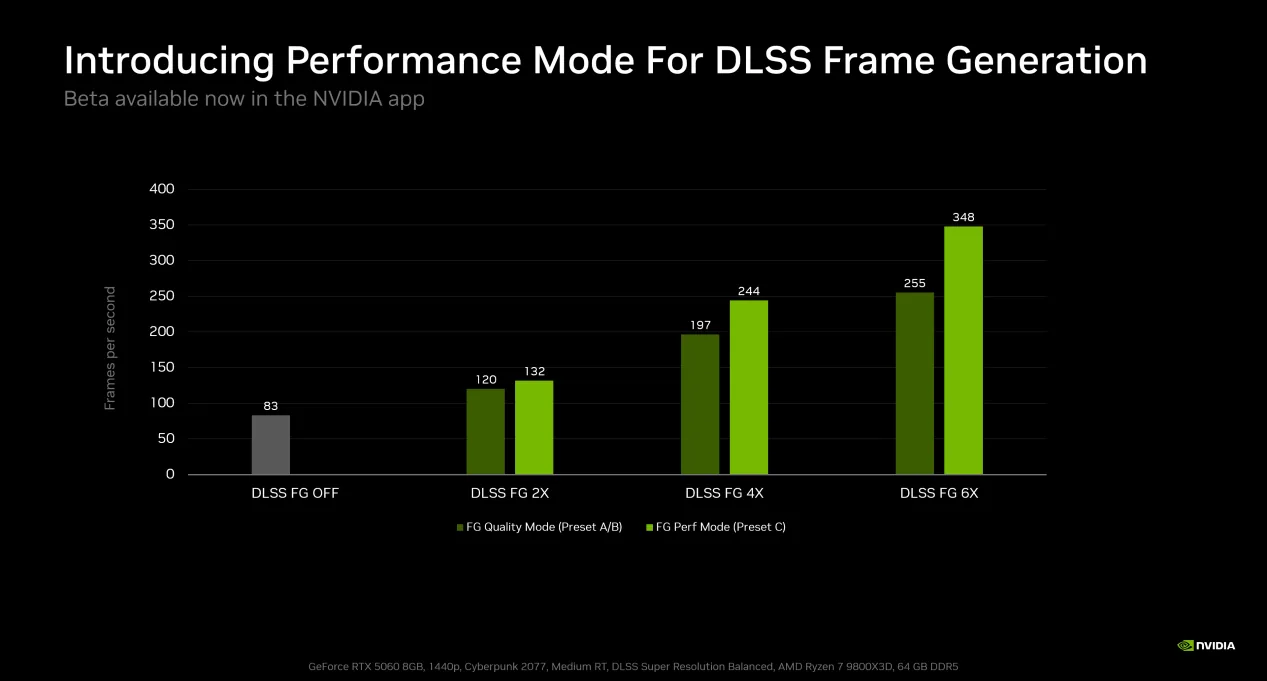
Think of DLSS Frame Generation like this: the GPU renders only some of the real frames, and the algorithm “inserts” the rest. Rendering pressure stays the same while frame rates rise. Preset C is a new “performance mode” preset NVIDIA added to this system. Its defining trait is that it maintains relatively high smoothness while significantly reducing the computational burden of the frame interpolation step, squeezing more frame rate out of mainstream and midrange GPUs.
The catch is that NVIDIA officially fences it off to Ada Lovelace and newer architectures, leaving RTX 30 series (Ampere) users with no way to enable it even if they want to. Universal MFG Unlocker 1.5.0 gets around this by supporting the DLSS 310.9.16 runtime, allowing Preset C to run on RTX 30 series.
Two Contrasts: What Official Support Won’t Give, the Tool Does
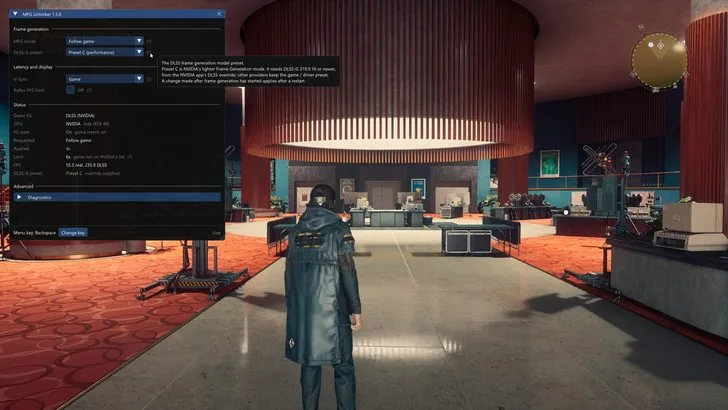
The first contrast comes from NVIDIA’s product segmentation: the RTX 30 series does not officially support DLSS Frame Generation, yet under the new tool it not only runs smoothly, but frame pacing (whether the time intervals between frames are even) is also greatly improved during 3x and higher multi-frame generation.
The second contrast appears at the vendor boundary. Thanks to seamless integration with OptiScaler, the tool lets GPUs from NVIDIA, AMD, and Intel all enable Intel XeSS multi-frame generation, with generation multipliers from 2x to 6x—a tool built around NVIDIA DLSS casually unlocks a rival’s frame interpolation solution as well.
| Item | Official support | After Unlocker 1.5.0 unlock |
|---|---|---|
| DLSS Preset C | Ada and newer RTX 40 / RTX 50 series GPUs and laptops | Extended to RTX 30 series |
| DLSS Frame Generation | Not officially supported on RTX 30 series | Runs smoothly |
| Frame pacing | — | Greatly improved for 3x and higher multi-frame generation |
| Multi-frame generation multiplier | — | XeSS MFG 2x–6x via OptiScaler |
Who Should Use It, Who Should Wait
- Good fit: Players with an RTX 30 series card who want to try frame generation and high-multiplier multi-frame generation; people who are used to tinkering with open-source tools and willing to tune settings themselves.
- Better to wait: Users already on RTX 40 / RTX 50 series can enable Preset C through the official route, so there’s no need to take a detour; users who demand high image consistency and stability and don’t want to introduce extra variables should also hold off for now.
Final Thoughts
Using architecture to draw feature boundaries is standard practice for NVIDIA, but third-party tools can always erase that line through runtime compatibility. Preset C was meant to ease the load on midrange cards, yet the users who truly need that relief are precisely the older-card owners left off the list. This update reminds us that the barriers between hardware generations are sometimes easier to bypass than you’d think.