
Unisplendour released its earnings forecast for the first three quarters of 2026 on October 14, projecting a 72.38%–117.97% increase in net profit attributable to shareholders—a growth range above general market expectations.
- Announcement date: October 14, 2026
- Coverage period: January–September 2026
- Net profit attributable to shareholders: RMB 2.42–3.06 billion, up 72.38%–117.97% year on year
- Net profit after deducting non-recurring items: RMB 2.10–2.74 billion, up 43.84%–87.68% year on year
- Basic earnings per share: RMB 0.85–1.07
- Data status: Preliminary estimates; detailed figures pending disclosure in the 2026 third-quarter report
All Three Metrics Are Up, but Not by the Same Margin
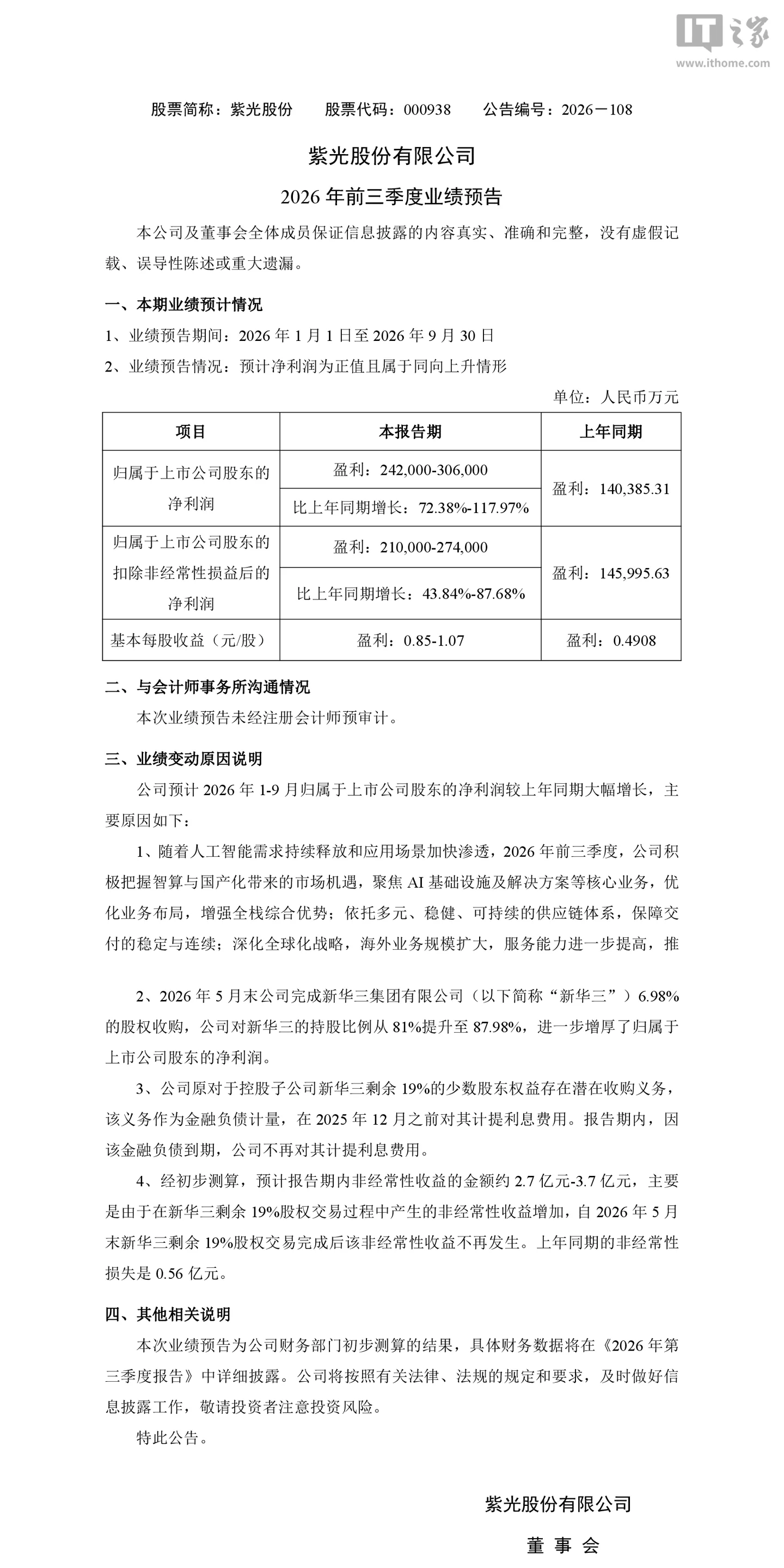
In the same period last year, the company’s net profit attributable to shareholders was RMB 1.404 billion, net profit after deducting non-recurring items was RMB 1.46 billion, and basic earnings per share were RMB 0.49. By comparison, all three metrics are rising, but at noticeably different rates.
There is an easily overlooked contrast here: in the same period last year, net profit after deducting non-recurring items (RMB 1.46 billion) was actually higher than net profit attributable to shareholders (RMB 1.404 billion), because that year included about RMB 56 million in non-recurring losses; this period, however, is expected to include about RMB 270–370 million in non-recurring gains, a complete reversal. This directly explains why the growth range for net profit attributable to shareholders (72.38%–117.97%) is significantly higher than the growth range for net profit after deducting non-recurring items (43.84%–87.68%)—part of the profit growth does not come from the core business.
Another detail is the width of the ranges: the upper and lower limits of the attributable-profit growth rate differ by about 45 percentage points, while those for the deducted-profit growth rate differ by about 44 percentage points. The forecast offers a range rather than a single point, indicating that the final figures still depend on the timing of recognition in the third quarter alone.
A quick note on two terms: net profit attributable to shareholders refers to net profit attributable to shareholders of the listed company; net profit after deducting non-recurring items is the profit remaining after stripping out one-off gains and losses such as government subsidies and asset disposals, and it usually gives a better picture of the true quality of the