
On October 15, U.S. AI company TypeSafe AI released decision model Jev 1.14.0, while bundling three experimental features—image input, a new question type called Box, and a 262k-token context window—into a program called “Danger Zone.” All are off by default; you have to turn them on yourself through API switches. The company explicitly says they have not reached production standards and are used at your own risk.
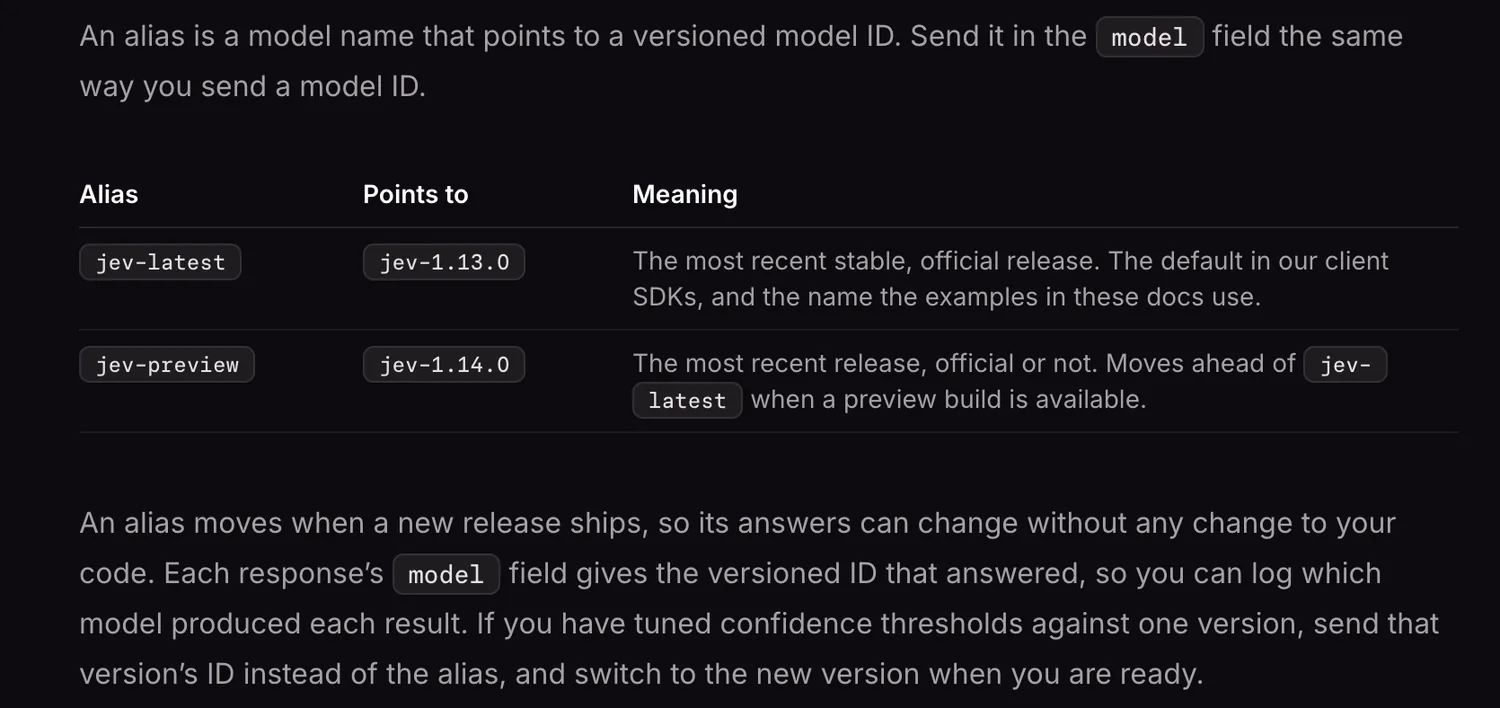
- Version and aliases: 1.14.0 currently uses the preview alias jev-preview and is expected to switch to the default alias jev-latest in about a week; 1.13.0 will remain available for some time
- Pricing: unchanged, $0.042 per million input tokens, output free
- Availability: image and long context can be enabled immediately through experimental switches; Box is exclusive to 1.14.0
- Weights: the source material does not mention whether Jev’s own weights are open; it only says official evaluations “cover open-weight models only”
- Risk notice: these features are not covered by the reliability guarantees of the formal release; you need to verify outputs yourself
A “no-frills” update, and a leaderboard with its own warning

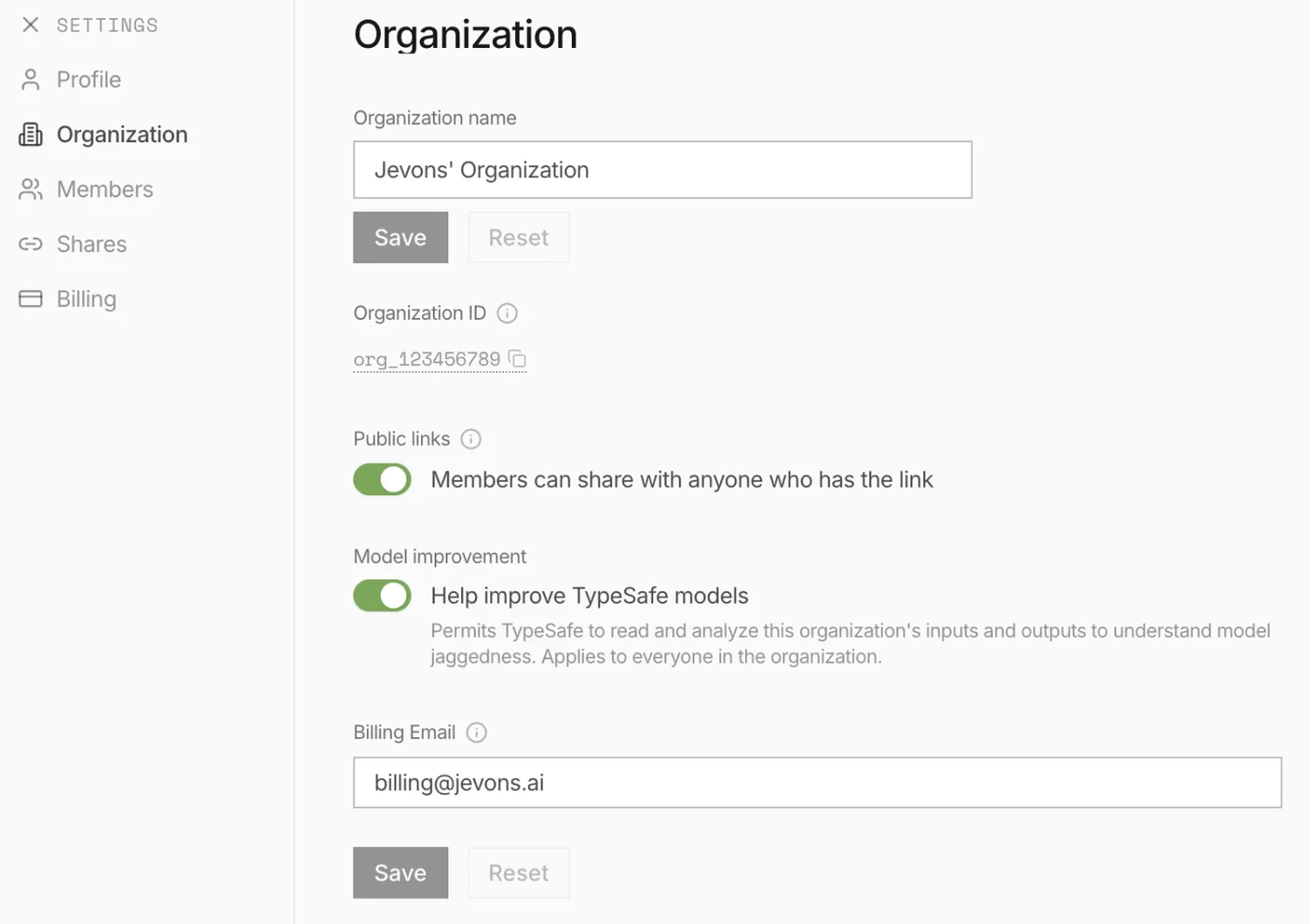
Jev 1.14.0 itself is not a major upgrade. TypeSafe describes it as a “no-frills” update with subtle but broad changes; the most noticeable expected improvement is multilingual capability. The official documentation also notes that although non-English languages such as Chinese can be handled, results are still not as good as in English, and developers should test with their own content before launch. This update also adds a “model improvement authorization” option: when enabled, TypeSafe can read and analyze inputs and outputs to identify unstable model behavior and troubleshoot failures in real-world scenarios; the company says these queries will not be used for model training.
Official internal evaluations show that in the composite intelligence score comparison across 8 models, Jev 1.14.0 ranks first with 60.0, above 1.13.0’s 58.9; the highest-scoring open model, kev-27b, scores 46.7. On the calibration error metric, 1.14.0 performs best at 1.6. More intriguingly, the top right corner of all three evaluation charts carries the same sentence: “Warning: AI benchmarks, do not take them at face value” — the company itself warns that the leaderboard is for reference only, covers open-weight models only, results may favor its own model, and scores may be adjusted later; it suggests focusing on the relative performance among open models.
Put in a broader context: Jev was officially launched on September 16. TypeSafe spent two years in stealth development and calls it the first System One model, meaning a decision model closer to fast, intuitive judgment. Unlike large language models that generate continuous text, Jev directly outputs structured decisions such as classifications, choices, and yes/no judgments, along with calibrated confidence scores. On October 10, TypeSafe announced an $870 million (about RMB 5.86 billion) Series A funding round at a $7.5 billion (about RMB 50.5 billion) valuation, led by a16z with participation from Sequoia Capital and DCVC—this update is the first model update after the funding. In the same space, Microsoft has launched Microsoft-Decision-1, while the open-source community has seen Jev-like projects such as Kev, Laya, and Decider emerge.
| Item | Jev 1.13.0 | Jev 1.14.0 |
|---|---|---|
| Alias | Remains available for some time | Preview alias jev-preview, switching to jev-latest in about a week |
| Image input | Already has multimodal capability, not officially opened | Experimental API opened |
| Box question type | Not supported | Exclusive |
| Default context limit | Not mentioned | 64k tokens per request, 32k tokens per question |
| After enabling experimental switches | Image and long context can be enabled | Limit raised to 262k tokens |
| Composite intelligence score | 58.9 | 60.0 |
| Pricing | $0.042 per million input tokens, output free | Unchanged |
Images, Box, and 262k: capabilities and limits come in pairs
Image functionality is characterized by being “fully composable”: status information, question instructions, and even evaluation criteria can all include images, and all three question types support image input. The company also revealed that 1.13.0 actually already had multimodal capability, but it had not been officially opened before. The limitations are also clear: currently only static PNG and JPEG images are supported; side lengths must be between 256 and 1,568 pixels; each image must not exceed 16 MiB; and costs are calculated by input tokens. The company notes that Jev’s performance on multimodal tasks is still not as good as on pure text tasks.
Context limits are greatly increased: by default, a single request supports up to 64k tokens and a single question up to 32k tokens; after enabling the experimental switch, both limits can be raised to 262k tokens. The company also warns that long context may make the model run slower and perform less accurately, and recommends enabling it only when truly needed.
The Box question type lets Jev directly locate specified targets in an image and return the corresponding bounding-box coordinates. The coordinates are normalized to a range of 0 to 1, corresponding to the image’s width and height respectively. Official use cases include identifying a cup on a counter, locating a signature in a scanned document, and framing a person at a doorway. It is also Jev’s first question type that does not serve only smart-if judgments. Two terms here are worth a one-sentence explanation: bounding box means using a rectangular box to mark the coordinates of a target’s location in an image; normalization means converting coordinates into values between 0 and 1 that are proportional to the image’s width and height.
Who can try it now, and who should wait
- People who should get started first: developers working on experimental projects involving agents, document scanning, or image review. Images and Box can eliminate some of the work of stitching in external vision models, but it is recommended to run them only in offline or canary environments and check item by item whether the returned coordinates and confidence scores are usable.
- People who should wait: teams that primarily work in Chinese or plan to go directly to production. The company has already made clear that non-English performance is not as good as English, that long context and multimodality are less stable than pure text, and that 1.13.0 remains available, so there is no hard reason to upgrade.
Final thoughts
Jev extends decision-making from text to vision, which means agents gain an additional input layer for “looking at an image and making a judgment.” But an experimental API does not equal production capability. Multimodality being weaker than pure text, and long context requiring a trade-off between speed and accuracy, are obvious costs. What will really determine its application space is whether it can consistently deliver reliable results under complex inputs.