
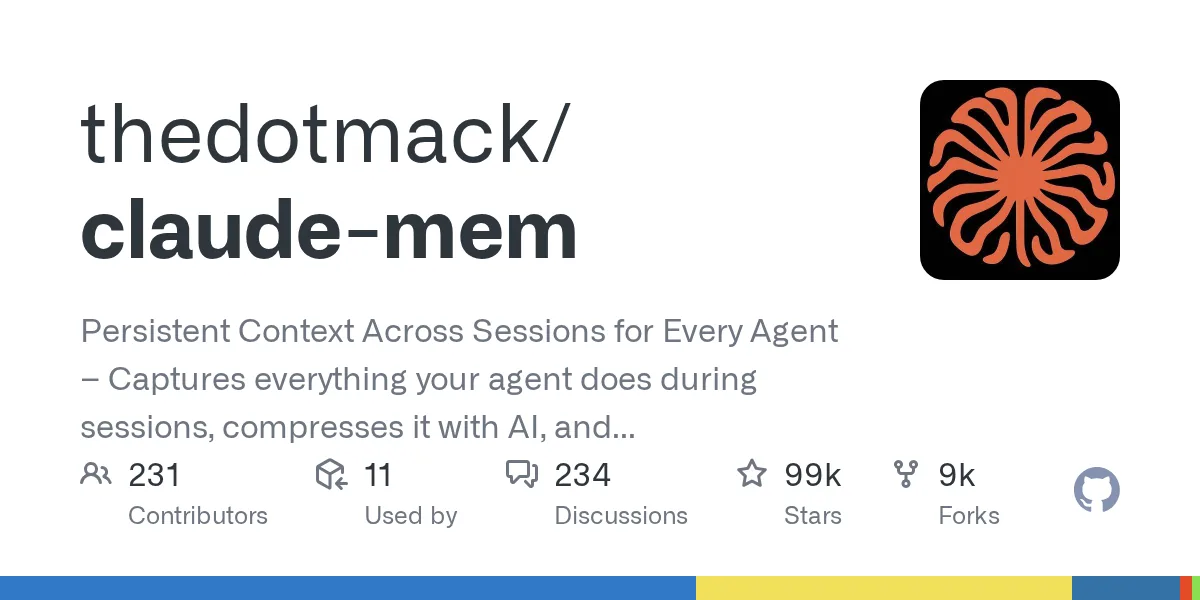
The claude-mem project that hit GitHub trending today has already become a “must-have” for AI Agent developers. It solves the long-standing problem of AI memory gaps—when a session ends, Claude Code always “loses its memory”; now, it can continuously capture tool calls, use AI to generate semantic summaries, and automatically inject relevant context into the next conversation. This isn’t simple chat-log replay; it’s a persistent memory engine designed for AI agents.
Core Features: Capturing and Compressing Memory
claude-mem’s workflow is like an intelligent “memory newsroom.” It listens to your Agent’s behavior in the background: when a tool is called, the observation results are captured; then a lightweight model generates semantic summaries; finally, they’re stored in a local vector database (ChromaDB or SQLite). When the next session starts, it recalls relevant memories based on the current task, making the AI seem to “remember” what you did before.

Getting Started: Install in Three Steps
For Claude Code users, just run this in your terminal:
| |
After it runs, a login page will pop up in your browser (login with an email verification code; no payment card required). Choose a memory provider, and you’re set. Once installation is complete, restart Claude Code, and new sessions will automatically include historical context.
If you use another IDE, there are matching commands too:
- Grok Bot:
npx claude-mem install --ide grok-bot - OpenCode:
npx claude-mem install --ide opencode - T3 Code:
npx claude-mem install --ide t3code - DeepSeek Harness:
npx claude-mem install --ide dsh
Technical Highlights and Design Trade-offs
Its three-layer architecture is worth digging into:
- Observer layer: A lightweight listener process focused on capturing tool-call output without blocking the main workflow
- Compressor layer: Calls OpenRouter/Gemini Anthropic APIs to generate summaries and supports configuring the compression rate
- Retriever layer: Uses RAG when querying ChromaDB/SQLite, recalling memories based on embedding similarity
There’s a clever “compromise” in the design: local memory uses Titanium (a lightweight SQLite wrapper) by default to ensure offline availability; but summary compression goes through cloud services, avoiding a local dependency on large models. That also explains why it advertises a “30-day free trial”—compression is a real API cost, while storage itself is nearly free.
Another key decision is support for switching between multiple providers. You can use claude-mem’s own hosted service, swap in your own OpenRouter key, or go directly through an Anthropic plan. This isolation design means users aren’t locked into a vendor and can transition smoothly to a self-hosted solution.
Who Is It For?
- Heavy Claude Code users: People who often work on the same project across sessions; it saves them from the tedium of repeatedly explaining context
- AI Agent developers: When debugging an Agent, they need to review past decisions, and this is far more efficient than manually digging through chat logs
- Knowledge managers: With RAG, project documents can become a searchable long-term memory library
Comparison with similar solutions:
- mem0: Focused on personal knowledge bases, emphasizing large, comprehensive memory storage
- Supermemory: Similar direction, but its IDE integration isn’t as deep as claude-mem’s
- OpenMemory: Open source, but its documentation is sparse, and production stability remains to be seen
The most critical difference is that claude-mem is specifically adapted to Claude Code’s tool-calling mechanism. It can accurately capture behaviors such as file_read and browser_tools, rather than simply storing raw message text.
Final Thoughts
As AI Agents move from one-off Q&A to ongoing collaboration, memory becomes a foundational capability. With 98,000 stars, claude-mem proves that developers have long had enough of the “start over every time” experience. It doesn’t show off; it simply solves the most basic problem: letting AI remember you as naturally as a human remembers an old friend.