
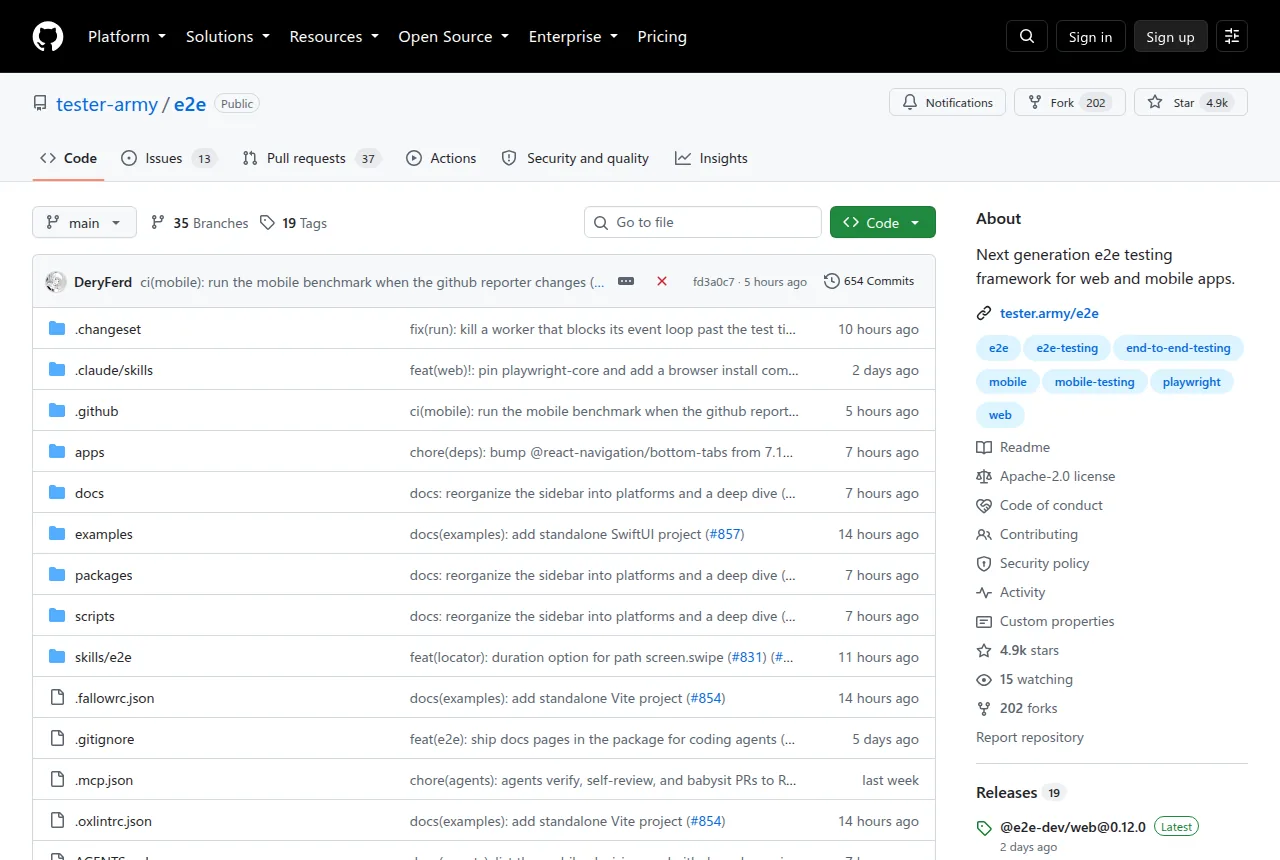
What is it? e2e is a new framework for writing end-to-end tests in natural language — simply tell it “upgrade to the Pro plan” and its AI agent will autonomously operate the application and verify the result. It’s worth a look today because it’s surged to the GitHub trending page (gaining 1,398 stars today), signaling collective endorsement from the developer community for the “AI testing” paradigm.
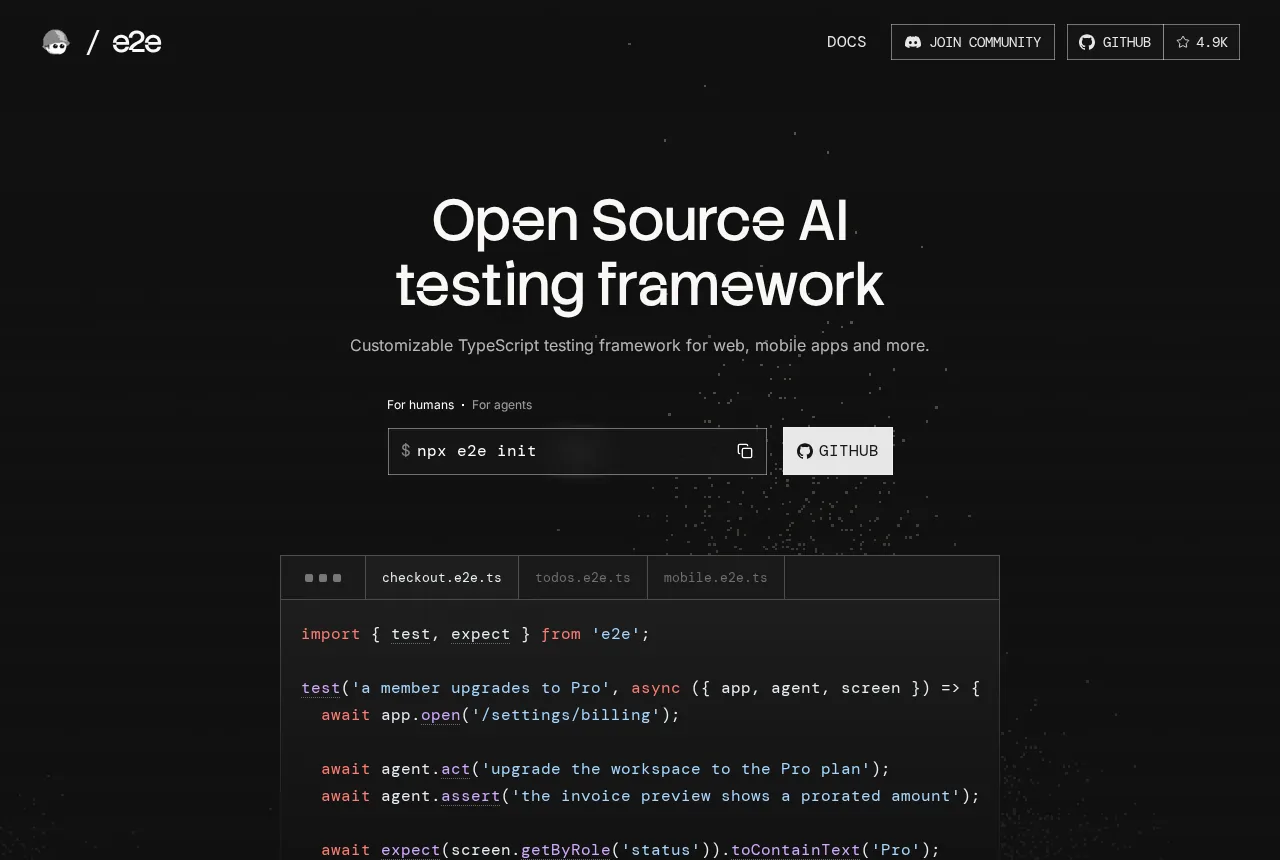
The Trick in One Sentence
Traditional test writing follows a “steps + assertions” pattern: open the page → click the button → enter the email → assert the success message. With e2e, you write in a “goal-oriented” style:
| |
The AI automatically decomposes the goal, selects actions (clicks, inputs, swipes), and handles exception branches; when an assertion fails, it self-corrects and retries. The test logic is decoupled from the operations — like a commander issuing orders rather than moving bricks themselves.
Core Features: Three Layers of Workflow
- Natural language goal descriptions: Describe the scenario you want to verify in plain sentences — no need to worry about how specific UI operations are implemented.
- Multi-engine support: Web uses Playwright (supporting Chrome/Firefox/WebKit), mobile supports iOS/Android simulators.
- Smart replay mechanism: The first run records the AI’s operation path; subsequent test runs before any code changes can be replayed directly (zero model calls), dropping costs by 90%.
Notably, e2e features a “debug-friendly” design: when a test fails, e2e replays the entire decision-making process, including how the AI was thinking (which locators failed to match and why an operation was retried). This addresses the biggest pain point in AI testing — the black-box, undebuggable nature.
Up and Running in Three Minutes: Five Commands to Set Up the Environment
| |
The framework defaults to TypeScript and is also compatible with JavaScript. Here’s an example test file:
| |
Note the last line uses a traditional assertion (expect). e2e’s philosophy is “let AI handle the hard parts, let humans handle precise verification” — details like whether a modal disappeared or whether a transition animation completed are still left for developers to assert explicitly.
Technical Highlights: Three Key Design Trade-offs
Layered test strategy: AI handles semantic-level goals (e.g., “refresh the page until the list loads”), while humans are responsible for precise assertions (e.g., “the URL query parameter contains
?tab=pro”). This division of labor avoids the common trap of over-generalization in AI-driven testing.Decoupled replay (reproducible decision recording): During the first run, the framework serializes every step of the AI’s operation (click coordinates, input text, wait duration) and saves it as a test snapshot. If no code changes are detected on subsequent runs, it replays directly instead of re-reasoning — preserving both AI speed and stability.
Agent-assertor separation architecture:
agent.act()handles operations,agent.assert()handles verification, and both share the same state snapshot. This means when an assertion fails, you don’t need to restart the application to determine whether the error came from the operation or an app bug, significantly shortening the debug cycle.
Who Is It For? Comparison with Similar Solutions
- Frontend/mobile teams: Teams with disorganized test cases, high maintenance costs, and repetitive cross-browser compatibility checks.
- QA automation newcomers: Don’t need to dive deep into Playwright or Appium API details — cover 80% of core flows using natural language first.
- Product/ops teams: Can initially participate in writing scenario descriptions (e.g., “coupon stacking purchase”), which engineers then transcribe into code.
Comparison with similar solutions:
- Cypress / Playwright: Mature but verbose — every UI operation must be hand-written. e2e reduces boilerplate code by 70% (as demonstrated in the sample repo).
- Selenium IDE record-and-playback: Generated scripts are hard to read and maintain. e2e outputs readable TypeScript + AI decision logs.
- Puppeteer + LLM scripts: Require you to handle retries, state snapshots, and model caching yourself. e2e has all these mechanisms built in.
It’s worth noting that e2e does not fully replace existing tests — it recommends “using AI assistance for critical payment flows, while keeping specific interaction details with traditional assertions.” This is a pragmatic, incremental approach.
Final Thoughts
e2e’s potential lies not in “using AI to write tests” but in “defining quality boundaries in natural language.” When developers are liberated from atomic operations, testing shifts from “verifying functionality” to “verifying intent.” This is the leap in software quality maturity we’ve been waiting for.
Currently, it supports mainstream models (GPT-4o, Claude 3.5 Sonnet) as well as local open-source models (Llama 3.2), and documentation is bundled with the project for offline access. If you’re struggling with test script maintenance, it’s worth spending half an hour trying it out.