
What Tencent Hunyuan and four universities built
Tencent Hunyuan Frontier, led by Tencent chief AI scientist Yao Shunyu, teamed with researchers from the National University of Singapore, University of Maryland, University of Georgia and Indiana University. They propose Terminal-RSI, a recursive training method for terminal agents. Zhidongxi reported the work on October 19; it was dated October 15.
Hard facts:
- Base model: Alibaba Qwen team’s open-source Qwen3.8-27B.
- Training stages: Base, RSR-1, RPR-1, RSR-2, RPR-2, producing Terminal-RSI-27B.
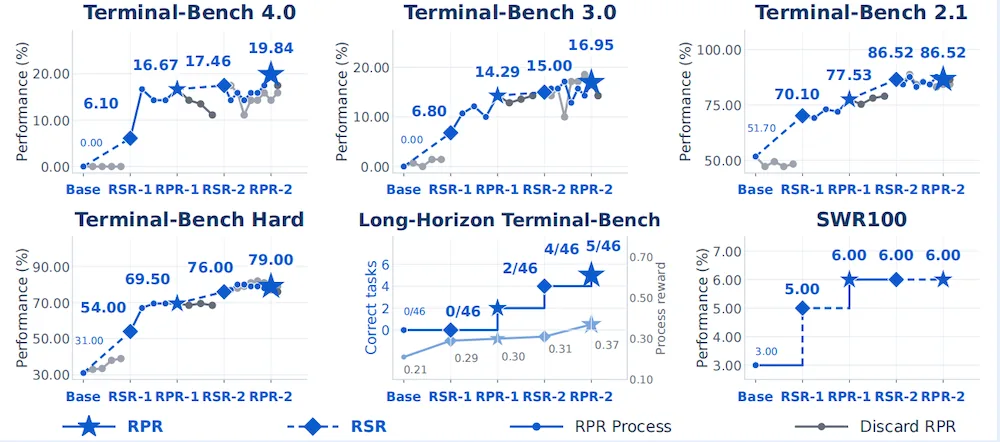
- Key score: 86.52% on Terminal-Bench 2.1; four Terminal-Bench average rises from 20.68% to 50.58%, a 29.90-point gain.
- Availability: source material does not disclose open weights, API pricing, product launch timing or commercial plans.
How RSR and RPR alternate
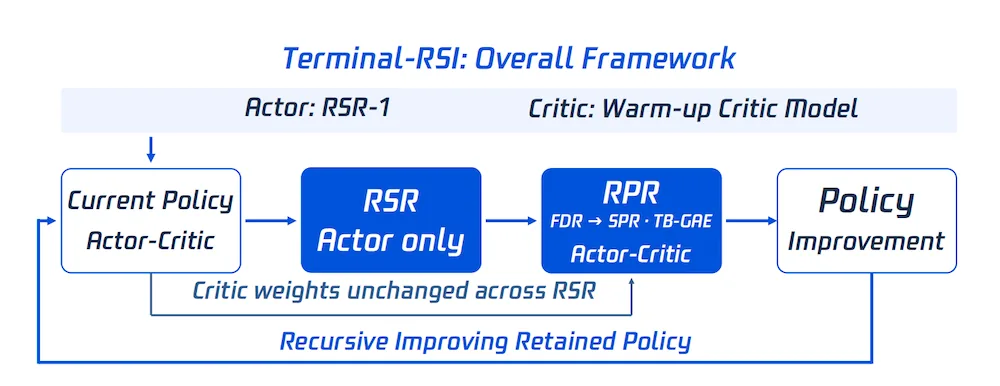
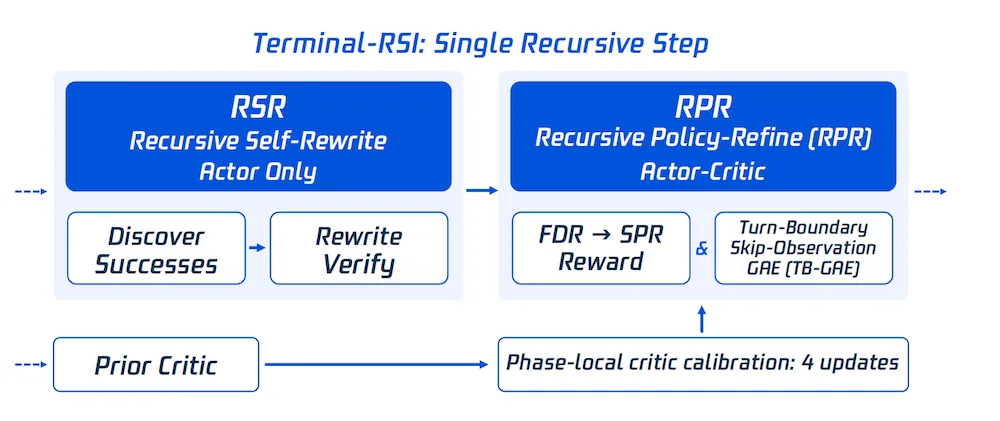
Terminal-RSI alternates Recursive Self-Rewrite (RSR) and Recursive Policy-Refine (RPR). RSR mines successful traces, rewrites them into reusable steps, and re-tests them in new environments; only validated traces enter training. RPR then uses reinforcement learning, retaining and recalibrating the previous value network. The critic estimates future returns. Training starts with RSR updating the actor while freezing the critic, then RPR updates both.
The paper also introduces TB-GAE to reduce noise from long environment logs by handling reward decay per real interaction turn. It compares RSR-first with direct PPO: on Terminal-Bench 2.1, RSR-first rises from 70.10% to 77.53%, while direct PPO scores 48.31%. The authors caution that the comparison does not fully control supervision costs from extra trace discovery and rewriting.
Results: averages double, long-horizon tasks lag
| Stage | Four Terminal-Bench average |
|---|---|
| Base | 20.68% |
| RSR-1 | 34.25% |
| RPR-1 | 44.50% |
| RSR-2 | 48.75% |
| RPR-2 | 50.58% |
The final model scores 19.84%, 86.52%, 16.95% and 79.00% on the four tests. Terminal-Bench 4.0 goes from 0% to 19.84%; Terminal-Bench Hard from 31.00% to 79.00%. But on the 46-task Long-Horizon-Terminal-Bench, strict completions only rise from 0 to 5 tasks on average, and process reward from 0.21 to 0.37. SWR100 rises from 3.00% to 6.00%, then plateaus after RPR-1. Extremely hard tasks fluctuate: 10.98% at RPR-1, 6.10% at RSR-2, back to 10.98%.
Reward changes also matter. Under Family Dense Reward (FDR), failed trajectories receive 50.09% of total reward across 4,352 audited traces. With Success-Prioritized Reward (SPR), that falls to 28.72%, and failed trajectories with at least 1 point drop from 158 to 0. The paper says offline rescoring cannot alone prove training impact.
Who should use it, who should wait
Teams working on terminal agents, repository repair, dependency handling, CLI automation or RL training pipelines can use RSR-first, critic calibration, TB-GAE and SPR as reference points. Teams planning production-grade long-horizon automation should wait: the study changes initialization, reward and learning rate together, uses only three independent evaluations per stage, lacks multiple random seeds and larger model comparisons, and validates only one 27B-scale model.
Final note
Terminal-RSI turns successful traces into training fuel, showing both promise and limits for recursive terminal-agent training. The hard problems remain long-horizon tasks, extremely hard tasks and reward allocation. It is a training-recipe clue, not a plug-and-play product launch.