The AI Office Race Goes Fully Offensive: Tech Giants Enter the “Horse Race”

In the summer of 2026, China’s three major tech giants formally made AI office a strategic battlefield: ByteDance integrated TRAE, the Coze team, and the Feishu product line into the Doubao system; Tencent WorkBuddy has already reached 10 million-plus monthly active users; Alibaba is focused on integrating desktop Agents, cloud Agents, and DingTalk capabilities. This is not an iteration of a single product, but a systematic organizational restructuring—WorkBuddy survived by “standing on the corpses of numerous failed projects”; Feishu was folded into the Doubao system, signaling that office software is transforming into an Agent invocation engine.
User Education Reaches Its “ChatGPT Moment,” a Counterintuitive Pricing System Revealed

Domestic models have recently truly crossed a key threshold: GLM-5.3-Flash and DeepSeek-V4-Flash not only improve instruction-following capabilities but also significantly reduce costs. Wang Hua of Sinovation Ventures points out that the “crayfish craze” earlier this year was really a geek carnival; because models were weak, configuration was difficult, and Harness was immature, ordinary users found it hard to participate. The turning point came recently: model, Harness evolution, and cloud-based deployment together enabled a consumer-grade Agent experience. Tencent treats WorkBuddy as a consumer-grade App to be polished, moving from a geek toy to a phone-App-level experience.
A key contrast is this: in the mobile internet era, 10 million MAU was not worth a giant battle, but in AI office, a clear business logic is visible—when Claude Code had not yet reached 10 million MAU, its annual recurring revenue (ARR) had already reached $20 billion. What the giants fear is losing a high-value economic entry point, not user scale.
Models and Harness Determine Success, Version Comparisons Show Divergence
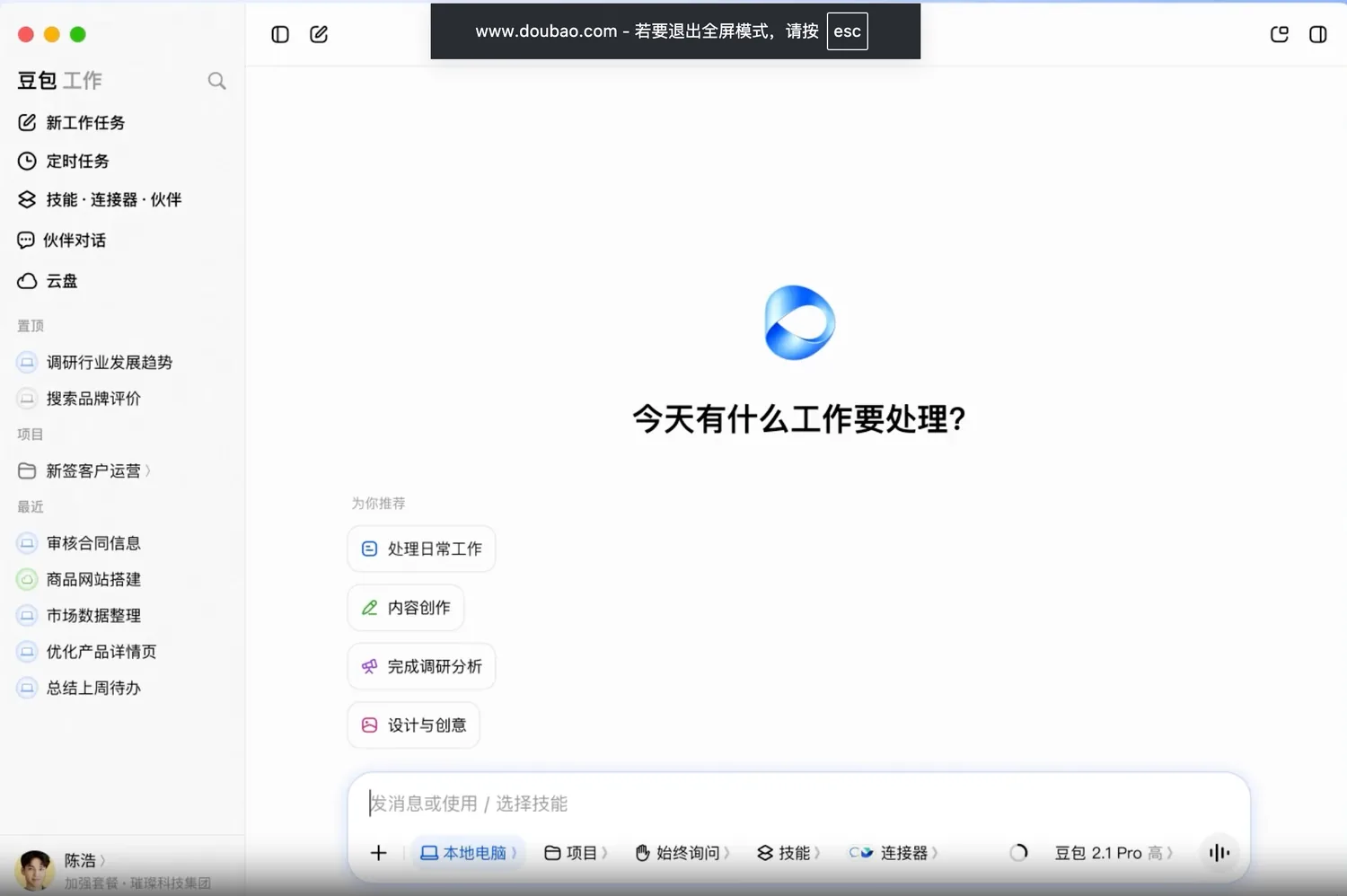
Current Agent products fall into three tiers: geek products (such as early crayfish), expert products, and mass-market products. The paths chosen by the giants differ markedly:
| Dimension | WorkBuddy (Tencent) | Qwen Office (Alibaba) | Doubao Office (ByteDance) |
|---|---|---|---|
| Product style | Minimalist, continuous rapid iteration | Engineering-driven, close to the model pipeline | Youthful, content presented up front |
| Model strategy | Open to multiple model integrations | Closed-source models first | Prioritizes its own ecosystem |
| Interaction logic | Chat panel + file-system organization | MCP/command-line compatible | Preset scenarios delivered directly |
Tencent’s more open model choice is seen as a key advantage—when long-horizon Agents raise their demands on model intelligence, ByteDance is constrained by its own model capabilities, while WorkBuddy can plug into the best ecosystem. Multiple participants report that office Agents happen to sit in the ideal compute range: they both demonstrate the real capabilities of large models and avoid the compute burden of consumer-facing products.
Adoption Advice: Match Products to Needs and Willingness to Pay
- Good to get on board now: Professional workers (programmers, legal, finance) with a clear willingness to pay can try WorkBuddy/Doubao Office. Power users have already developed paying habits; programmers and expert users readily accept the RMB 68–98 monthly tier; some users top up as much as RMB 2,000–3,000 in a day.
- Better to wait: Non-expert users pursuing maximum model performance should wait—current models are still in a pre-convergence phase; users