
The takeaway bag opened, six drumettes squeezed into a paper bucket. I took one bite and stopped — this piece didn’t taste like the spicy chicken wings I ordered last week.
I called the store. The person on the other end answered crisply: they’re the same, both our chicken wings.
I dug up last week’s order, laid both wings side by side on the desk, snapped a photo and sent it over. Ten minutes later, the refund hit my account.
The difference between those two wings in the photo has a precise, gram-level name in the industry — one that simply never appears on menus. It shows up on quotation sheets at wholesale markets.
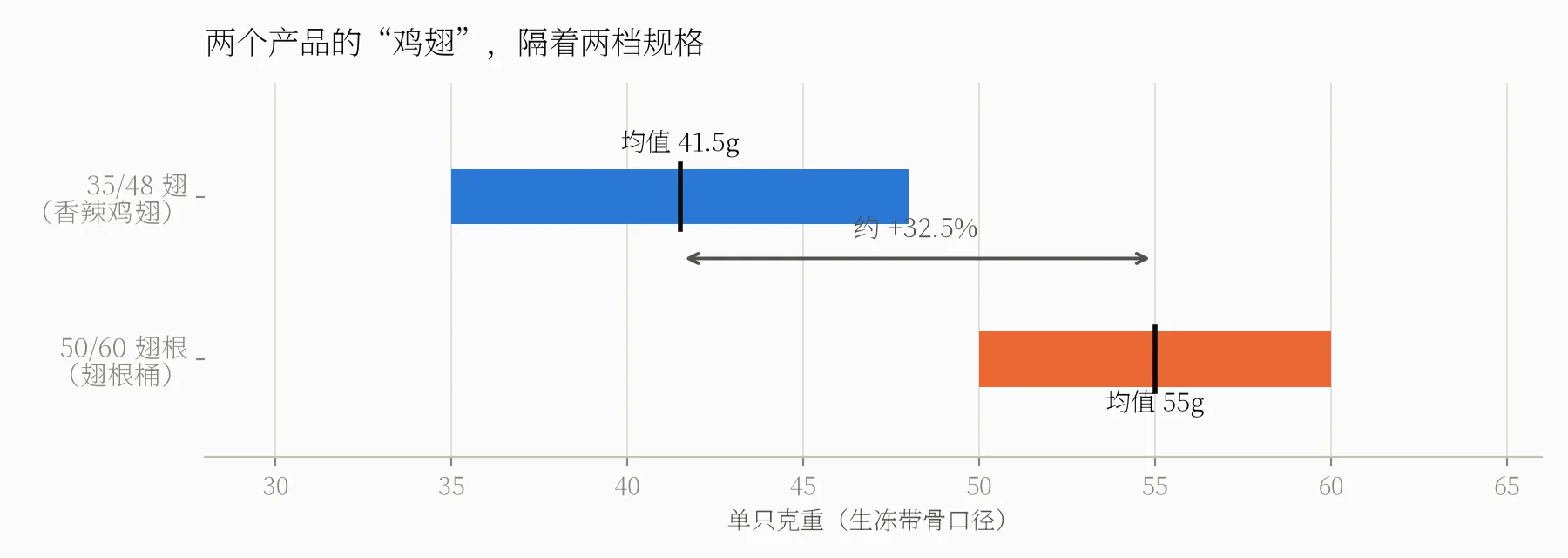
Tastien’s “Spicy Chicken Wings” use wings in the 35/48 spec, while the drumette bucket (officially called “Double Enjoy Drumettes”) uses 50/60-spec drumettes. On the industry-standard per-piece weight basis, 35/48 averages about 41.5g per piece, 50/60 averages about 55g per piece. Two strings of numbers separated by a menu layer that consumers can’t see, while the store tells you on the phone “they’re the same.”
That Field Absent from the Menu
China’s chicken cut-parts market trades by specification numbers.
Mysteel publishes a weekly summary table of white-feather broiler cut-part prices across major producing regions. Poultry is priced by part and weight tier. Drumette tiers are listed like this:
| Quotation Format | Meaning | Pricing Unit |
|---|---|---|
| 30-40 Drumettes | 30-40g per piece | CNY/kg |
| 40-50 Drumettes | 40-50g per piece | CNY/kg |
| 50-60 Drumettes | 50-60g per piece | CNY/kg |
How do you know these numbers mean “grams per piece” rather than “pieces per kilogram”? On the same table, drumsticks are listed as “80-100 / 100-120 / 150 and above.” It’s common knowledge that a single drumstick weighs 80–150g; if these figures were read as “pieces per kilogram,” each drumstick would weigh just 6–12g — absurd. The table also lists chicken feet as “30-40g … 70g and above,” where larger numbers correspond to higher prices, which also tracks: heavier means more expensive.
The retail-side evidence from brands is even more direct. KFC’s primary chicken supplier, Liuhe, prints on its retail drumette packaging: “Approx. 34–47 pieces/pack, 35–48g/piece (unthawed state),” with each pack weighing 1.66kg. The three numbers — 34–47 pieces, 35–48g per piece, 1.66kg per pack — are internally consistent. 35/48 is grams per piece.
You can also search for Taihe Food’s “Drumette 35–48” on wholesale e-commerce platforms: 1.66kg × 10 bags per carton, wholesale price ¥345–355/carton. The product description reads: “Product located above the wing mid-joint, tender meat, low ice content, suitable for barbecue, Chinese fast food, Western fast food.” Fast food is literally written in the usage field.
Tiered by Weight, Down to a令人发指 Degree
This isn’t a rough-and-ready industry. Grading itself is the business.
Xiu Libin, a man in Heilongjiang known in the media as the “Chicken King,” runs precision chicken cut-parts. A NetEase report quotes him:
Wings weighing between 30g and 35g are generally sold to barbecue restaurants; 36–45g wings go to household consumers; those over 65g are used for smoked and braised preparations.
He required his facility to refine wing-mid grading from the previous four tiers down to twelve, and commissioned a custom sorting machine in 2018. Barbecue restaurants want small wings (cheaper, cook faster, look better on skewers), households want medium wings, and smoked/braised products need large wings — each weight tier maps to a distinct channel and price point.
In other words, every commercial chicken wing you ever eat is weighed, graded, and routed to a channel before it leaves the factory. “Specification numbers” aren’t some mysticism — they’re the infrastructure of this entire supply chain. Whether two fast-food products’ wings share the same spec is a question with a single correct answer, one written into procurement contracts.
Two Products Both Called “Wings”
On Tastien’s official snack menu, these two items sit side by side:
- Double Enjoy Drumettes — Spicy drumettes, double the flavor
- Spicy Chicken Wings — Crispy and juicy, delightfully spicy
On the group-buying page, the drumette bucket is listed as “3 pairs of Double Enjoy Drumettes, 6 pieces total,” at a recurring promotional price of ¥13.9–20.9.
Neither product name carries any weight specification, any grade number, or any anatomical detail. To consumers, “Spicy Drumettes” and “Spicy Chicken Wings” are just two spicy fried-wing options. To procurement, they are two entirely different SKUs with two different specification numbers. That layer of translation is accessible only to the merchant.
My own measurements confirmed it: the drumette bucket uses 50/60-spec wings; the Spicy Chicken Wings are 35/48-spec. On the phone, the store person said “they’re the same.”
What the Phone Call Couldn’t Clarify, the Photo Could
Let’s be honest about the consumer’s positional weakness: the sentence “I feel like these wings are different” is worth virtually nothing against a customer-service script.
Yes, individual pieces vary. Yes, batch fluctuations exist. Yes, breading absorbs oil and shrinkage occurs during frying. Each statement carries a grain of truth, so each can be deployed. Subjective perception will always be neutralized by subjective explanation.
But a different specification number is a falsifiable factual claim — it falls outside the realm of customer-service rhetoric.
I laid both wings side by side in one photo: size, shape, cross-section — all discernible to the naked eye. What that photo accomplishes is translating “I feel they’re different” into “These two types of wings are different” — upgrading from subjective impression to objective evidence. Ten minutes later, ¥13.9 was refunded.
The refund itself doesn’t matter. What matters is the trigger for that turning point: not my verbal质疑, but that photograph. A face-to-face verbal confrontation had zero effect; visual evidence landed the hit in one shot.
This Isn’t an Isolated Case — There’s a Word for It: Shrinkflation
“Reduced portion, unchanged price” has a term in economics: shrinkflation. It’s nothing new in China:
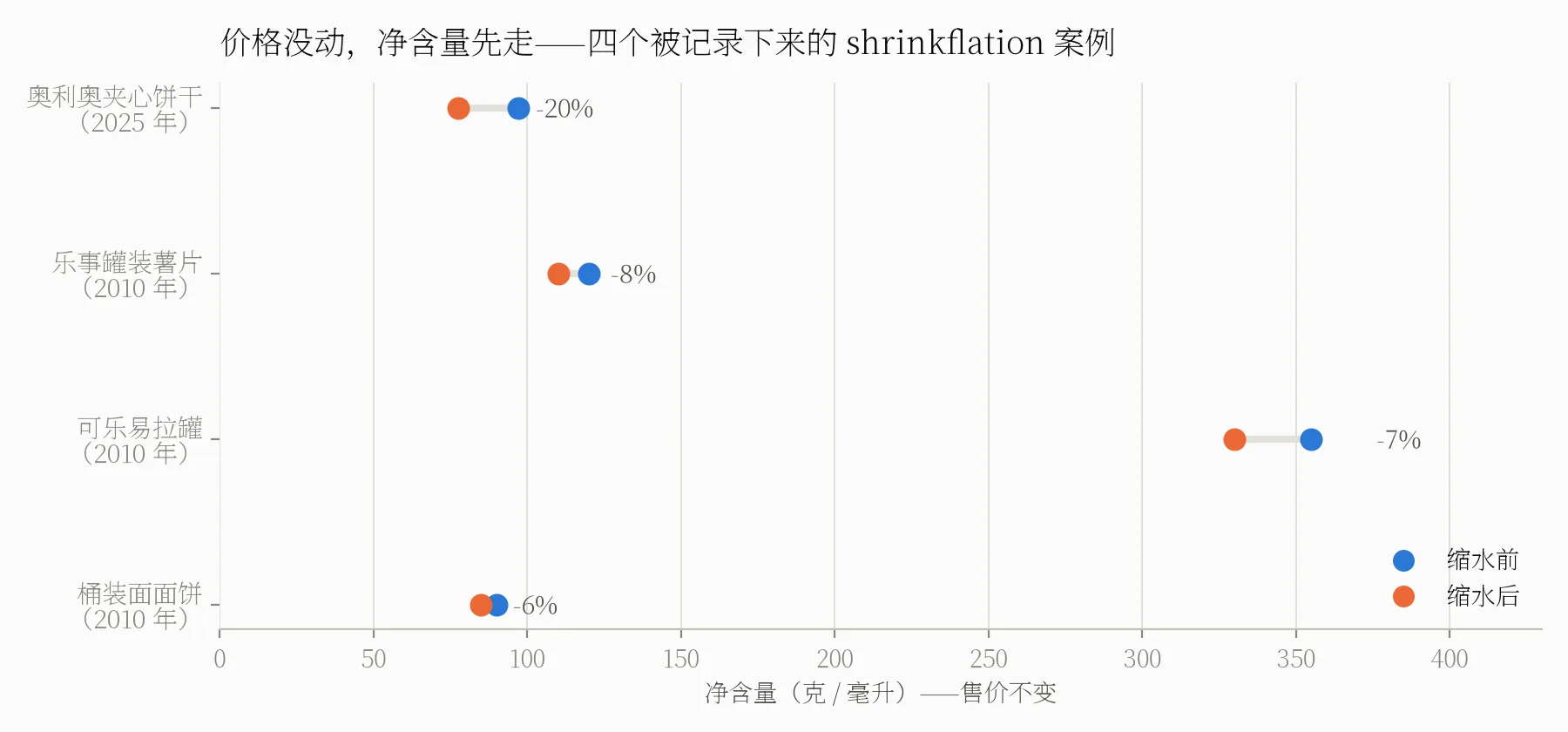
- 2010–2011: Master Kong and Uni-President reduced instant noodle cake weight from 90g to 85g while keeping the price unchanged; Coca-Cola and Pepsi shrunk their cans from 355ml to 330ml; Lay’s tub chips went from 120g to 110g. Master Kong’s response at the time was “a temporary measure to adjust product specifications” — a carefully chosen phrase, since the specs were indeed printed on the packaging; it’s just that nobody reads the weight numbers.
- 2023 Zhenjiang Consumer Association takeaway inspection: Of 18 merchants inspected, 4 sold actual weights below the listed amounts, with portions ranging from 15g to 270g short after removing packaging; one Huainan beef soup listed approximately 1,000g on the page but measured only 730g in reality.
- Discount snack channels: Media reports calculated that Oreo cream-filled biscuits were reduced from 97g to 77.6g — nearly a fifth less — while the package dimensions remained almost unchanged.
At least retail shrinkflation still prints the net content on the package, so comparison is theoretically possible. The foodservice version goes even further: menus carry no weight field at all. Switch a spec tier, and there’s no “reduction” to point to even in principle. That’s also why you’ll never win an argument on the phone — you’re simply speaking on different information planes.
If You’ve Run Into This: A Practical Checklist
First, the legal basis — all verified against the original text:
- Article 8 of the Consumer Rights Protection Law: Consumers have the right to know the “specifications” of goods — specifications are explicitly listed within the right-to-know framework. Omitting them from the menu and declining to answer when asked both cross the line.
- Article 20 of the Consumer Rights Protection Law: Business operators must provide information that is truthful and comprehensive, and must not engage in false or misleading advertising; they “shall give truthful and clear responses” to consumer inquiries. That “they’re the same” on the phone runs straight into this article.
- Article 19(4) of the Provisions on Clearly Marked Prices and the Prohibition of Price Fraud (SAMR Order No. 56): Prohibits “using deceptive or misleading language, text, numbers, images, or videos to indicate prices and other pricing information.”
- Article 55 of the Consumer Rights Protection Law: Fraud establishes a remedy of refund plus three times compensation, with a minimum of ¥500. But the prerequisite is “fraud” (subjective intent), and Article 21 of Order No. 56 provides merchants an escape clause for “no subjective intent.” I took the refund and stopped, because the cost of proving intent — that a clerk’s offhand remark rises to corporate-sanctioned spec substitution — far exceeds ¥13.9.
Three-step evidence collection (per attorney guidance from Liu Xiao of Beijing Kangda Law Firm, legal advisor to SAMR):
- Photograph on site — the product itself, the weighing label, and the packaging, all in frame.
- Preserve the receipt and payment records.
- In scenarios requiring weight verification, record a video that simultaneously captures the scale reading, the corresponding product, and the store sign — three elements that fix the evidentiary link.
Complaint channels: 12315 (phone / app / 12315.cn / WeChat and Alipay mini-programs under the same name). Market regulation departments must decide whether to accept a complaint within 7 working days of receipt and close the case within 45 working days after acceptance; if the process drags, dial 12345 to escalate, creating dual-channel oversight.
Coda
That side-by-side photo is still on my phone: Spicy Chicken Wings on the left, drumettes from the bucket on the right.
Before I took it, the store person said “they’re the same.” After, ¥13.9 was refunded.
The price difference isn’t worth much. What’s valuable are those two strings of numbers that will never appear on any menu: 35/48, 50/60.