
StepFun Open-Sources Step 5 Preview, Dual-Precision Weights Go Live

Zhidongxi reported on October 15 that the Chinese large model that just reached No. 2 worldwide on OpenRouter’s weekly token-usage chart has released its weights.
- Publisher and date: StepFun, October 15, 2026
- What was released: Step 5 Preview model weights in BF16 and FP8 precisions
- Where to get it: available simultaneously on Hugging Face and ModelScope
- Free trial: available in Tencent WorkBuddy for two weeks
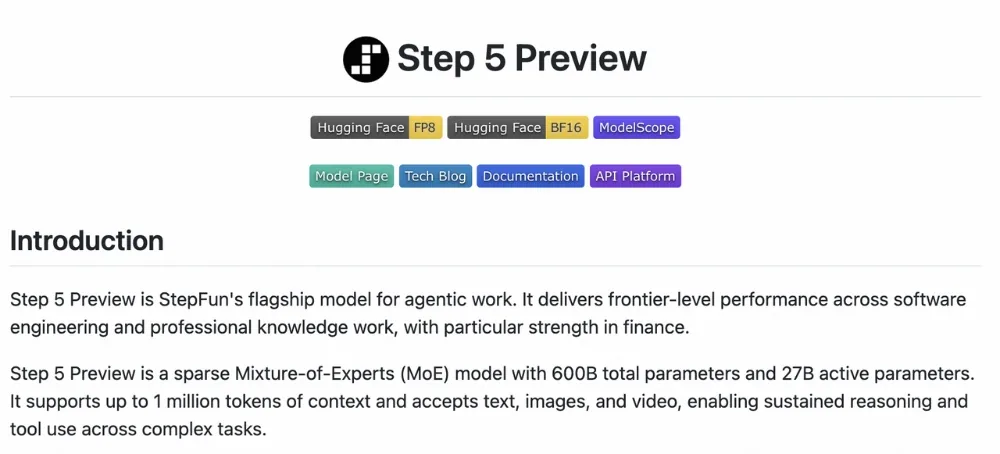
- Disclosed parameters: sparse MoE, 600B total parameters, 27B active, 1M-token context window
“Open-sourcing the weights” means they can be downloaded, self-deployed, and fine-tuned, not just accessed through an API. Sparse MoE (Mixture of Experts) activates only part of its parameters per inference, trading less compute for more capacity; BF16 and FP8 are two numeric precisions, and the latter uses less VRAM.
No. 2 on the Weekly Chart, 18.8 Trillion Tokens in Seven Days, Cost About 1/8 That of Claude Opus 5
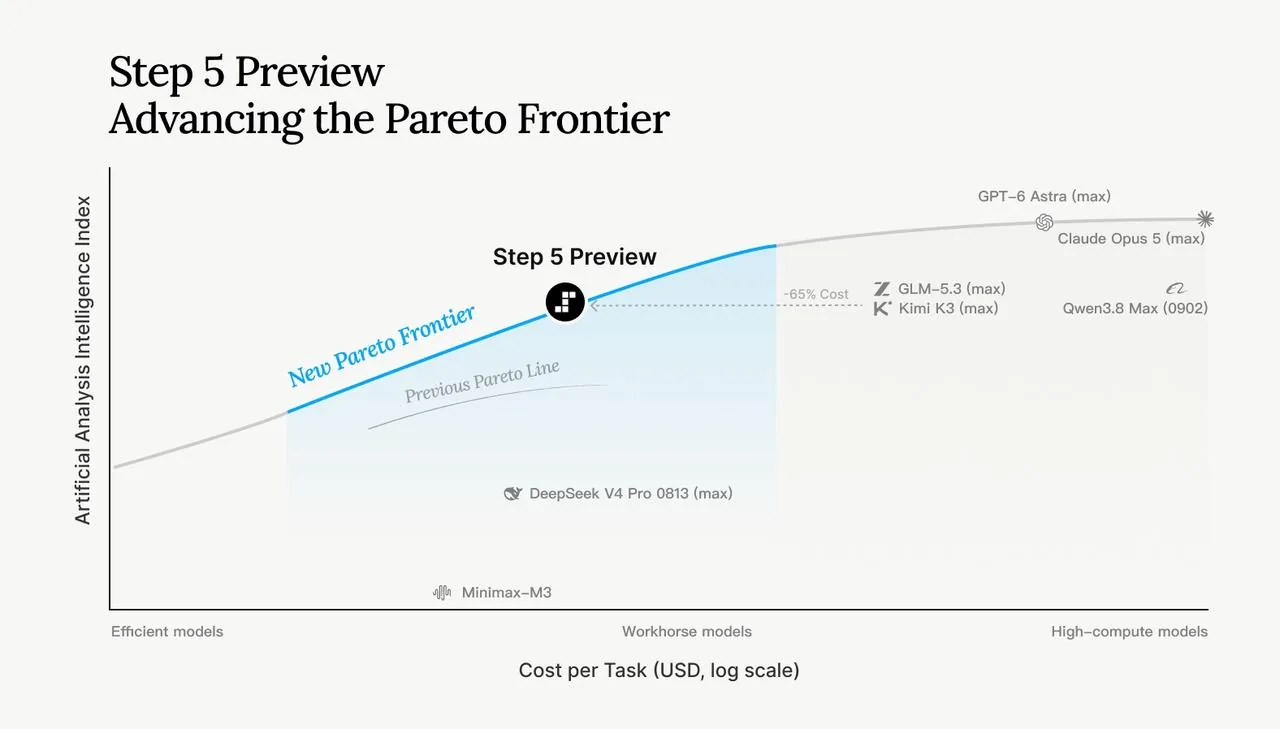
On Artificial Analysis’s Intelligence Index, Step 5 Preview scores 44, ranking among the top three open-source models globally. As of October 15, 2026, it ranks second on both the weekly and daily charts on the open-model platform OpenRouter, with token usage of about 18.8 trillion over the past seven days.
The sharpest contrast is cost: Step 5 Preview’s average total cost per task is $0.71 (about RMB 4.75), while Claude Opus 5 costs $5.86 (about RMB 39.22), making the former about 1/8 of the latter.
| Metric | Step 5 Preview |
|---|---|
| Architecture / Parameters | Sparse MoE; 600B total parameters, 27B active |
| Transformer layers | 92 |
| Context window | 1M tokens |
| Intelligence Index | 44 |
| Average cost per task | $0.71 (about RMB 4.75) |
| Comparison: Claude Opus 5 cost per task | $5.86 (about RMB 39.22) |
92-Layer Narrow-and-Deep Architecture and Sparse GQA: Where Does the Efficiency Come From
According to StepFun’s technical blog, the model is built by stacking 92 Transformer modules. Its depth is comparable to trillion-parameter open-source models such as Qwen 3.8 Max and Kimi K3, while its total parameter count is less than a quarter of theirs and its active parameter count is less than a third.
Why choose “narrow and deep”? StepFun explains: Agent tasks require repeatedly calling external tools, and each call can bring in a large amount of new text. The model may not have the chance to use explicit chain-of-thought reasoning, and instead relies more on “implicit reasoning” while reading the context; with too few layers, information for multi-hop dependencies may not finish propagating before the depth is exhausted.
Attention layers are interleaved at a 3:1 ratio: three-quarters are gated sliding-window attention, and one-quarter are sparse full attention. After comparing several linear-attention approaches, the team found the gap to be small, but the sliding-window structure is the simplest and more amenable to speculative decoding (where a small model drafts first and a large model verifies, speeding up generation).
The bottleneck for a million-token context is in the full-attention layers. The solution is Sparse GQA—introducing sparse indexing into grouped-query attention (GQA, where multiple query heads share key/value heads to save compute and memory), filtering first and then computing. The method: compress adjacent historical positions into “blocks” (block size 8), reducing filtering cost by 8x; take the union of filtering results for adjacent tokens and merge computation to improve GPU utilization; finally, every 8 tokens form a group, and 4,096 tokens are selected in total. Information coverage is 78.06%, nearly on par with the 79.09% of a finer-grained approach.
Training stability used three layers of measures: convert hidden states to FP32, reducing extreme values by nearly tenfold; convert normalization-layer scaling factors to FP32, alleviating output oscillations from zero-centered RMSNorm; and fine-grained gradient clipping, where clipping just the 0.00004% of each layer’s gradients was enough to suppress spikes.
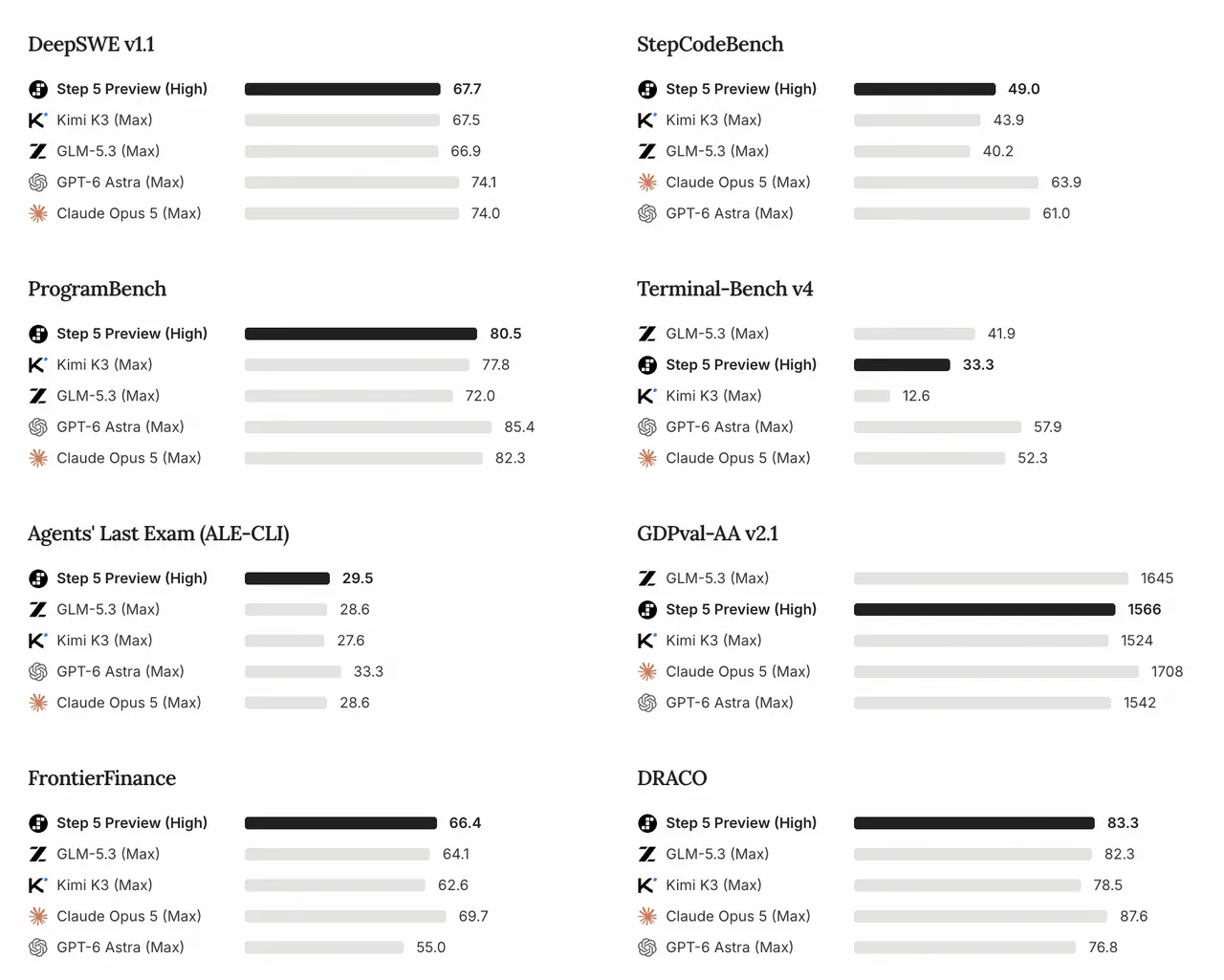
StepFun reports that on ALE-CLI, the financial investment research benchmark FrontierFinance, and the cross-domain deep research benchmark DRACO, it outperforms Kimi K3 and GLM-5.3, trailing only GPT-6 Astra or Claude Opus 5.
Who Should Use It, and Who Should Wait
- Good fit: teams that need private or local deployment, value long context and agent tool use, and are cost-sensitive. BF16 and FP8 weights are already live on Hugging Face and ModelScope; you can get them running first, then decide whether to scale.
- Should wait: users who just want to try conversation can start with the two-week free trial in Tencent WorkBuddy; teams whose business is already tied to the fine-tuned performance of a closed-source model should first run a small-scale comparison on their own tasks.
Final Thoughts
Open-sourcing the weights means the architecture and training design must stand up to more real-world deployment environments, not just leaderboard scores. Parameters and scores are the threshold; whether it can plug into real business workflows is the dividing line