
Three conclusions up front. First, contributing a software copyright as capital is legal — Article 48 of China’s Company Law permits intellectual property as a contribution. Second, to justify a valuation of 1 million RMB for a single copyright, you need roughly 4 to 6 million RMB of annual revenue attributable to it. Below that level, the income approach simply cannot produce the number. Third, and most critically: Article 18, paragraph 2, item 1 of China’s Copyright Law names “computer software” expressly in the list of works whose copyright belongs to the employer. Which means a large number of developers’ registrations were never legally theirs to begin with.
Where the question started
Someone asked a question that looks simple. A limited liability company in Hangzhou carries 1 million RMB of registered capital, all of it subscribed and none of it paid in. China’s revised Company Law requires full payment within five years, and the deadline is a real pressure. The owner has a piece of software they wrote. Can they have it appraised, transfer it to the company, and make the paid-in capital “real”?
The question looks like a financial maneuver. Underneath it sit three layers of law. The first is the form of contribution — whether intellectual property qualifies. The second is the appraisal — how much the asset is worth. The third is the one most people skip: whether the thing is yours at all.
I ran a research pass on this question. Eight dimensions scanned in parallel, 59 sub-agents, 131 findings accumulated, and after an adversarial verification round, 7 survived. More claims were killed than survived. What follows is what held up.
The first layer: what the official guidance says
The methodological anchor is a professional guideline from the China Appraisal Society — Expert Guideline No. 16 for Asset Appraisal: Appraisal of Computer Software Copyright Assets (Zhong Ping Xie [2023] No. 23), issued December 11, 2023.
It offers three methods.
The cost approach: Value = Replacement Cost × (1 − Depreciation Rate). Replacement cost includes direct costs, indirect expenses, reasonable profit, and related taxes. Within direct costs, coding is the core phase — the guideline explicitly mentions using models like COCOMO to estimate it. Depreciation splits into functional and economic.
The income approach: P = Σ[Ft / (1+i)^t], where Ft is the future income for period t, n is the remaining economic life, and i is the discount rate. Expected income can be derived through the incremental income method, the relief-from-royalty method, or the excess earnings method.
The market approach: requires comparable transactions, normally no fewer than three. Public software copyright transactions in China are scarce, so this route is effectively closed.
For the contribution purpose specifically, Article 12, paragraph 2 contains a notable line: where the appraisal conclusion will determine the registered capital, the appraiser “should distinguish and evaluate important software copyright assets item by item, and appraise each separately.” Article 15 adds a warning: software copyright registration in China is a formality review, and “in practice there may be material discrepancies between the registered source code and documentation and the actual software.”
In plain terms: the registration certificate proves nothing. The appraisal is what matters, and the appraisal must rest on real revenue or real cost.
The second layer: the number that decides everything
The three income-approach parameters have real measured ranges in practice.
On the discount rate, several actual 2024–2026 appraisal reports produced values of 15.78%, 17.29%, and 20.81%, built respectively through risk accumulation, CAPM plus an intangible-specific risk premium, and prior appraisal returns. Note these figures sit well above company-level WACC — in the same report, the company’s WACC was only 12.64%.
The royalty rate has official statistics behind it. The China National Intellectual Property Administration’s 2024 Patent Licensing Statistics, published in December 2025, shows that for the software and information technology services sector, licensing based on a percentage of sales had a 2024 median of 3.0%, with a five-year median of 5.0%. One shift worth noting: the software category median was 5.0% in 2023 and fell to 3.0% in 2024.
On the income period, measured cases land between 4.75 and 6 years.
Run those through a sensitivity model:
| Scenario | Attributable annual revenue | Royalty rate | Discount rate | Period | Valuation |
|---|---|---|---|---|---|
| Conservative | 3M | 1.7% | 20.81% | 5 yr | ≈150K |
| Median | 5M | 5% | 17.29% | 5 yr | ≈800K |
| Optimistic | 8M | 6.9% | 15.78% | 6 yr | ≈2.05M |
Working backwards gives a hard rule: to reliably reach a 1 million RMB appraisal value for a single copyright, you need roughly 4 to 6 million RMB of identifiable, attributable annual revenue.
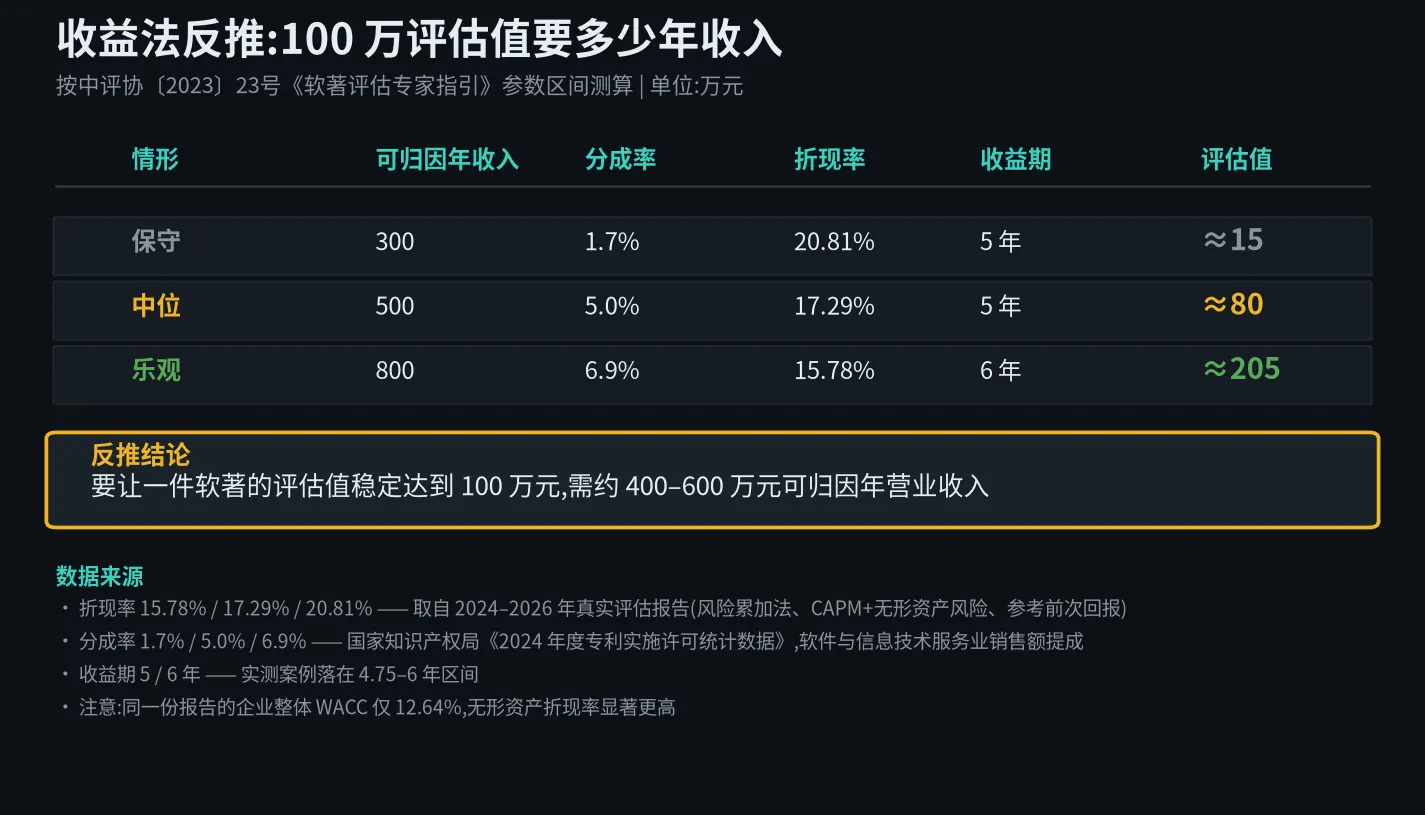
The value of this rule is that it turns the question into a yes-or-no test. Ask first: does this copyright have 4 to 6 million RMB of attributable annual revenue? If yes, the income approach holds. If no, you take the cost approach honestly — and the cost approach’s ceiling is bounded by real man-hour investment.
One counterintuitive point worth recording: the income approach is not necessarily higher than the cost approach. In the software at issue in Beijing First Intermediate Court case (2023) Jing 01 Min Zhong No. 5775, a 2006 cost-approach appraisal produced 10 million, while a 2009 income-approach appraisal produced only 7.55 million. Which method yields more depends on the specific asset.
The third layer: the one that kills the plan
The first two layers are arithmetic. The third is not arithmetic — it is ownership.
Article 18, paragraph 2, item 1 of China’s Copyright Law (2020 amendment) reads:
Works created mainly using the material and technical conditions of a legal person or an unincorporated organization, and for which that legal person or organization bears responsibility — such as engineering design drawings, product design drawings, maps, diagrams, and computer software — constitute special works for hire
For this category, the author retains only the right of attribution; all other copyright belongs to the employer.
Computer software is named expressly. It is not ordinary work for hire; it is the category the statute assigns to the employer outright.
The force of this provision compounds with another fact: copyright registration is a formality review. The registry does not verify that the software exists, that the applicant actually wrote it, or that it has any technical value. Chinese courts are explicit — “copyright ownership cannot be determined solely on the basis of a registration certificate.” The certificate is prima facie evidence, rebuttable.
So registering a copyright in an individual’s name does not change its legal ownership. When courts assess work-for-hire status, they look at a three-part evidentiary chain: whether the work was completed during employment, whether its content relates to the role or business, and whether the author’s conduct indicated it was for the employer’s use. Where an employment contract or agreement stipulates that work-for-hire copyright belongs to the employer, the court applies the agreement directly.
For a structure where “the shareholder is the company’s sole operator,” all three elements are almost always satisfied: the timing falls within the company’s existence, the content is the company’s business, and the conduct was for the company’s use.
The route the courts have closed
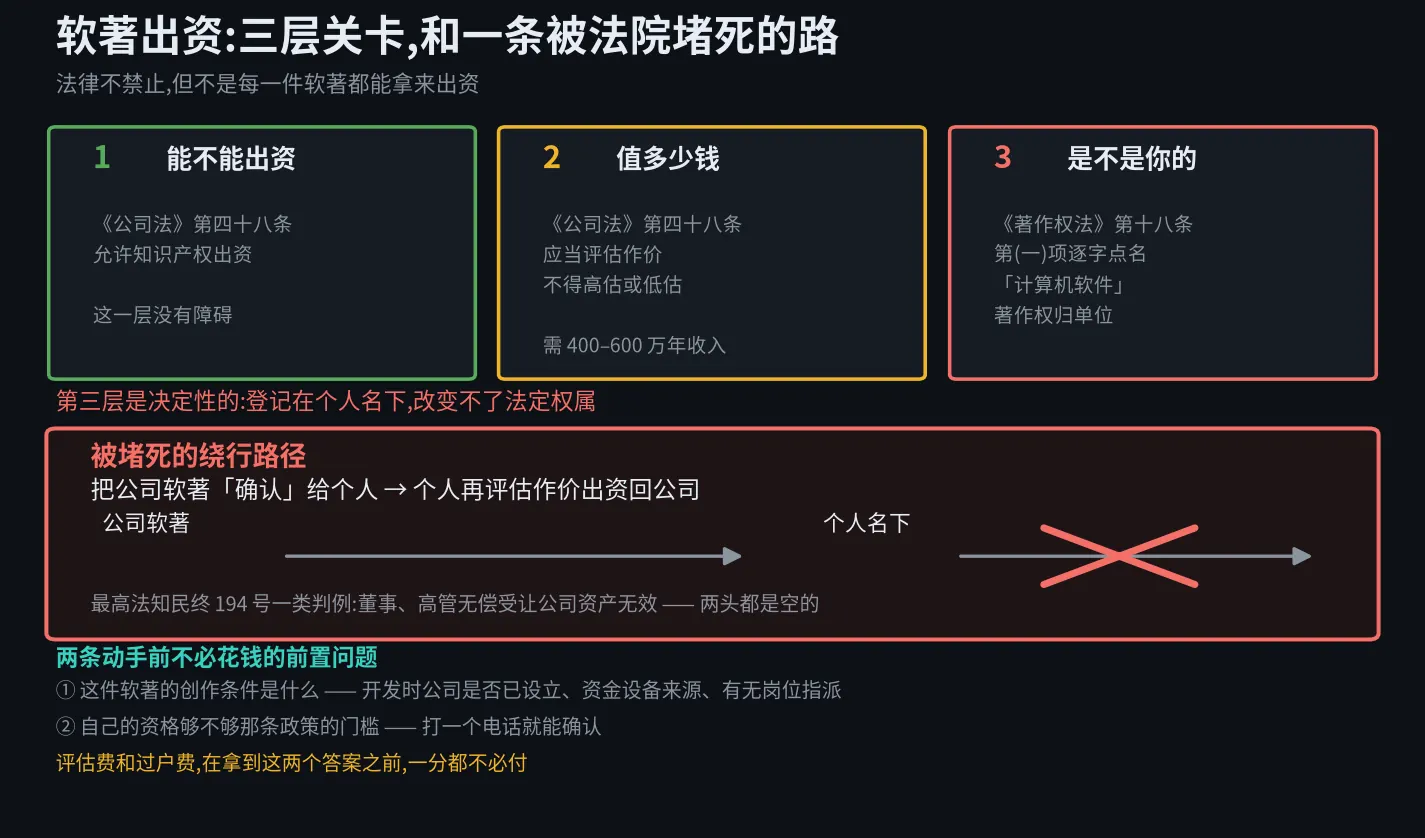
At this point a natural reaction appears: what if I first “confirm” the company’s copyright to myself as an individual, then contribute it back to the company at an appraised value?
The courts have ruled on that route. Cases such as the Supreme People’s Court’s Zhi Min Zhong No. 194 have established the rule: a director or senior manager’s receipt of company assets without consideration is invalid. One line from the research captures it precisely — “transferring from the company to an individual at zero or nominal consideration, then appraising and contributing it back, will be found to harm the company’s interests.”
The logical flaw is straightforward. If the copyright was work for hire, its ownership belonged to the company from the moment of creation. “Confirming it to the individual” confirms a right that never existed in the individual’s name. “Contributing it back at value” sells the company’s asset to the company. Both ends are empty — and the appraisal act in the middle becomes evidence of fabricated contribution.
Three red lines
The compliance section of the research draws the boundary clearly. This is not a question of whether you get caught; it is written into the statutes.
First, Article 48 of the Company Law: “Non-monetary property contributed as capital shall be appraised for value and verified; it shall not be overvalued or undervalued.” Articles 49 and 50 follow: a shareholder who under-contributes must make up the difference and compensate losses; where the actual value of non-monetary property at incorporation is significantly below the amount stated in the articles of association, that shareholder makes up the shortfall.
Second, the Asset Appraisal Law imposes liability in both directions. An appraiser who signs a false report is suspended for two to five years, five to ten in serious cases, and barred for life if a crime is constituted; a firm issuing a false report is suspended six months to a year, with license revocation in serious cases. But many clients miss the other half, Article 52: where the client colludes with or instigates an appraisal firm to issue a false report, it is ordered to correct; refusal brings a fine of 100,000 to 500,000 RMB, and criminal liability where a crime is constituted. There is no arrangement in which “the appraisal firm takes the blame.” The client carries independent liability.
Third, Criminal Law Article 229 includes a prosecution threshold: fabricated amounts of 1 million RMB or more constituting 30% or more of the actual amount. Note that figure. It sits exactly at the scale of a 1 million RMB registered capital.
If the purpose of a fabricated appraisal is to obtain government funding, fraud charges stack on top. Zhejiang’s thresholds: 6,000 RMB and above is “relatively large,” 100,000 and above is “huge,” and 500,000 and above is “especially huge” — corresponding to ten years or more, up to life imprisonment.
The research collected real cases: five shell companies defrauding technology support funds over three years, with the principal sentenced to fifteen years; twenty-two shell companies registered to defraud startup subsidies, with the principal sentenced to eleven years.
One commonly misstated point needs correcting: the crimes of false capital contribution and capital withdrawal, under the 2014 legislative interpretation of the NPC Standing Committee, apply only to companies subject to the paid-in capital registration system; ordinary subscription-system companies are outside those two offenses. But this does not mean the subscription system grants immunity — the civil make-up obligations under Articles 49 and 50 remain.
A different track: how policies differ on capital structure
If the aim is to make paid-in capital real while perhaps also qualifying for a policy, then how different policies treat capital structure becomes the decisive variable.
Route one: returnee entrepreneurship funding (currently in a gap period)
Its entrepreneurship-track eligibility text reads: the applicant’s own funds (including technology contribution) must account for 30% or more of registered capital, and “enterprise funds (including paid-in capital and capital reserves) actually in place must be no less than 1 million RMB.” Those two words — actually in place — are decisive: a company whose 1 million is entirely subscribed does not qualify. And even if it did, the program also provides that “the disbursement shall not exceed the amount of enterprise funds already in place.”
But the verification turned up something more consequential: this route may currently be unavailable at all.
The governing document, the Hangzhou Future: Three-Year Action Plan for College Student Innovation and Entrepreneurship (2023–2025) (Hang Zheng Ban Han [2023] No. 45), expired on December 31, 2025. The successor 2026–2028 version exists only as a draft for public comment (comment period December 22, 2025 to January 21, 2026), and as of September 2026 no formally issued version or new document number could be located. The draft still contains the line “Hang Zheng Ban Han [2023] No. 45 is simultaneously repealed,” but the effective date field is left blank.
The practical result: application windows in past years all fell in the first half — 2024 closed April 26, 2025 closed June 20. For 2026, no application notice has appeared at all.
In other words, the policy is in a gap period. This is not “the window was missed” — it is “the new window has not opened.”
One widely circulated figure needs correcting: the four tiers described as “special project 1–5M / key project 1M / excellent project 500K / startup project 30–200K” come from a 2013 document, Hang Wei Ban Fa [2013] No. 84, and represent an obsolete standard. The 2023–2025 version had already changed the wording to “general projects 30,000–1M RMB, special projects up to 5M RMB”; the 2026–2028 draft changes it again to “200,000–1M RMB, with special projects up to 5M RMB.” The floor rose from 30,000 to 200,000. Running the numbers off the old tiers will produce the wrong answer.
Route two: AI+OPC (no capital threshold)
Hangzhou’s 2026 “AI+OPC” initiatives. OPC means one-person company. The Municipal Market Supervision Bureau’s Several Measures to Support One-Person Company (OPC) Innovation and Entrepreneurship (Hang Shi Jian [2026] No. 43) states in Article 12: “It is strictly prohibited to set office area, headcount, registered capital, or similar as admission or subsidy thresholds.” The companion provincial group standard, Terminology for Artificial Intelligence OPC, defines eligibility as: led and controlled by one core natural person, generally no more than ten employees, with AI technology research, development, application, or services as the main business.
No sole-ownership requirement. No registered capital threshold. No paid-in requirement. No restriction on incorporation date.
District-level rules are more concrete. Binjiang District’s Ten Measures for “AI+OPC” Startup Protection (Hang Gao Xin [2026] No. 4) includes Token vouchers covering up to 60% with a per-company annual cap of 1 million RMB, up to 3 million RMB annually for agent platform procurement, and a 1 billion RMB district-level special industry fund. Yuhang, Shangcheng, and Xiaoshan each have computing-power vouchers or startup guarantee loans. Most subsidies require admission to a recognized OPC community as a precondition.
One caveat: the municipal Action Plan for Building a National “AI+OPC” Entrepreneurship Highland (2026–2028) and its 12 companion measures could not be located in an officially issued full text, document number, or government gazette version during the research — only in secondhand reporting. The “computing-power vouchers up to 10 million RMB per year” figure in that reporting is also doubtful; the currently verifiable first-hand provision caps vouchers at 30% of computing contract cost and 8 million RMB per company annually. District-level documents are the layer with document numbers, full text, and executability — which is why choosing where to register matters more than chasing municipal-level headline numbers.
On method
The structure of this research matters to how much the conclusions can be trusted.
Eight dimensions scanned in parallel: official guidelines, empirical cases, income-approach parameters, compliance red lines, registration practice, high-value directions, asset inventory, and policy linkage. Each dimension was scanned once, then deepened to fill in sources and numbers.
Then came adversarial verification. Fourteen core claims rated high or medium confidence each received three independent perspectives instructed to try to refute them: one checking whether figures and sources were accurate and whether “subscribed” and “paid-in” had been conflated; one checking legal compliance, whether the claim implied inflated appraisal; one checking commercial reality, whether it overestimated feasibility. Two refutations out of three killed the claim.
Seven survived. Seven were killed or required correction. Among the casualties: using Expert Guideline No. 14’s valuation of an early-stage technology company as a whole to “stack onto” the copyright contribution (No. 14’s stated appraisal purposes do not include contribution at all — using it that way is precisely how one slides toward fabricated contribution); treating “actual value below 70% of the subscribed amount” as a threshold for finding under-contribution (there is no quantitative standard in law; that was one firm’s individual view); and a claim citing an “FDE model” as a moat (tracing found the term appears nowhere in the source report).
A final completeness critique hunted for gaps. Its first finding was that the report’s founding assumption had never been verified — it assumed throughout that the subject met the “high-level returnee” eligibility definition without ever checking. The denser finding came in the registration-practice dimension: that computer software is expressly named in Copyright Law Article 18 matters more than every discussion of whether a technology contribution counts as paid-in.
One correction is worth recording: the draft stated Hangzhou’s software development rate as 27,748 RMB per person-month. Verification found that figure belongs to Guangzhou; Hangzhou’s actual rate is 28,813 RMB. That number feeds directly into the cost approach and would have depressed the entire conclusion.
Last
Back to the original question. Contributing software copyright as capital has been legally possible for three decades, but whether it works turns on two prior questions that have nothing to do with appraisal.
First, what were the creation conditions — had the company been incorporated, where did the funding and equipment come from, was there a work assignment? Only software that can be shown to be independent creation outside the company is personal property available for contribution.
Second, whether your own qualifications meet the threshold of the policy you are targeting.
Both come before any appraisal, and neither costs money — the first is listing each asset’s development timeline and funding source, the second is making a phone call.
As for appraisal and transfer fees: not a cent needs to be paid until those two questions are answered.
One more note. During the research I came across a risk advisory issued in August 2024 by the Shenzhen Asset Appraisal Association, naming a category of business it instructed firms to “undertake with caution” — buying copyrights or patents cheaply, then appraising them at hundreds or thousands of times the purchase price, and contributing them to complete paid-in capital. The advisory also lists six items that must be verified for contribution purposes; the first is “authenticity and legality,” the fourth is “ability to generate continuous, identifiable economic benefit.”
Put those two sentences together, and you have the entire boundary of this question.