
Stronger CoCo, and the Shift of Cost Governance Forward
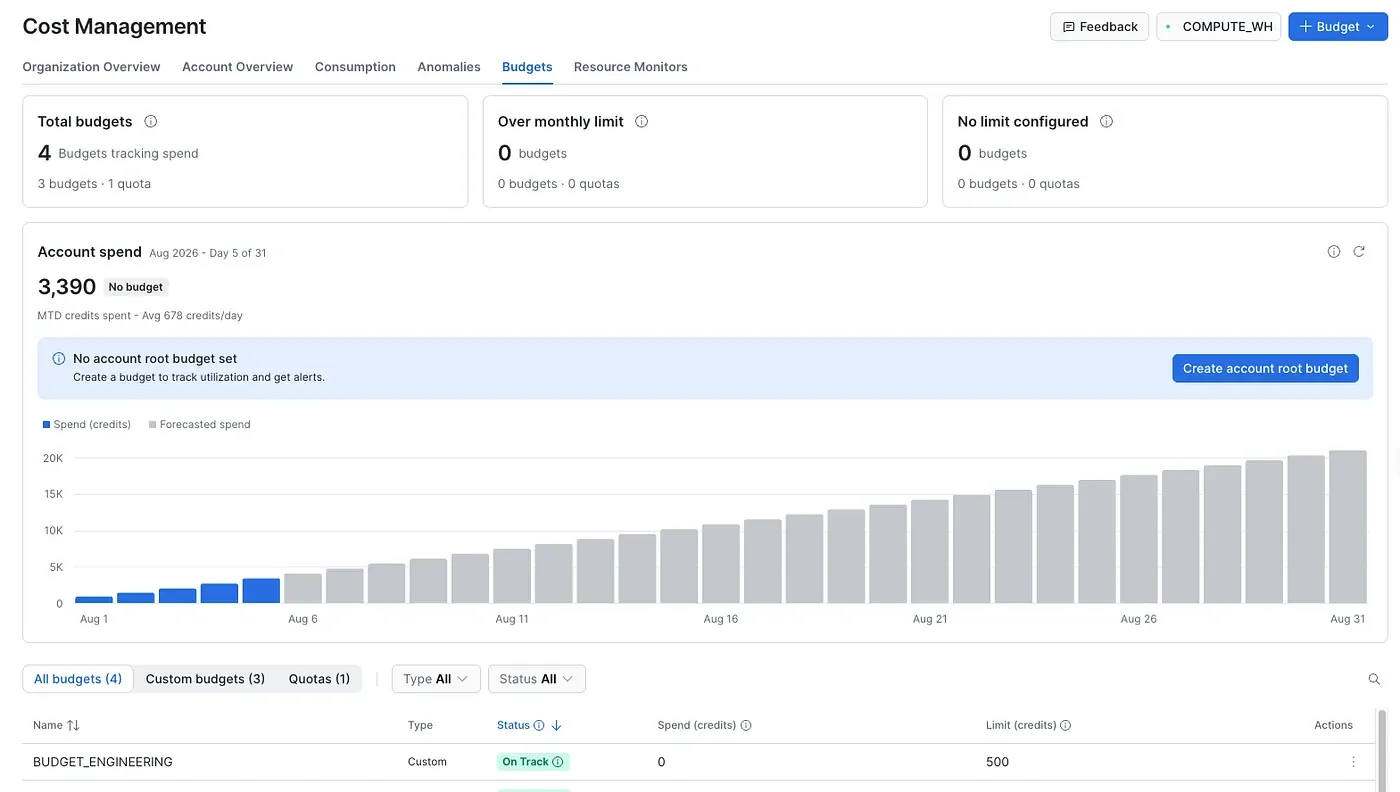
Snowflake CoCo is pushing natural-language interaction into real workflow territory: users can have it generate and run SQL, execute multi-step tasks, and call large language models at every turn. The key shift is that agent-like sessions are no longer just “Q&A” — they continuously consume tokens and translate into credits. If an organization enables the capability without establishing governance, costs can escalate quickly alongside usage frequency, model choices, and workflow complexity.
Snowflake’s approach is straightforward: first see where the costs come from, then optimize default behaviors, and finally set hard boundaries for high-risk scenarios. The relevant capabilities can be managed via SQL, the Snowsight admin interface, or even directly within a CoCo session.
See First: Historical Views and Natural-Language Queries
The first step in cost governance is attribution. CoCo writes usage records from different entry points into the ACCOUNT_USAGE view, covering CLI, Snowsight, and Desktop. Each record corresponds to a single request, including TOKEN_CREDITS, total TOKENS, and a breakdown of input, output, and cache tokens by model; USER_ID, USER_TAGS, and METADATA can be used to allocate costs by user, department tag, or execution region. Historical data is retained for up to 365 days, sufficient for both short-term troubleshooting and long-term trend analysis.
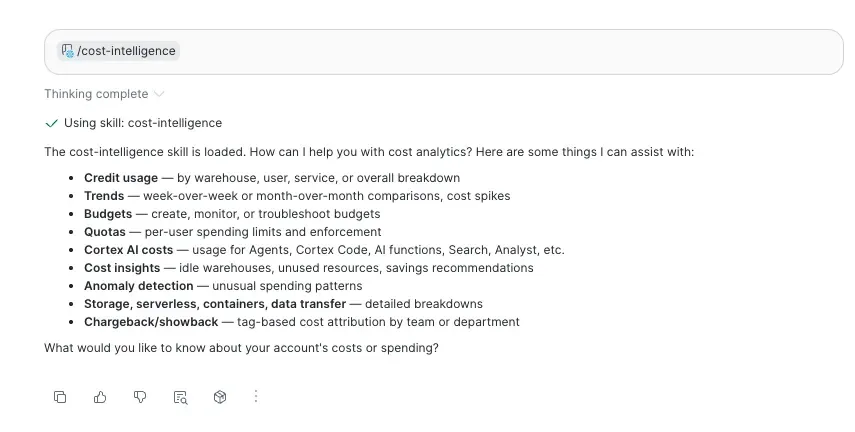
For teams that don’t want to repeatedly write SQL by hand, CoCo includes a built-in /cost-intelligence skill that lets you query this usage history in natural language. You can ask things like “Which models incurred the highest costs in CLI this month” or “Break down spending by department tag,” and it can also help create quota and notification thresholds. The key insight here is bringing cost analysis back to where the usage actually happens, lowering the barrier to governance.
Key data points include:
- Basis of measurement: token consumption is converted into credits;
- Attribution fields: user, tags, metadata, and model-level token breakdowns;
- Historical window: ACCOUNT_USAGE views retain data for up to 365 days.
Set Boundaries: Daily Limits and Cross-Domain Quotas
If the goal is to quickly prevent any single user from overusing a particular entry point, administrators can set a daily estimated credit ceiling per surface. CoCo CLI, CoCo Desktop, and CoCo within Snowsight each map to a separate account-level parameter, with the option to override at the user level. A parameter value of -1 means no restriction, 0 means fully disabled, and a positive value means access is blocked once the rolling 24-hour estimated usage exceeds the threshold, until usage drops back below it.
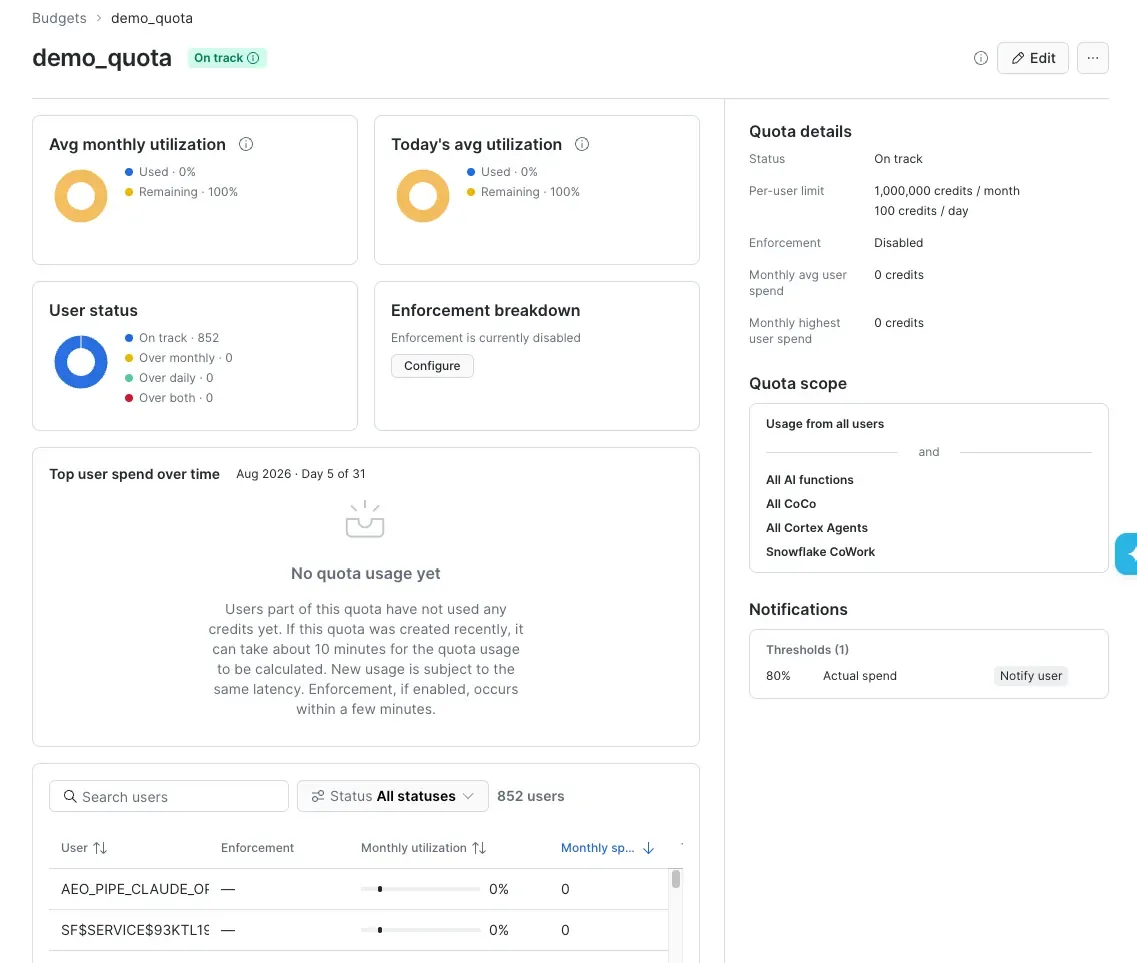
A more systematic approach is the per-user quota. Currently in public preview, it lets you set a monthly limit and an optional daily limit per user, with block enforcement enabled. Unlike a budget that only sends alerts, a quota can automatically block new AI requests once the limit is reached. It covers AI functions, Cortex Agents, Snowflake CoWork, and CoCo — but a single quota tracks only one category at a time, either warehouse compute or AI domains; the two billing systems cannot be mixed. Quota periods follow UTC calendar days and months, and blocks are automatically lifted as a new period begins.
To clarify terminology, a quota is best understood as a usage limit with mandatory enforcement, while AI domains refer to the resource boundaries within Snowflake that are tracked and controlled along AI-service dimensions.
Alerts and Model Governance: Don’t Route Every Request to the Most Expensive Model

Budgets work more like an early-warning system: they compare actual credit usage for the current month against a set ceiling and project, based on time-series trends, whether you’re likely to overshoot. Account budgets apply to the entire account, while custom budgets can focus on object groups or tags to target specific teams or projects; for AI spend, the AI_SERVICES service type covers Snowflake CoWork and Cortex Agent. Notifications can be sent to email, Amazon SNS, Azure Event Grid, Google Cloud Pub/Sub, or routed via webhook into Slack, Microsoft Teams, and PagerDuty.
However, budget data refreshes on a schedule that can lag up to 6.5 hours. Switching to hourly refreshes lowers that latency but increases the budget’s own computation cost by 12×. Therefore, budgets are suited for alerts, while quotas are suited for hard enforcement.
Another high-leverage governance lever is model access control. Snowflake Cortex currently supports both role-based RBAC and an account-level allowlist; if either permits access, the user can invoke the corresponding model. RBAC authorizes through model objects and application roles and offers finer granularity — it is also the direction Snowflake is moving toward. The legacy CORTEX_MODELS_ALLOWLIST is being phased out: as of August 2026, it can only be set to None, and by November 2026 it will be fully removed. Organizations building governance today should design primarily around RBAC.
Automated Guardrails and an Implementation Roadmap
For AI Functions, you can also combine CORTEX_AI_FUNCTIONS_USAGE_HISTORY, Snowflake alerts, and tasks to build automated guardrails: account-level monthly spend alerts, user-level monthly spend caps, and runaway query detection with auto-cancellation. A runaway query is one that runs anomalously long and rapidly consumes resources. Note that cancelling a query can only prevent further costs from accumulating — it cannot recover credits already consumed.
Overall, Snowflake is providing CoCo with a治理 stack that strengthens progressively across three layers — “see, shape, cap”: usage history and /cost-intelligence provide visibility, model access control reshapes the default cost structure, and daily limits, quotas, budgets, and automated tasks handle enforcement and early warning. A pragmatic rollout path is to first establish a cost baseline, then tighten model permissions, and finally layer on limits and quotas as the team scales. As enterprise agents move from pilot to everyday production, cost governance will transition from a back-office finance concern into a foundational capability of the AI platform engineering practice.