SiliconFlow solution director Tang Anbo used the 19th State-Owned Enterprise CIO and Digital Technology Subsidiary Summit (autumn 2026, hosted by D1Net) to reframe large-model deployment as a cost-per-token problem rather than a GPU-count problem. No product launch was involved: the source is a conference talk, with no version numbers, public price list or open weights disclosed.
- Occasion: 19th SOE CIO summit, autumn 2026
- Speaker: Tang Anbo, solution director at SiliconFlow
- Core formula: token productivity = capacity × utilization × delivery quality
- Architecture: four decoupled layers — model gateway, model service platform, high-performance inference framework, compute scheduling
- Model coverage: nearly 100 models adapted
- Silicon: deployment data on Huawei Cloud, MetaX and Moore Threads
- Cost: one SOE group cut Qwen cost from over 100 yuan to under 10 yuan per million tokens
- Published: LeiFeng.com, October 23, 2026
Four layers, four owners
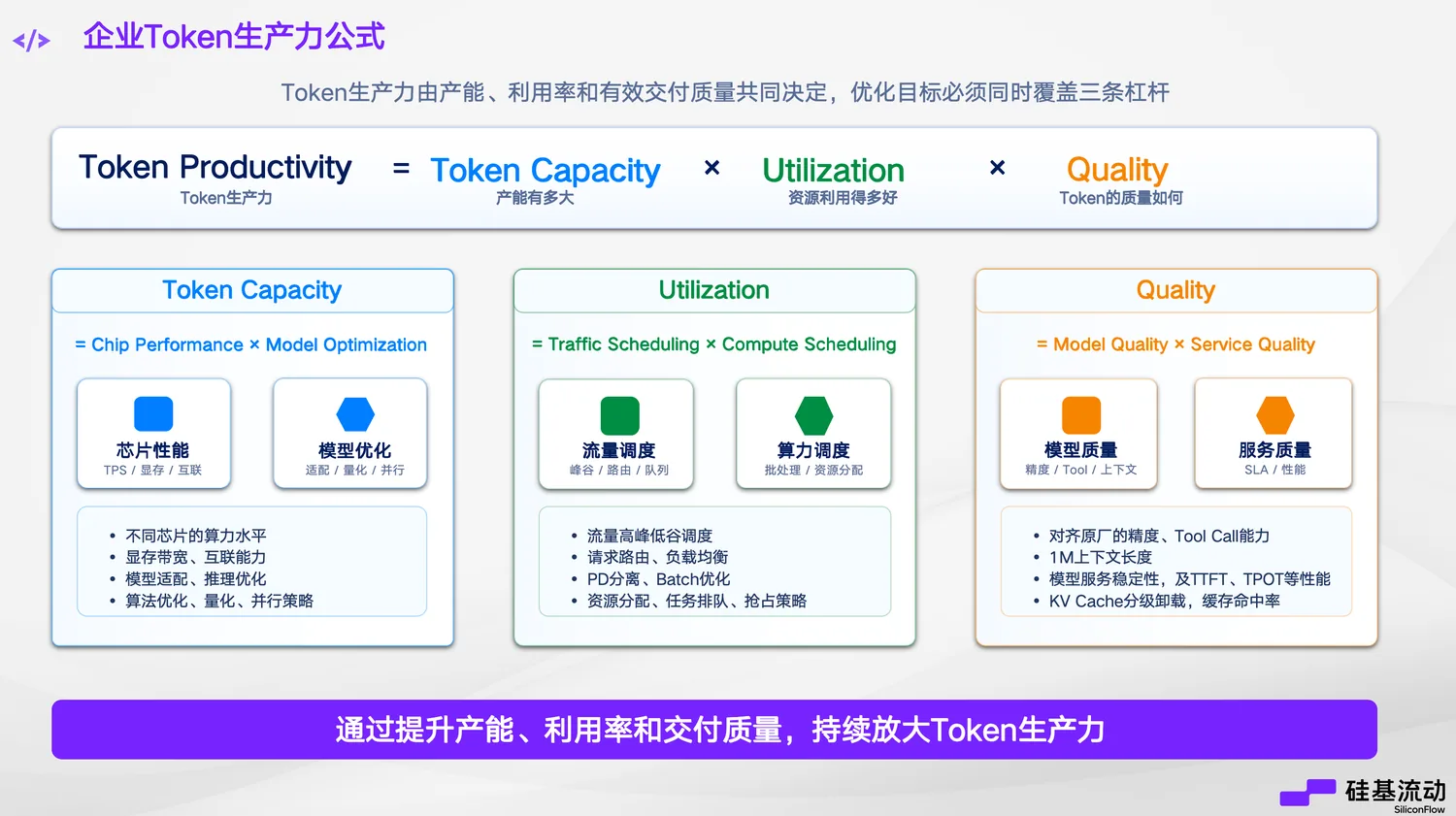
Tang frames enterprise pressure as threefold: model architectures and versions iterate too fast, business units demand too many different models, and costs still have to come down. SiliconFlow positions itself as the conversion layer between compute and tokens — pooling hardware, then using a self-developed inference engine to make models run faster. It builds “token factories” on its public cloud and, separately, inside state-owned enterprises.
That layer is split four ways. The model gateway faces users directly, handling metering, billing and authentication for every call, plus routing: requests go to different model services based on latency requirements, or get scheduled on performance-first or cost-first policies. The model service platform manages model onboarding, takedown and a model repository, freezing deployment best practices so enterprises can launch a model in one step instead of re-adapting each time. The inference framework is co-optimized with chip vendors through in-house operator and communication libraries. Compute scheduling handles elasticity: conservative estimates overload quickly, while provisioning for daytime peaks wastes capacity, so autoscaling is paired with operational levers such as time-of-day internal pricing that pushes some workloads into discounted night hours. Decoupling also avoids rip-and-replace, since existing in-house platforms can be connected capability by capability.
The silicon numbers back the architecture:
- With Huawei Cloud, an industry-first DeepSeek R1/V3 token service on domestic chips, plus optimized inference for CloudMatrix super-node clusters, reaching over 1,920 tokens/s decode throughput per card on DeepSeek-R1
- A world-first commercial Kimi-K2 deployment on a MetaX Xiyun C550 cluster
- DeepSeek-V3 on Moore Threads MTT S5000 at over 4,000 tokens/s prefill and over 1,000 tokens/s decode per card
Prefill is the phase that reads the whole input at once; decode generates output token by token. Because they stress hardware differently, they are often split apart (PD disaggregation). KV cache tiered offloading stores attention caches in layers to avoid recomputation.
The case: same machines, bigger models
A state-owned enterprise group started with roughly 50 machines and a simple model: subsidiaries applied for boxes and deployed whatever model they needed. In practice, 40 to 50 model instances ran on that pool with low utilization — one unit holding a machine for a single model, others busy by day and idle at night, others used only a few days a week.
The rework did two things: unify the models, unify the compute. Duplicate models were consolidated to about ten, and machine-level allocation gave way to serverless model services, with all business units calling a shared API and no longer caring which box hosted what.
The counterintuitive part: on the same roughly 50 machines, the group not only kept its small models but freed enough capacity to deploy large-parameter models such as GLM-5.2 and DeepSeek-V4-Flash-0731 — models it previously had no conditions to run. Tang argues the ceiling on model intelligence sets the ceiling on application innovation, so more scenarios moved from unusable to usable.
| Dimension | Before | After |
|---|---|---|
| Machines | ~50 | ~50 |
| Model instances | 40–50 | ~10 |
| Allocation | Apply per machine | Serverless model service, shared API |
| Model range | Mostly existing small models | Adds GLM-5.2, DeepSeek-V4-Flash-0731 and other large models |
| Cost per million tokens (Qwen) | Over 100 yuan | Under 10 yuan |
| Same-model benchmark | Baseline | 40%–100% gain |
| Output speed | — | Above 30 tokens/s from single to higher concurrency |
Cost fell by more than 90%, but Tang stresses the bigger win was unlocking scenarios; 30 tokens/s is the baseline for acceptable coding experience.
Half the bill sits in the application layer
As agents scale, a new gap opens between application and infrastructure. Developers once needed some grasp of indexes and SQL tuning; now application teams may not understand inference and caching behavior, which directly hits efficiency.
In coding, repositories evolve for years, with daily commits and builds. How that code is packaged into context matters enormously. Poorly built context misses the cache on every request, recomputing hundreds of thousands of input tokens; well built, roughly 90% of content may hit cache. In one example, a system supported 100 concurrent requests without cache hits and 200 with them — no extra hardware, just less recomputation.
A second lever is DevOps. Daytime is the compute peak and coding inputs are long, so generating caches on demand piles load onto the worst hours. Preprocessing repositories during nightly builds and writing results into KV cache ahead of time shifts that work off-peak. That capability still depends on joint work with the scenario owners.
Practical advice
- Start now if: you run dozens of inference machines split among subsidiaries that each apply for hardware. The waste is usually duplicate instances and time-of-day mismatch rather than a chip shortage; model consolidation plus a unified API gateway is a low-risk first step.
- Wait if: your volume is small and you run one or two models. Four-layer scheduling and time-of-day pricing pay off at scale, and an early scheduling layer adds operational surface; fix context construction and cache hit rate first.
Final thoughts
The value of the talk is not the architecture diagram but the shift from buying GPUs to three auditable multipliers: capacity, utilization and delivery quality. Multi-vendor domestic silicon data shows the optimization headroom is real, and a case that keeps 50 machines while cutting cost by an order of magnitude suggests most enterprises earn their first returns from existing assets rather than new purchases. The context and DevOps half of the bill is still exploratory, and whether it standardizes will decide where the next round of ROI comes from.