
A funding round where the customer becomes a shareholder
The Bengaluru-based Indian startup Scimplify has closed a $25 million strategic funding round to use AI to produce specialty chemicals and critical materials, moving into supply segments long concentrated in China and a handful of other countries.
- Funding amount: $25 million, all equity, led by Hitachi Ventures
- New investors: its customers Germany’s Henkel and U.S.-based Teknor Apex; existing investors Accel India, Bertelsmann India Investments, Omnivore, and 3one4 Capital participated
- Valuation: $250 million post-money, according to a person familiar with the matter; the company declined to disclose its valuation
- Total equity funding: $80 million, according to the company
- Use of funds: about $7.5 million for U.S. expansion, including building a manufacturing network, and another $2 million to continue developing its AI platform Scinode; co-founder Sachin Santhosh said the allocation may change as plans evolve
- Production footprint: about 90% of production is currently in India, and the company plans to extend its production network to the U.S. and Japan over the next year
Notably, this round is smaller than the previous one but carries a higher valuation:
| Metric | March 2025 Series B | This round |
|---|---|---|
| Funding amount | $40 million | $25 million |
| Post-money valuation | $150 million | $250 million (according to a person familiar with the matter) |
| Total equity funding | — | $80 million |
Scinode and 500 factories: compressing 12–18 months into 2 months

Founded in 2023, Scimplify does not take on building plants itself: after receiving an order, it first develops the chemical manufacturing process at R&D facilities in Bengaluru and Hyderabad, then transfers it to partner factories for commercial production, with in-house scientists and engineers overseeing the work. The network covers more than 500 manufacturing facilities.
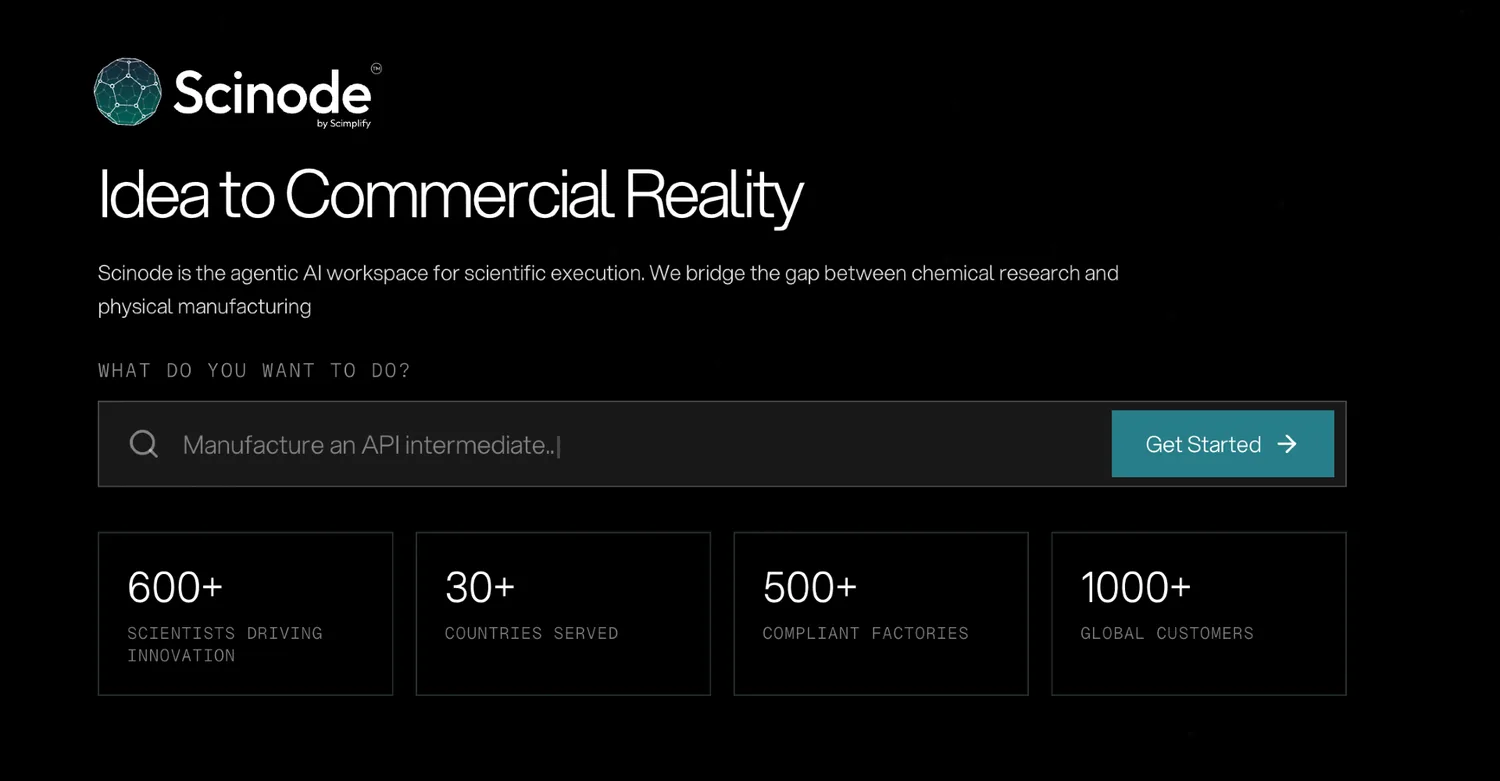
Coordinating this process is its in-house AI platform, Scinode. According to Santhosh, the platform equips different functions with specialized AI agents (AI programs capable of autonomously completing a certain type of task), for R&D, manufacturing, and quality control respectively, working backward from customer requirements to determine what needs to be done.
The most straightforward selling point is speed: from receiving a customer request to delivering finished material, Scimplify has taken as little as two months on some projects, whereas such work typically takes 12 to 18 months. The company says it has served more than 1,000 customers, with products delivered to more than 40 countries; its customers include Japanese electronics maker TDK, German chemical group BASF, and Hitachi. Santhosh cited a TDK project as an example of the speedup but said the specific timeline varies by project.
In terms of material categories, it is extracting tungsten derivatives from waste, providing an alternative source for a material whose supply is highly concentrated in China, while also building a position in rare earths—another category where global supply chains depend heavily on China.
A striking contrast: overseas revenue rose from under 5% to more than half in 18 months
The shift in revenue mix is more telling than the funding numbers:
- Overall annualized revenue (ARR, current revenue annualized over a year) is about $200 million, triple the level a year ago, and the company aims to reach $400 million within a year
- U.S. annualized revenue is about $60 million, six times the $10 million of a year ago, and currently accounts for about 30% of its business
- Customers outside India contribute more than half of revenue, compared with less than 5% about 18 months ago
- Energy, electronics, and defense now account for about 45% to 50% of revenue, compared with less than 15% a year ago
- The company says it has been EBITDA-positive (earnings before interest, taxes, depreciation, and amortization) for two consecutive months and expects to be profitable after tax this month
The fact that an Indian company’s main revenue source shifted from domestic to overseas in just over a year says more about how urgent the procurement wave aimed at “reducing dependence on China” is than a $250 million valuation does. The jump in the share of energy, electronics, and defense corresponds to two drivers: AI is pushing up material demand for electronics and energy infrastructure, while ongoing wars are driving defense procurement.
Who should pay attention, and who should wait
- Worth watching: manufacturers looking for a second source for categories such as specialty chemicals, tungsten, and rare earths, as well as procurement teams in electronics and defense supply chains—especially teams that treat “time from demand to mass production” as a core metric. What it sells is a combination of process development and a contract manufacturing network, not a single-material catalog.
- Can wait: customers that need large-scale, long-term, stable supply. About 90% of production is still in India, and production networks in the U.S. and Japan are still planned; whether “two-month delivery” can be replicated from individual projects to a broader range of categories also needs time to verify. In addition, the company declined to disclose its valuation, and the $250 million figure comes from a single person familiar with the matter, so it should not be treated as established fact.
Final thoughts
At its core, Scimplify hands the slow work of materials process development to AI agents for orchestration, with external manufacturing capacity executing it. It proves that “orchestration capability” can be valuable, not that AI has created new materials. Reconfiguring supply