TL;DR:“RSS aggregation → processing → social distribution”—no single open-source project handles the entire pipeline, but each layer has mature tools. The combination closest to my LynxPipe’s full shape is RSSHub (sources) + Huginn/n8n (processing) + Postiz (distribution), with a combined star count exceeding 280K. Here’s the full research: each project’s star count (verified via GitHub API on 2026-08-22), RSS capabilities, and supported social channels.
Background: What Is LynxPipe
My self-hosted content pipeline hub. The chain: 12 RSS sources fetched → LLM reviewed/rewritten → Hugo static site deployed → WeChat Official Account/TG distributed, with token-bucket rate limiting, bilingual sync, and seen-dedup. Cron runs three shifts daily at 9/15/21. I’ve previously written about its architecture migration.
I’ve always wondered: does anything like this already exist in the open-source world? If so, what’s worth learning from, and which parts of what I built were genuinely justified? That’s what prompted this post.
I’ve organized the research targets into four layers—also the structure of this article:
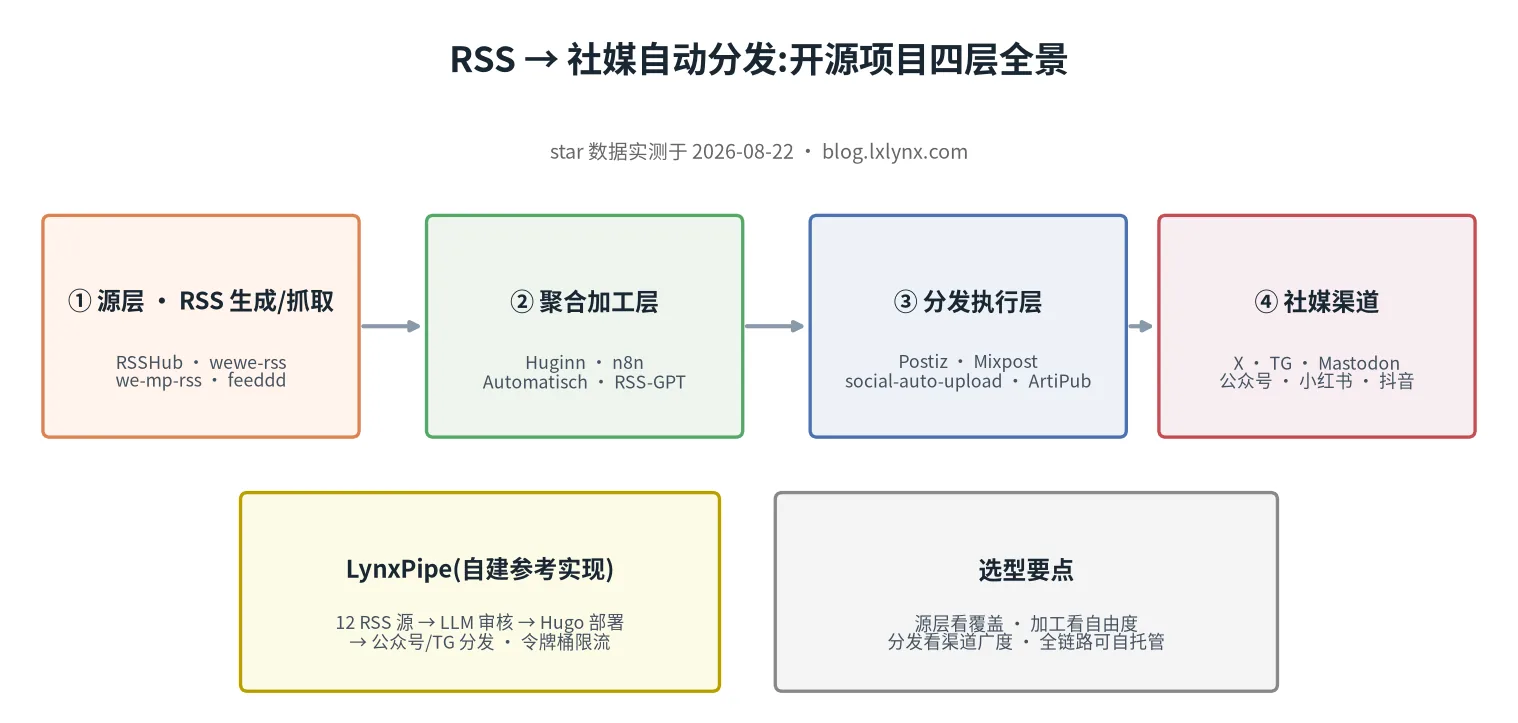
- Source layer: Turning things without RSS into RSS (or fetching directly)
- Aggregation & processing layer: Subscribing, filtering, AI processing
- Distribution layer: Pushing content to various social platforms
- Social channels: The publishing-difficulty landscape of each platform
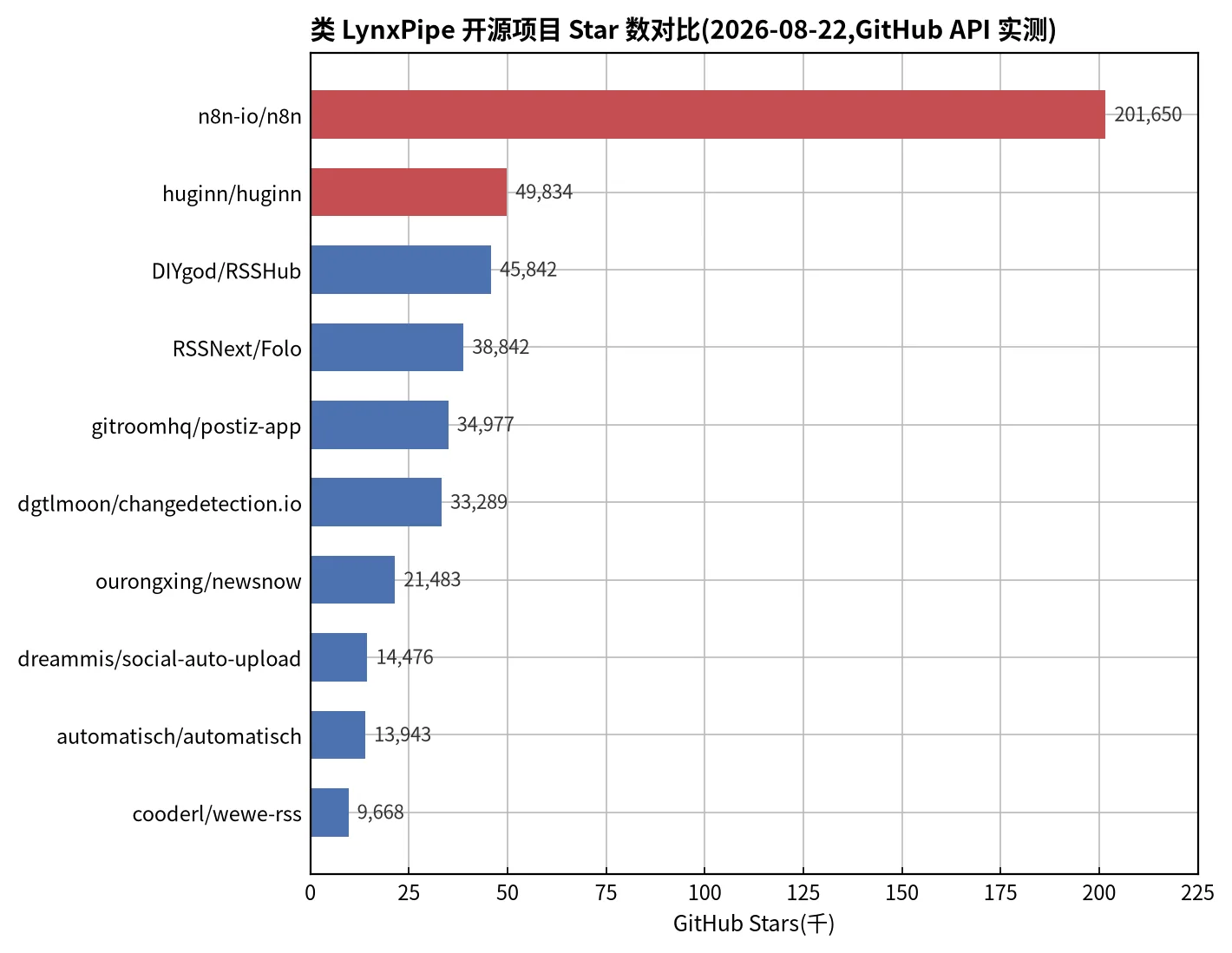
Star counts: all verified today via the GitHub API (gh api repos/<owner>/<repo>), not copied from READMEs or third-party leaderboards. Freshness guaranteed.
Source Layer: Turning Everything Into RSS
The consensus in this layer is clear: the gap in the RSS ecosystem is Chinese platforms and SPA websites, and the projects filling that gap are themselves major projects.
DIYgod/RSSHub — 45,842 ⭐
The undisputed king of this space, with the motto “Everything is RSSible.” 4,000+ routes convert services that don’t offer RSS—Weibo, Bilibili, Zhihu, Douban, NetEase Cloud Music—into standard feeds. The work my vendor_watch does with Playwright rendering for Z.ai/Anthropic blogs, RSSHub has made into a public good via community routes.
- RSS capability: Generation (4,000+ routes, the most comprehensive coverage of the Chinese internet)
- Distribution capability: None, source layer only
- Takeaway for me: My 12 fixed sources are all foreign media that already have RSS, so I don’t use RSSHub; but if I ever need to monitor Weibo/Bilibili dynamics, self-hosting an RSSHub instance is the shortest path
cooderl/wewe-rss — 9,668 ⭐
WeChat Official Account to RSS, using a clever approach: pulling articles via the WeRead (微信读书) API, with self-hosting support. WeChat Official Accounts are one of the most closed content ecosystems on the internet, and this project provides a stable—if unofficial—gateway.
- RSS capability: Generation (WeChat Official Accounts only)
- Risk: Relies on the WeRead API, an unofficial channel with failure risk
rachelos/we-mp-rss — 4,366 ⭐
A similar project with more features: converts Official Account articles to Markdown/PDF, scheduled updates, OPML export. Pick one of these two; we-mp-rss is heavier on “subscription management.”
feeddd/feeds — 2,098 ⭐
Free WeChat RSS, with a pitch of “extendable to any app”—not just Official Accounts, but content sources from other apps too.
Summary
Every project in this layer follows a “reverse-engineer + generate” approach; none do distribution. Chinese-platform RSS-ification is already quite mature (RSSHub alone covers most of it). No need to reinvent the wheel here.
Aggregation & Processing Layer: LynxPipe’s True Peers
huginn/huginn — 49,834 ⭐
A veteran agent system, YC-backed, running since 2013. Its core concept is an “Agents network”: RSS Agent subscribes to sources → Filter/Transform Agent processes → Twitter/Telegram Publisher Agent pushes out. This is conceptually the closest project to LynxPipe—a data-flow pipeline with conditional triggers and multi-destination output.
- RSS capability: Consumption (RssAgent) + Generation (SiteAgent scrapes web pages into RSS)
- Distribution channels: 20+ built-in agents including Twitter/X, Telegram, Email, Slack, Webhook
- Shortcomings: Written in Ruby, UI aesthetics stuck in the last decade; no built-in LLM processing (you write a WebsiteAgent to call APIs yourself); poor mobile experience
- Takeaway for me: My “LLM review + seen dedup + per-channel rate limiting” logic maps to a combination of FilterAgent + memory Agent in Huginn. It validates the soundness of my pipeline, but also shows that complex logic in a pure-configuration agent system doesn’t save you from writing code
n8n-io/n8n — 201,650 ⭐
The star champion of the entire list—but to be clear: it’s a general-purpose workflow automation platform (fair-code licensed, not strictly OSI open source), not an RSS tool. That said, it has a native RSS Feed Trigger node plus 400+ integrations (TG, Twitter, WeChat Work all present), and building an “RSS → summary → multi-platform publish” workflow is about as officially documented as it gets.
- RSS capability: Consumption (RSS Trigger node)
- Distribution channels: Almost every mainstream platform has a node, including Telegram, X, LinkedIn, Mastodon
- Shortcomings: The fair-code Sustainable Use License has commercial restrictions; exporting complex workflows as JSON is a maintenance nightmare (I’ve lived through this)
- Positioning: If you don’t want to code, n8n is the fastest route to build this kind of pipeline; if you want full control over details, stick with custom scripts
automatisch/automatisch — 13,943 ⭐
An open-source Zapier alternative, positioned like n8n but lighter. Has an RSS trigger; its distribution integrations are a cut below n8n’s. The second-choice option outside n8n; its ecosystem is still growing.
yinan-c/RSS-GPT — 354 ⭐
Small but beautiful, and the project most “spiritually similar” to what I do: uses ChatGPT to generate personalized summaries of your RSS subscriptions, delivered to your email. Fully托管 on GitHub Actions, zero server cost. It proves that the “RSS + LLM processing” path has real users—it just stops at email for distribution.
Summary
This layer is LynxPipe’s main battlefield. The conclusion is somewhat counterintuitive: star count ≠ fit. n8n has the most stars but is a general-purpose engine; building an RSS distribution pipeline is just one of many use cases. Huginn is the most conceptually aligned but runs on an aging tech stack. There isn’t a single ready-to-use project that delivers all three: RSS in → AI processing → social out. My self-built LLM review, bilingual sync, and token-bucket rate limiting—each of these would require custom nodes or scripts in any existing project.
Distribution Layer: Pushing Content Into Social Media
gitroomhq/postiz-app — 34,977 ⭐
The new king of this track, taking off in 2024: an “agentic social media scheduling tool.” 20+ channels: X, LinkedIn, Threads, Mastodon, Bluesky, Telegram, Instagram, Facebook, YouTube, TikTok, Reddit, Pinterest… basically every name you can think of. They also released postiz-agent (CLI), letting AI agents schedule publishes directly.
- RSS capability: No native RSS input (must be fed by n8n/Huginn)
- Distribution channels: Broadest among open-source tools, officially 28+
- Shortcomings: Oriented more around a “scheduling calendar” mental model, not an event-driven pipeline; Chinese platforms (WeChat Official Account, Xiaohongshu, Douyin) are not on the list
- Fit: Postiz for Western platforms, custom scripts for Chinese ones—that’s the realistic combo in my view
inovector/mixpost — 3,527 ⭐
Self-hosted social media management written in Laravel, covering 12 networks (Facebook, X, LinkedIn, Threads, TikTok, etc.). The open-source version is functional; the Pro version is paid. It feels like a “SMB marketing tool”—a bit heavy for a personal pipeline.
dreammis/social-auto-upload — 14,476 ⭐
The must-have answer for Chinese video distribution: automated uploading to Douyin, Xiaohongshu, WeChat Video, TikTok, YouTube, and Bilibili. Playwright-driven browser automation, working around the reality that these platforms don’t offer APIs. Anyone running a WeChat Video matrix in China inevitably uses this or its derivatives.
- RSS capability: None
- Distribution channels: Douyin/Xiaohongshu/WeChat Video/Bilibili/TikTok/YouTube—exactly the half of the map Postiz is missing
crawlab-team/artipub — 3,204 ⭐
One-click multi-platform distribution for text/image posts: Toutiao, Zhihu, Juejin, CSDN, WordPress, etc. Browser extension + backend management. Maintenance has slowed, but the approach has been widely replicated by later projects.
wechatsync/Wechatsync — 6,209 ⭐
Same positioning as ArtiPub—a one-click article sync tool supporting Toutiao, Zhihu, JianShu, Juejin, CSDN, and Typecho. Chrome extension format, the lowest barrier to entry.
Summary
The distribution landscape is two分裂 worlds: Western (Postiz/Mixpost, using official APIs—wide but shallow channels) and Chinese (social-auto-upload/ArtiPub/Wechatsync, using browser automation—narrow but deep channels). The reason is simple: Chinese platforms basically don’t open personal publishing APIs, so browser simulation is the only way. LynxPipe’s direct WeChat Official Account publishing uses the official freepublish API, making it a rare happy case on this map.
Reading Entry Layer (Brief Mention)
RSSNext/Folo — 38,842 ⭐
“AI RSS Reader,” formerly Follow. Turns RSS reading into an AI-powered feed, boosted by blockchain points and other mechanics. Growing extremely fast. It doesn’t do distribution, but it represents the latest evolution at the “RSS reading experience” entry point—the exact mirror opposite of my output side.
ourongxing/newsnow — 21,483 ⭐
Real-time trend aggregation, all hot lists in one screen with an elegant Zread-style interface. It’s “hot-list aggregation” rather than an RSS pipeline, but a great reference point when choosing input-layer tools.
##横向 Comparison Table
| Layer | Project | Stars | RSS Capability | Distribution Channels | Notes |
|---|---|---|---|---|---|
| Source | DIYgod/RSSHub | 45,842 | Generation (4,000+) | None | Everything is RSS |
| Source | cooderl/wewe-rss | 9,668 | Generation (Official Accounts) | None | WeRead channel |
| Source | rachelos/we-mp-rss | 4,366 | Generation (Official Accounts) | None | With OPML/PDF |
| Source | feeddd/feeds | 2,098 | Generation (extensible) | None | Free |
| Processing | n8n-io/n8n | 201,650 | Consumption (trigger) | 400+ integrations | fair-code |
| Processing | huginn/huginn | 49,834 | Bidirectional | 20+ built-in agents | Ruby, veteran |
| Processing | automatisch/automatisch | 13,943 | Consumption | Medium | Open-source Zapier |
| Processing | yinan-c/RSS-GPT | 354 | Consumption | Email only | GPT summaries |
| Distribution | gitroomhq/postiz-app | 34,977 | None | 20+ (Western) | Agentic |
| Distribution | inovector/mixpost | 3,527 | None | 12 (Western) | Laravel |
| Distribution | dreammis/social-auto-upload | 14,476 | None | 6 Chinese video platforms | Playwright |
| Distribution | wechatsync/Wechatsync | 6,209 | None | 7 Chinese text/image platforms | Extension |
| Distribution | crawlab-team/artipub | 3,204 | None | 6 Chinese text/image platforms | Maintenance slowing |
| Entry | RSSNext/Folo | 38,842 | Consumption | None | AI reader |
| Entry | ourongxing/newsnow | 21,483 | Aggregation | None | Hot lists |
Three Takeaways for Myself
1. Stay the course, but borrow ideas. Compared to the strongest combo (Huginn’s concept + RSSHub’s sources + Postiz’s distribution), LynxPipe’s unique value is full-pipeline controllability: LLM review standards, bilingual sync, rate-limiting strategy—these are all written to my own taste. Switching to any off-the-shelf platform would mean downgrading. But two components are worth seriously evaluating for integration: for the Z.ai/DeepSeek sources I monitor in vendor_watch, I could check whether RSSHub already has a route (saving me from maintaining my own Playwright scripts); and if I want to expand beyond TG to X/Bluesky, self-hosting Postiz as a “distribution executor” attached to the end of my pipeline would be more cost-effective than maintaining per-platform API wrappers myself.
2. The open-source gap for “RSS → AI processing → multi-platform distribution” as a single tool still exists. After this research, I can confirm: no project occupies this exact niche. RSS-GPT only goes to email, Postiz doesn’t ingest RSS, and n8n requires you to build it yourself. Theoretically, this is a slot for a potentially large open-source project—but given that Chinese platform API closures are the biggest uncertainty, I’ll treat this as an observation item for now.
3. Browser automation is the destined path for Chinese distribution. social-auto-upload’s 14K stars prove the demand is real and massive, but this path requires a quarterly arms race against platform anti-bot measures. Whenever an official API is available (like WeChat’s freepublish), it should always be the first choice—that’s exactly what LynxPipe does today.
Research methodology: Tavily parallel search to discover candidate projects → gh api to verify star counts and descriptions one by one → official documentation to confirm channel support. Star data as of 2026-08-22.