
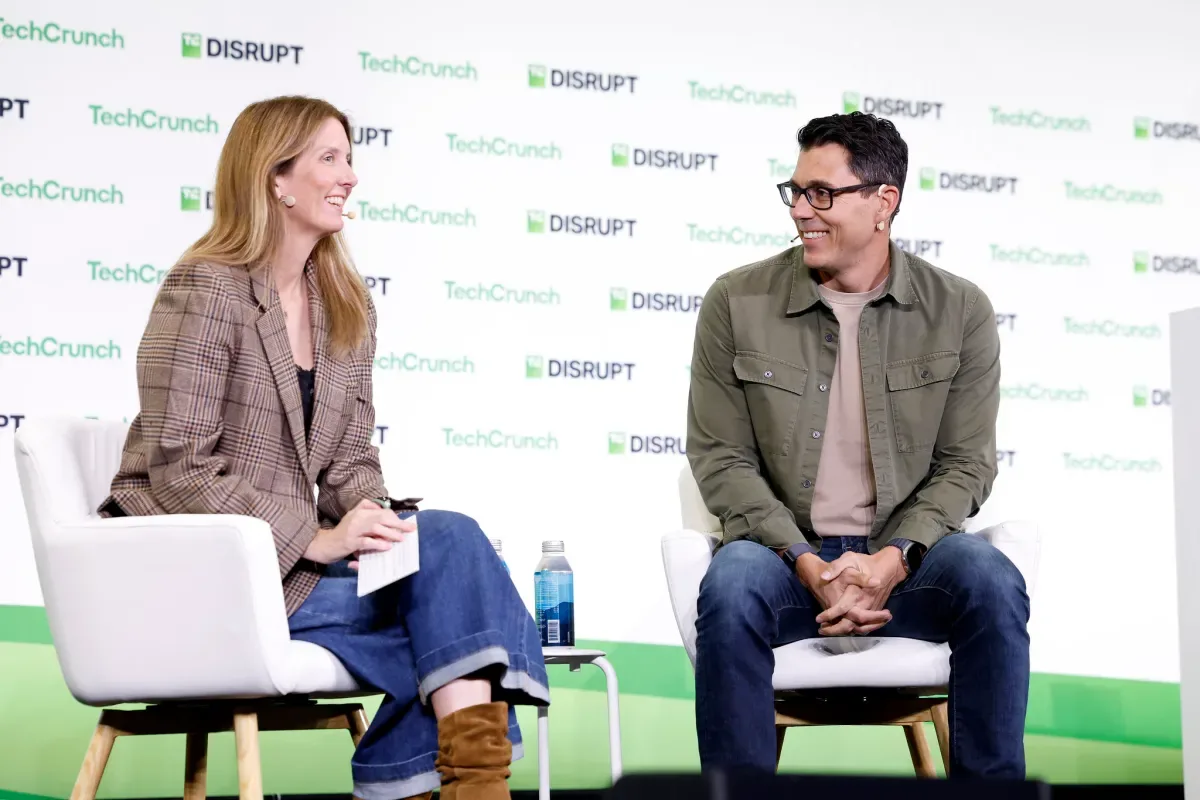
Rivian founder and CEO RJ Scaringe confirmed onstage this week at TechCrunch Disrupt that the company’s future in-car systems will be able to run AI agents developed by third-party companies. The example he gave was Anthropic.
Key points:
- Where it was announced: This week, during a live interview at TechCrunch Disrupt, said directly by founder and CEO RJ Scaringe
- When it will be available: No timeline. Rivian declined to add details, telling the outside world to wait for December’s “AI & Autonomy Day”
- Who it’s open to: Agent products from frontier AI labs. The only one Scaringe named is Anthropic; the report itself also lists OpenAI’s Dots and Meta’s Muse as imaginable candidates
- Are vehicle controls open? No. Vehicle-level controls like brakes and steering will never be handed to agents
There’s Already a Homegrown Agent in the Car

Rivian recently launched an AI assistant that lets drivers and passengers talk directly “to the car.” It differs from how most automakers do things: instead of relying on Apple CarPlay or Android Auto, it built the entire in-car software stack from the ground up, writing apps like navigation itself (while also integrating popular apps like Apple Music).
What supports this experience is Rivian’s own agentic framework—think of it as an “intent triage desk” that first determines what a natural-language sentence means the user wants to do, then dispatches it to the corresponding module in the vehicle software. The vast majority of requests are everyday ones: lower the temperature, turn on seat heating, read a news summary.
Scaringe used a traffic-light metaphor to explain model routing: “You ask the car a question, and it first decides which model to use. It can use a local model running on the edge—that is, the vehicle’s local compute; if the question is more complex, it goes to the cloud. Even in the cloud, we use different models.”
As of May this year, the agent could already access external apps like Google Calendar. Scaringe said the next step is to integrate products from frontier AI companies.
The Hard Part Isn’t the Model—It’s the “Plumbing” and Boundaries
But he quickly added the caveats: getting these agents to run in the car isn’t easy. “There’s a huge amount of plumbing work behind the scenes, and it’s not just inside Rivian—it also requires a lot of coordination with each lab to make sure they connect that plumbing.”
The safety constraints are even harder. Putting this kind of software anywhere near safety-critical systems means Rivian has to be extremely cautious. “You don’t want an agent deciding ‘it’s time to brake, or time to steer.’” He made clear that no vehicle-level controls will be handed to agents.
What really needs to be connected is context. Scaringe’s envisioned scenario is: first have the assistant turn on seat ventilation, then immediately say, “We talked yesterday about that meal—I’m hosting on Friday. Can you help me think about what to cook?” The car needs to pull context from your conversation with an assistant on another device. That means Rivian will have to connect the vehicle to user context that apps like Muse have already collected.
There’s a contrast here: Rivian spent years keeping its software stack in-house, and now it’s actively inviting external agents into the car—a stance inconsistent with its earlier refusal of CarPlay and Android Auto. And it isn’t the first U.S. automaker to do so: earlier this year, Tesla launched features letting users chat with SpaceX’s Grok chatbot and the Grok Bot assistant.
Who It’s For, and Who Should Wait
- Current Rivian owners: The existing voice assistant already works, so use it for things like “adjust the A/C, turn on seat heating, read the news” for now. There won’t be a clear answer on third-party agents until at least the December event.
- People considering buying a car for AI agents: Better to wait. There’s no timeline, no clarity on which models will be covered, and no confirmation of which labs will participate.
Final Thoughts
Voice-controlled cars are nothing new; what’s scarce is whether context can flow across devices. Rivian drawing a clear boundary outside vehicle controls is a wise kind of conservatism. December’s AI & Autonomy Day is where the answers will be revealed—what’s worth watching then isn’t which model got integrated, but how far the “plumbing” has reached.