IT Home, October 23: The Artificial Intelligence Research Institute of the China Academy of Information and Communications Technology (CAICT), the Key Laboratory of Artificial Intelligence Large Models and Software/Hardware Evaluation of the Ministry of Industry and Information Technology, and the China Artificial Intelligence Industry Development Alliance jointly released the Monitoring Report on Large Model Token Service Performance (2026) today (October 23).
According to the report, as large model technology iterates rapidly, token services have become the key link in moving from technology to application, and China’s daily average token calls continue to climb. In June 2026, domestic daily average token consumption was about 500 trillion, nearly four times that of December 2025.
A growing number of MaaS (Model as a Service) platform vendors supply large model token services through public cloud APIs. However, users lack intuitive criteria for judging token service performance and face various problems such as difficulty in selecting services.
Based on monitoring data from January to August 2026, the report analyzes platforms’ token service call success rates, throughput speed, time to first token, stability, price, and context windows. It compares the official platforms of large model developers with the performance differences of four open-source models — DeepSeek, Qwen, GLM, and Kimi — on third-party platforms, further analyzes the key factors affecting token service performance, summarizes core industry observations, and sets out the next work plan. The aim is to provide a reference for users’ service selection and to offer direction for the industry to optimize service capabilities.
1. Domestic token service throughput per second doubled from 2025, but remains below overseas levels
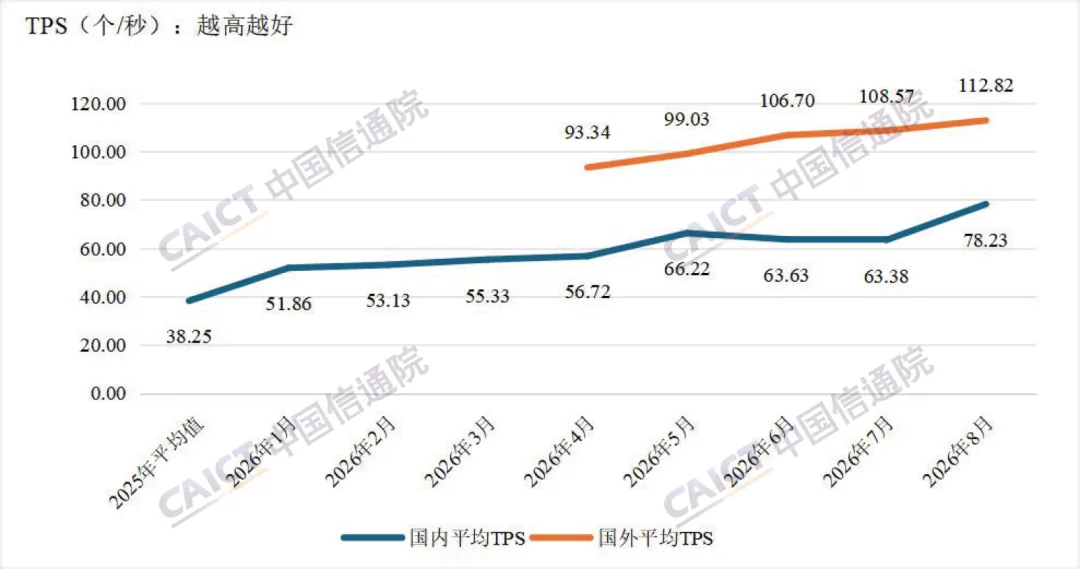
The report states that in August, the average TPS (output tokens per second) of domestic models reached 78.23, doubling the 2025 average of 38.25. However, the average TPS of typical overseas models in August was 112.82, an increase of more than one-fold from 51.35 in December 2025, and overall better than domestic models.
2. Token service latency increased, with consistent trends at home and abroad
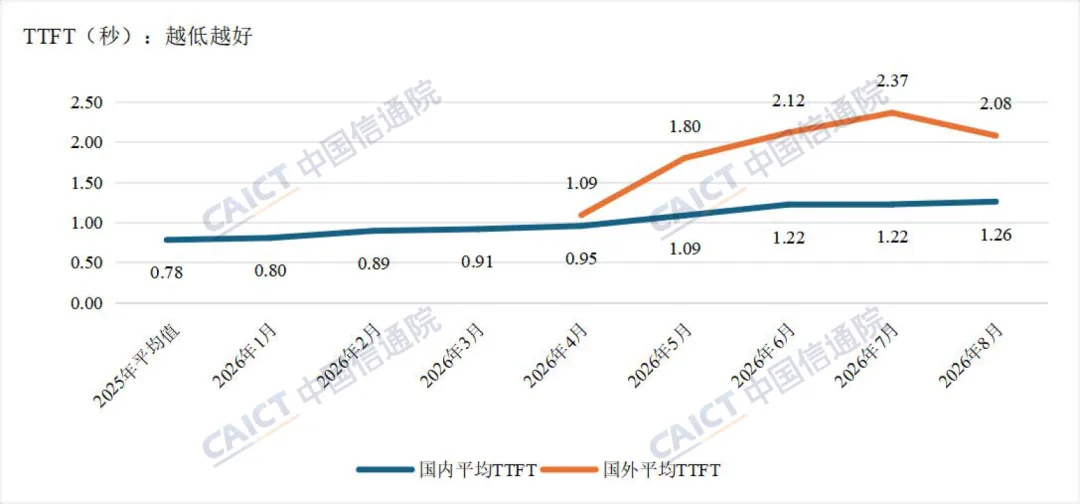
The report states that since the start of the year, the average TTFT (time to first token) of domestic models has continued to rise, reaching an average of 1.26 seconds in August, a marked increase from the 2025 average of 0.78 seconds. At the same time, the average TTFT of typical overseas models reached 2.08 seconds in August, also a marked increase from 1.04 seconds in April.
It is worth noting that the rise in TTFT is not simply performance degradation, but the result of simultaneous factors including larger model parameter counts, longer context lengths, and increased call volumes.
3. Token service prices rebounded noticeably in 2026
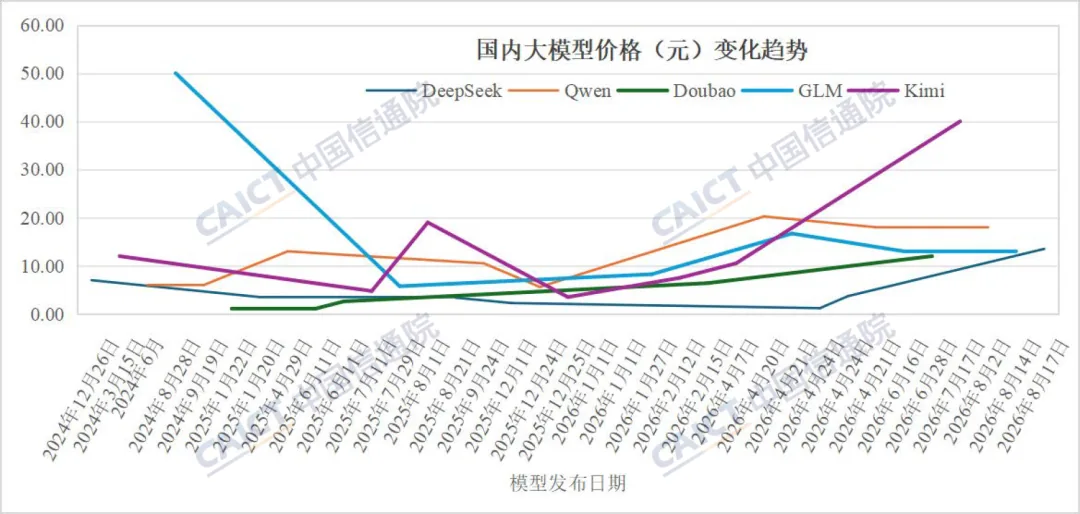
After two years of price wars, model service prices at home and abroad rose noticeably in 2026, according to the report. The normalized average domestic price was 6.8 yuan in the second half of 2025, while the average so far this year is 13.46 yuan, an increase of nearly one-fold. Overseas prices remain higher than domestic ones, with the average normalized price of typical models released since 2026 at about 117.8 yuan.
4. Model context lengths continue to expand toward the million-token level
Among the monitored models, 47.8% have context lengths of 1M (one million tokens), and 95.7% reach 200K or more, an increase of more than 76 percentage points compared with the end of 2025, while the share of models below 200K continues to shrink.
5. Open-source models show significant token service performance gains, while the same model varies widely across platforms
In May, new versions of four open-source models were released and monitored; results show TPS continuing to rise and TTFT continuing to shrink. For example, the TPS of DeepSeek-V4-Pro in August reached twice that of DeepSeek-V3.2.
On latency, after the major models completed generational upgrades in May, TTFT generally rose for a period, and as inference optimization measures were implemented, latency metrics gradually fell back to pre-upgrade levels.
At the same time, the four models showed differing TPS, TTFT, and call success rates across platforms. Some third-party platforms clearly outperform the model services provided by official platforms, with TPS for the same model differing by up to nearly one-fold between platforms. Differences in inference acceleration, optimization strategies, and cost control for the same model are the main reasons for the performance divergence.