
I. That Catchphrase Conflates Four Distinct Concepts
A saying circulates in online dating discourse: “If you want a long-term relationship, reveal short-term traits; if you want a short-term relationship, reveal long-term traits.” It’s popular partly because it captures an asymmetry people observe again and again: some who only want something casual act deeply invested and eager to commit; others who genuinely want something lasting come across as understated early on and aren’t taken seriously. These observations get compressed into an apparently actionable rule, and so it gets shared widely.
There is indeed a real psychological phenomenon behind it. Evolutionary psychology’s Sexual Strategies Theory (SST) models short-term mating (a mating strategy characterized by brevity and low investment) and long-term mating (a strategy characterized by stability, high investment, and mutual maintenance) as two distinct psychological mechanisms (Buss & Schmitt 1993). The original text, however, uses hypothetical phrasing — this is theoretical explanation, not a laboratory verdict. On the empirical side, “situations do elicit different standards” has direct experimental support: when male college students separately evaluated marriage partners versus casual sex partners, their age preferences did differ (Young et al. 2005); height preference shifts across contexts appeared in cross-cultural samples too, but only in men, with marginally significant effects (Pisanski et al. 2022); additionally, sex differences in preference direction were replicated in a 2020 large-scale study across 45 countries — men placed more weight on youth and physical attractiveness, women on older age and the partner’s economic prospects (Walter et al. 2020). These results support “short-term standards ≠ long-term standards,” but all effects are small, sex-specific, and trait-specific (strong research support, but mostly from single or small samples, and measuring stated preferences rather than real choices). In other words: the brain does process short-term and long-term mating differently, but there is no single, powerful “context switch.”
The problem is that the leap from “two sets of standards” to that catchphrase involves a serious oversimplification. It conflates at least four distinct concepts: displaying short-term attractiveness (making oneself appear appealing), expressing short-term relationship intent (stating openly that one only wants something brief), displaying long-term partner value (making oneself appear reliable, someone to build a life with), and falsely promising a long-term relationship (verbally pledging marriage and a future with no such intention). In the catchphrase, these four get merged into a pair of “attributes,” as if they were two sides of the same coin. In reality, a person can be highly attractive in the short term without ever being deceptive, and can have zero appeal while genuinely wanting something lasting. The catchphrase compresses “what someone looks like” and “what kind of relationship they want” into a single variable — a compression step that no research supports.
II. Why It Sounds Right: Five Mechanisms, Five Boundaries
The catchphrase circulates because the psychological mechanisms beneath it are partly real; it goes wrong because each mechanism’s scope of applicability gets exaggerated. Let’s take them one by one.
Scarcity and psychological reactance. The intuition that we want what we can’t have is ancient; the corresponding concept in psychology is reactance (the motivational drive to restore freedom when one’s choices are threatened) — a theoretical explanation. It can explain why moderate reserve might draw more attention than unconditional availability; it cannot explain which facet of reserve is doing the work, let alone sustain a durable strategy.
The classic test of “hard to get.” Walster et al. (1973) tested the hypothesis that “women who are hard for everyone to get are more desirable” across five experiments — all failed. A sixth experiment identified what actually works: the women rated highest by men were “selectively available” (accessible to the pursuer himself, unavailable to others). Men retained her accessibility as a positive, interpreted her exclusivity as precious, and sidestepped all the drawbacks of uniformly hard-to-get types (strong research support — this is the strongest link in the entire evidence chain; the limitation is a 1973 male college student sample). What this explains: the engine of attraction is exclusivity — “you’re special to me” — not “you’re rejecting me.” What it cannot explain: rejection itself holds no magic; being uniformly cold toward everyone does not increase attractiveness.
Uncertainty enhances attraction. Whitchurch et al. (2011) had 47 female college students browse fictitious male profiles: the group told “the person’s interest in you is uncertain” gave the highest attractiveness ratings, even higher than the “clearly likes you” group. The authors speculated the mechanism is cognitive occupation — the more you think about it, the more attracted you become (strong research support, but a single small-sample experiment measuring one-time initial attraction only, with no long-term outcomes). What this explains is the racing heartbeat while you’re still guessing someone’s feelings; it stops there. Anything long-term is beyond its scope.
The backlash of being too hard to get. A scoping review synthesizing 18 studies found that “playing hard to get” can only be effective when uncertainty is at a moderate level; excessive difficulty causes the other party to withdraw their own interest, leading to mutual waiting and reciprocal inhibition (Houle et al. 2023) (strong research support, scoping review). This is precisely where the catchphrase breaks down: push “unavailability” to an extreme and the effect reverses.
Intermittent reinforcement. The internet often explains “hot-and-cold” behavior as intermittent reinforcement (a schedule in which rewards appear unpredictably, paradoxically producing more persistent behavior). The concept originates from operant conditioning, but among verified studies, no direct experiment links intermittent reinforcement to romantic attraction. This belongs to folk experience and theoretical extrapolation — it cannot be cited as research backing. At most, it reminds us that uncertainty affects attention, but attention ≠ liking, let alone willingness to build a relationship.
Viewing these mechanisms side by side, the conclusion is remarkably consistent: they operate only at the initial attraction stage, under relatively stringent conditions, and not one supports disguising intent. The catchphrase sounds plausible because it borrows the names of these real mechanisms; it goes wrong because it compresses these well-documented, condition-bound effects into an unconditional directive.
III. The Biggest Misunderstanding: Attractiveness ≠ Short-Term Intent
Most people who act on that catchphrase stumble over the same misunderstanding: they treat “possessing initial attractiveness” and “only wanting a short-term relationship” as the same thing, so the traits that make someone appealing early in a relationship get collectively stigmatized as “short-term attributes.”
Broken down, the things that can boost initial attraction are actually quite ordinary: appearance and self-presentation, confidence, independence, social skills, humor, personality, boundary-setting, not over-accommodating, having your own life, romantic attraction (the appeal that triggers romantic interest), and not projecting excessive neediness. To be clear: this list is an inductive summary at the level of folk experience and theoretical explanation — verified research hasn’t tested each item individually; but none of them has any logical connection to “short-term relationship intent.” A person genuinely seeking a long-term partner can simultaneously possess every trait above.
Conversely, equating “expressing long-term intent” with “coming across as boring” is the other face of the same misunderstanding. Long-term partner value is often invisible early on — not strategically hidden, but because it requires time and context to surface: emotional stability (the capacity to not be easily perturbed by minor events and to self-regulate under pressure), consistency, integrity, and a sense of responsibility cannot be fully observed in two or three meetings.
So: short-term attractiveness does not equal declaring that you only want something short-term; a person can absolutely be seeking a long-term partner while possessing strong personal appeal in the early stages of a relationship. The idea of binding the two has no research provenance — it comes from speculative generalizations about “the love lives of attractive people.” What truly needs distinguishing has always been attraction versus intent, not the so-called “short-term attributes” versus “long-term attributes.”
IV. Relationships Develop in a Sequence — Naturally
There is indeed a rough display sequence within relationships: attraction first, long-term assessment later. But this is the ordering of judgment tasks, not the ordering of disguise tasks.
When a relationship is just beginning, the first question people ask is “Do I want to keep getting to know this person?” — not “Should I marry this person?” This isn’t strategy; it’s cognitive necessity: most components of long-term partner value — values, emotional stability, conflict-resolution style — can only be observed through interaction and cannot be fully presented on day one. Therefore, long-term value is typically not the most important information upfront; what matters more initially is Attraction, Chemistry (the immediate sense of draw and fit between two people), and Curiosity; as the relationship deepens, the weight of Trust, emotional stability, consistency, values, responsibility, career and life direction, and Compatibility (whether both parties’ habits and goals can sustain long-term coexistence) gradually rises.
Here are two mutually irreplaceable judgments, both of which must hold: long-term partner value cannot fully substitute for initial attractiveness, and initial attractiveness cannot substitute for the trust and compatibility needed in a long-term relationship. The former explains why someone who looks great on paper may still not spark; the latter explains why a spark is only the beginning.
Distilling this process into a six-stage model, each step corresponds to a core question:
- Attraction — “Do I want to keep getting to know this person?”
- Curiosity — “What else about this person is worth discovering?”
- Connection — “How does it feel to be with them?”
- Trust — “Is this person reliable?”
- Long-term Compatibility — “Are we suited to enter each other’s lives?”
- Commitment — “Are we willing to build a long-term relationship together?”
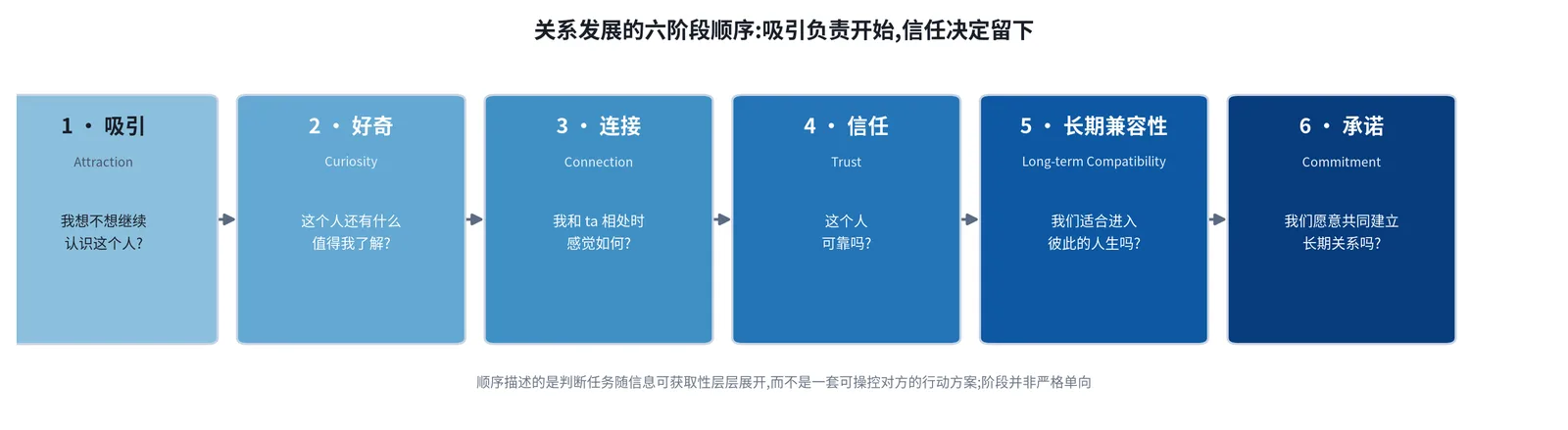
Attraction typically opens the door to a relationship, while long-term value determines whether both parties want to stay.
It should be noted that this six-step micro-sequence is currently an observational framework: among verified studies, not a single one has directly tested it. What exists: short-term and long-term contexts elicit different standards (Young et al. 2005; Pisanski et al. 2022), but those are situational differences, not sequential evidence; the three components of Sternberg’s Triangular Theory of Love — passion, intimacy, and commitment — now have a cross-cultural measurement foundation across 175 countries and 117,000 participants (Kowal et al. 2025), but that dataset is purely measurement-based with no sequential conclusions; the closest longitudinal evidence comes from a roughly 7-year tracking study from age 14 to 21, where romantic relationship quality and duration did show orderly development with age, culminating in “linked romantic love” at age 21 as the mature form (Seiffge-Krenke 2003) — but that’s a developmental age sequence, not steps within a single relationship. Even more noteworthy: trust doesn’t always come “after” attraction. Trust includes an automatic, implicit component — experiments have shown that subliminal priming alone can enhance the trust and love and commitment one feels toward a partner, without requiring deliberate reflection or accumulated time (Murray et al. 2011, research on impulsive trust in the Journal of Personality and Social Psychology; strong research support, with some experimental effects marginally significant). “Trust comes late” is fine as an intuition; as a law, it’s challenged by this evidence.
So, using the six stages as a lens for observing relationships is sound — it describes how judgment tasks unfold layer by layer as information becomes accessible. Using it as an operational manual for “manipulating the other person in this exact sequence” is both unsupported by evidence and a departure from its original intent. A genuinely healthy relationship is not strategic deception, but letting the other person gradually see different layers of one’s authentic value as the relationship develops.
V. Why Premature “Long-Term Commitment” Backfires
First, let’s distinguish two things the catchphrase merges: premature commitment and long-term value. Wanting a long-term relationship is not itself a problem and doesn’t generate any backlash; what generates backlash is premature investment, over-commitment, or projecting intense neediness without sufficient understanding.
Why does excessively premature commitment make people pull back? At the mechanistic level, there are at least three layers (the following are theoretical explanations and folk experience; direct evidence is lacking). First, it disrupts the information sequence: before the other person has had a chance to answer “Do I want to keep getting to know this person?” they’re handed a “rest of our lives” proposal. What they receive isn’t a sense of security but an unverified debt — like discussing marriage after two weeks of acquaintance, or planning a shared future before even meeting in person. Second, it’s the inverse of the scarcity effect: an instant all-in bet signals “this commitment is cheap; anyone could get it.” Third, it forms a closed loop with the mechanisms in the previous section: extreme push-pull gets read as “you’re not serious,” causing the other party to withdraw interest (consistent with Houle et al. 2023’s reciprocal inhibition finding), and an extreme all-in bet gets read as “you don’t vet people.” Both extremes share the same error: failing to let the other person participate in the judgment.
“Premature commitment carries risk” currently has no verified direct experimental test; SST lists “commitment seeking and avoidance” as one of its core adaptive problems (Buss & Schmitt 1993) — that’s theoretical explanation; the closest direct evidence, the “sliding vs. deciding” research (whether key transitions like cohabitation and marriage involve conscious mutual decisions or inertia-driven sliding), falls outside the scope of verified evidence and can only be listed as an open question. In other words, this section describes something that’s theoretically plausible and experientially common but still lacks direct empirical support — its weight should be understood accordingly.
If someone has no long-term relationship intent yet deliberately pledges marriage, love, or a future solely to obtain sex or short-term benefit, that is deception, not a sophisticated relationship strategy. The most dangerous part of the catchphrase hides on the flip side of that line — it implies that “displaying long-term traits” is a tool you can switch on at will, and treating another person’s heart as a tool is precisely the hardest starting point to repair in an intimate relationship.
VI. A Mature Relationship Needs No Reverse Disguise
Social Penetration Theory (Altman & Taylor 1973) uses an “onion model” to describe self-disclosure (the degree and depth to which one proactively reveals personal information to a partner): a relationship starts from the outermost layer of superficial information, peeling inward layer by layer toward the core (theoretical explanation; this theory falls outside the scope of verified evidence, but its description aligns with the direction of everyday observation). Intimacy is built through disclosure that is gradual and mutual — not by betting everything at once, and certainly not by performing in reverse.
This is the healthy version of the “natural sequence”: not “first pretend to be short-term, then pretend to be long-term,” but “first build attraction, then gradually establish trust, and finally assess whether both parties are suited for a long-term relationship.” The problem with disguise isn’t just moral — it’s also inefficiency: feigned indifference gets exposed when the other person’s patience runs out; feigned deep affection crumbles at the first conflict of interest. Authentic value carries no performance cost and won’t suddenly vanish one day. A person who presents themselves authentically, layer by layer, naturally possesses that so-called “display sequence” — attraction, trust, and commitment are, at their core, different facets of this person’s reality, not three costumes.
VII. For Male Readers: Don’t Study Manipulation — Study Authenticity
This seventh section is written directly for male readers. This type of content surfaces mainly in male-oriented discussion communities, and men are also encouraged to perform more in the early stages of relationships.
The first piece of advice is evidence-based, not a moral stance. A machine-learning comparison across 29 laboratories, 43 longitudinal dyadic datasets, and over 10,000 couples found that the strongest predictors of long-term relationship quality all came from the relationship’s own dynamics. Perceived partner commitment (the sense of the other person’s investment in the relationship) ranked first, followed by appreciation, sexual satisfaction, perceived partner satisfaction, and conflict; while individual-difference variables — including attachment (the habitual expectations an individual forms regarding intimacy and distance) anxiety and avoidance, and negative emotion — had no incremental predictive power beyond relationship variables (Joel et al. 2020; strong research support, though the “no incremental prediction” claim has some dissenting views). This means: disguising “high value” and manufacturing scarcity target “personal image” — a variable that barely affects relationship quality. What truly determines relationship quality is the investment and appreciation the other person perceives in interaction. Directing effort toward what can be perceived is the only direction research can offer.
In contrast, the two paths are sharply distinct. The low-grade logic: wanting a particular type of relationship, so pretending to be a different kind of person — wanting long-term so feigning short-term, wanting short-term so feigning long-term. The mature logic: improving genuine attractiveness while also possessing genuine long-term partner value. An ideal adult can embody both sets of traits simultaneously — attractiveness: independence, confidence, being interesting, having boundaries, having your own life, not being overly dependent on a partner; long-term partner value: integrity, emotional stability, consistency, responsibility, problem-solving ability, long-term planning, respect for one’s partner, and reliability.
Applied to daily life, it comes down to simple things: build an independent life, develop your career and interests, let emotional stability become an observable fact; learn to establish boundaries, keep distance from irrelevant people — which is, in research terms, the reverse application of “selective availability” (Walster et al. 1973) — be clear and gracious in expressing interest to the person you want, give the other person space to decline, and don’t pester after being rejected. Learning to express interest is a lesson many men receive little training in growing up, yet it’s critically important — and it demands two things at once: courage, and integrity.
VIII. Conclusion: Attraction Starts It; Trust Determines Who Stays
Returning to the catchphrase from the beginning. Its error isn’t naive — precisely because half of it is true: short-term and long-term mating do activate different psychological mechanisms, and attraction and intent do genuinely blur together in the observer’s eye. Its real mistake is twisting these real phenomena into a disguise manual.
And the sequence it obscures is, in fact, a simple thing. Attraction brings two people closer. Connection makes them willing to keep discovering each other. Trust stabilizes the relationship. Compatibility determines whether they can walk the same path. Commitment is the result of both parties’ free choice. Not a single step requires disguise, and not a single step can be substituted by disguise.
So the answer is: first, attract authentically; then, open up gradually; build trust through shared experience; and finally, honestly assess whether both of you are suited for a long-term relationship. The risk of this process lies in exposing what’s real, not in appearing insufficiently clever. But only what’s real can be used to build trust — and trust is the thing in a relationship that best withstands time.