Summary
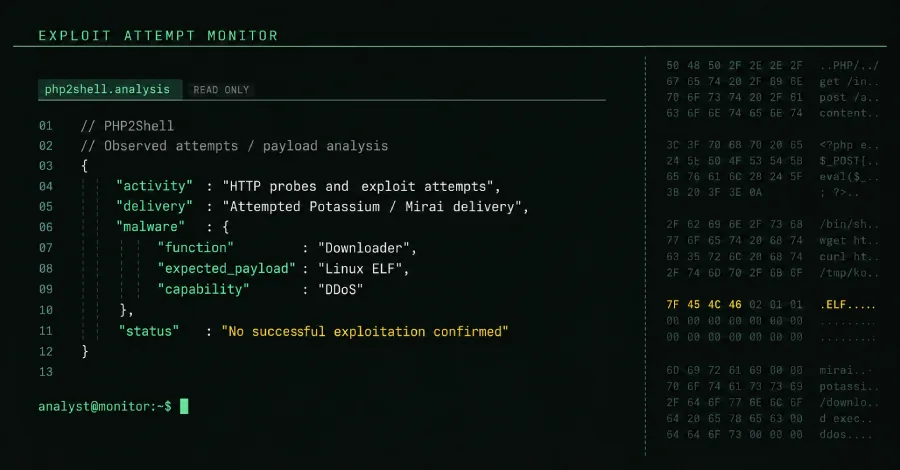
Threat actors have been observed making unsuccessful attempts to exploit the newly disclosed PHP2Shell vulnerabilities in order to rope infected systems into a Mirai botnet variant called Potassium, as it emerges that weaponizing the flaws may be harder than previously thought.
The attacks target CVE-2026-109618 and CVE-2026-109619 (CVSS scores: 9.2), which can result in unauthenticated remote code execution (RCE) via specially crafted HTTP requests. The vulnerabilities have been patched in PHP versions 8.5.12, 8.4.27, 8.3.36 and 8.2.35.
Malware analysis (Sophos)
Analysis of the sample revealed that it is an updated and significantly expanded version of the Mirai-derived botnet variant identified in early 2026. The sample displays downloader and network disruption functionality.
It resolves a hard-coded, encrypted command-and-control (C2) address, establishes a TCP connection to 134.199.154[.]64 and sends an HTTP request. The malware then checks for an HTTP 200 response status and verifies that the resulting payload begins with the ELF magic bytes 7F 45 4C 46, indicating that it expects a Linux ELF binary as a follow-on payload.
A resolver function supports IPv4 addresses and hostname resolution, with additional fallback resolution logic that includes hard-coded public DNS servers such as 8.8.8.8, 1.1.1.1 and 1.0.0.1. As with Mirai historically, this sample can execute DDoS attacks.
Attack chain
Attacks were found to originate from three IP addresses: 85.11.167[.]243, 217.60.242[.]76 and 45.198.224[.]169. These attack sources contact 92.118.112[.]100 to retrieve a loader responsible for deploying the Mirai variant. Further analysis within a network-contained sandbox revealed that the botnet issues a DNS query for thunder.godofthunder[.]st, resolves it to 134.199.154[.]64, and establishes a C2 channel on TCP port 50792.
The end goal is to launch sustained volumetric flood attacks against two adjacent hosts located within a single Ukrainian network: 45.88.138[.]0 and 45.88.138[.]44.
The lack of a successful attack leveraging PHP2Shell in the wild suggests that threat actors are struggling to come up with reliable exploits, Sophos added.
Background on Potassium
Potassium was first flagged by botnet tracking platform Synthient in March 2026. Nokia Deepfield researchers described the malware as a Mirai fork which uses ChaCha20 for the static config table (the first time ChaCha20 has been seen used this way in a Mirai variant), a single static byte (0xED) for everything on the wire, a named reverse-shell protocol (SHELL / SHOUT) on the same channel as attack commands, and a DNS misdirection scheme that swaps the two 16-bit halves of every resolved A record before connect().
Arctic Wolf said the botnet supports 24 commands to facilitate flood attacks over ICMP, TCP, UDP and the OpenVPN protocol. Both the ARM and x86 builds also contain configuration for resolving C2 infrastructure through Ethereum Name Service (ENS). ENS resolution was disabled in both samples, indicating that the capability was present but inactive; if enabled in future variants, it could complicate disruption by reducing reliance on registrars and DNS providers, requiring defenders to block the ENS names, RPC infrastructure and resolved C2 addresses.
Mass exploitation tooling (SOCRadar)
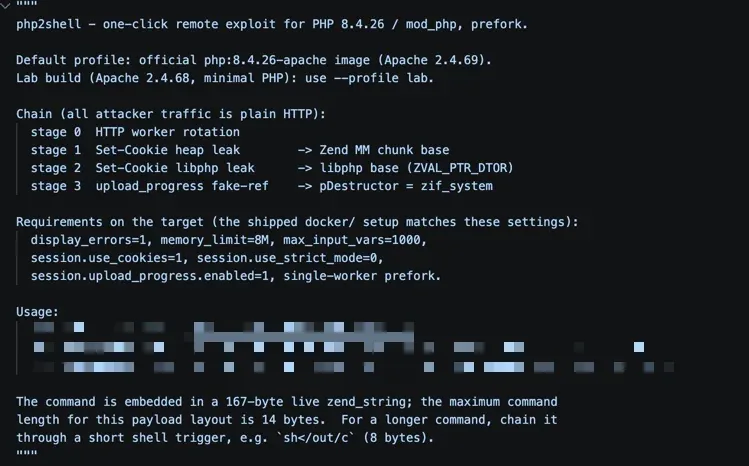
SOCRadar said it found PHP2Shell exploit tooling for PHP 8.4.26 on an exposed attacker-controlled server (206.188.197[.]105:9999), alongside three screening scripts that check live websites for preconditions the PHP2Shell chain depends on. The scripts checked about 20 public websites, spanning Canada, China, Finland, France, Poland, the U.K. and the U.S., for the PHP version, server setup and session settings the exploit needs.
The central file, aslr_exploit.py, is a Python exploit the operator labels a one-click PHP2Shell exploit for PHP 8.4.26 under Apache mod_php. It works entirely over ordinary HTTP requests in three broad steps: it recycles the target’s PHP worker, leaks memory addresses through the session cookie to defeat ASLR, and then abuses PHP’s session upload progress handling to run a shell command.
The companion scripts are:
- php2shell_fp.py, which reads PHP version and server setup from about 20 sites;
- deep_probe.py, which examines 11 of those sites for visible errors, phpinfo pages, file inclusion and session injection to ascertain whether they meet exploit prerequisites;
- wp_attack.py, which focuses on five WordPress sites to conduct user and plugin enumeration.
There is no evidence of shell access on any screened site as of October 22, 2026, indicating the targeted sites did not meet the exploit’s preconditions.
The toolset is assessed to be part of a broader operation that involves the attacker extracting API keys and backend URLs from websites’ client-side JavaScript, systematically sweeping web and API routes for unauthenticated access, and using a pool of rotating proxies to spread traffic and evade rate limits and blocking. Related artifacts on the server additionally point to web-archive reconnaissance and automated CAPTCHA solving. Taken together, the toolset points to a financially motivated actor focused on cryptocurrency and Web3 targets.
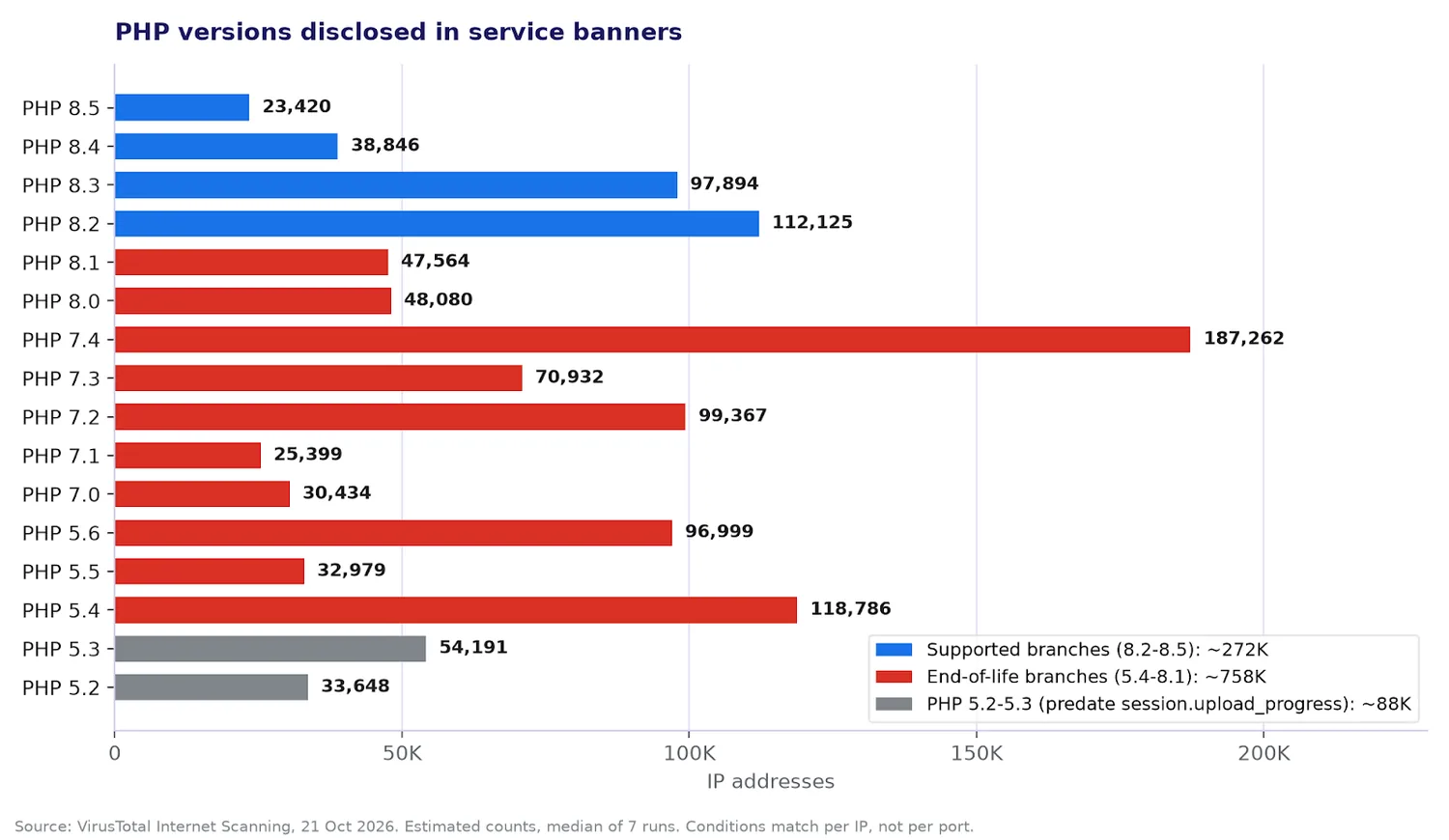
Hunt.io also flagged the same exploitation server (206.188.197[.]105), saying the threat actor behind the operation targeted 123 servers across cloud, shared-hosting and ISP networks. About 57 run PHP, many on unsupported 5.x to 7.x versions; ten rejected the request outright, including three of the five sitting behind Cloudflare. None was exploited.
According to the article, 10 open directories hold PHP2Shell-related tooling. The listed addresses include:
- 206.188.197[.]105
- 102.210.149[.]166
- 122.10.110[.]72, 122.10.17[.]49
- 58.221.60[.]160:8000
- 41.223.30[.]7, 157.230.117[.]70
- 104.219.251[.]31
- 107.150.31[.]151
- 217.160.132[.]82
- 47.100.125[.]108, 54.169.109[.]7, 139.162.165[.]136
Defeating ASLR (VulnCheck)
The disclosure coincides with the development of a PHP2Shell exploit that can achieve remote code execution on ASLR-enabled x86-64 systems with PHP’s recommended production configuration.
Spencer McIntyre, director of exploit development at VulnCheck, told The Hacker News that address space layout randomization (ASLR), a protection designed to make memory corruption vulnerabilities much harder to exploit, has been one of the biggest obstacles. His team developed a novel technique that chains the two vulnerabilities together, using a memory leak to bypass ASLR and achieve remote code execution on x86-64 systems, even with PHP’s recommended production error-display setting enabled.