
Core Event: Photon Closes a $4.5M Seed Round

AI startup Photon has recently closed a $4.5 million seed round, co-led by Gradient and A*, with participation from Vercel, HongShan, Z Fellows, Llama Ventures, and others. The company says it had already attracted more than 40,000 developer sign-ups before the round closed and grew revenue 10x in four months. The funding will be used to continue developing its developer tool platform and accelerate the shift from traditional mobile apps to AI agents.
Key facts:
- Round: Seed ($4.5M)
- Co-leads: Gradient, A*
- Participants: Vercel (also a technology partner), HongShan, Z Fellows, Llama Ventures, and others
- Developer scale: 40,000+ (as of Q3 2026)
- Revenue growth: 10x in four months
- User churn rate: <3%
- Message volume growth: 5x in the past month
From an “App Funeral” to Developer Tools: Rebuilding the AI Interaction Entry Point

Photon went viral for hosting a literal “mobile app funeral” in San Francisco on September 17, 2026: the event was held in a church, pointedly placed app icons into a coffin, and invited representatives from Vercel, Stripe, OpenAI, and others to take part in Developer Day. Though the performance art had a tongue-in-cheek tone, it conveyed the firm conviction of co-founder Daniel Tian (a dropout from UPenn’s M&T program) and CTO Ryan Zhu (formerly a visiting student at the MIT Media Lab) about the industry trend: “the era of mobile apps is ending.”
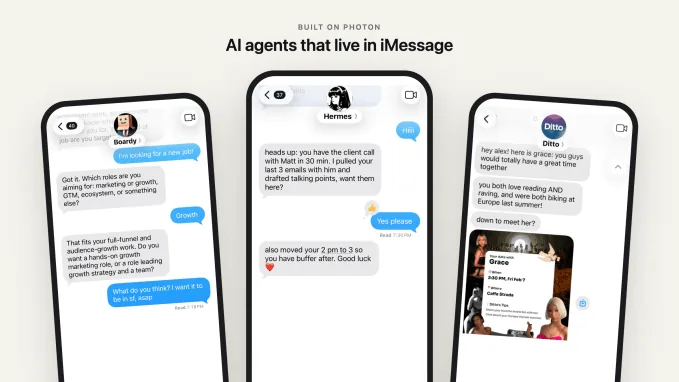
The core logic is: users don’t want to keep downloading new apps; they prefer interacting with AI agents through messaging apps they already use (such as iMessage, WhatsApp, Telegram, etc.). For example, Tian once used a bot he built to automatically reply to friends in iMessage on his behalf; after the tool was open-sourced and adopted by thousands of developers, it directly prompted him to drop out and start a company.
Today, the Photon platform offers a complete development suite, including:
- Unified API: masks differences across underlying messaging protocols
- Extensible channel framework: supports iMessage, WhatsApp, SMS/RCS, email, voice, and more
- Command-line tool (CLI): improves build efficiency
- Observability Suite: monitors agent status and performance
Its hosted version promises 99.95% availability, far higher than running the open-source version locally (suited to hobby projects), and has achieved SOC 2 Type II and HIPAA compliance, opening up commercial possibilities for healthcare AI agents.
An Unexpected Contrast: 98% of Usage Comes from the Open-Source Version
Although its paid offering has been commercialized (the free tier is capped at 10 active users, and exceeding that requires upgrading to a paid plan), Photon’s open-source version still accounts for 98% of actual usage—a sign that the community-driven lightweight development ecosystem remains the main force today, and explaining why its message-processing capacity surged 5x in a month.
Product Comparison
| Feature | Open Source | Hosted (Pro) | Notes |
|---|---|---|---|
| Availability | ~99% (depends on deployment environment) | 99.95% SLA | Enterprise-grade assurance for hosted |
| Compliance | None | SOC 2 Type II, HIPAA | Barrier to entry for healthcare/financial use cases |
| Supported users | Any (unlimited) | Free tier ≤10 active users | Automatically moves to paid when exceeded |
| CLI & Observability | Basic support | Full support | Significantly improved publishing/debugging/monitoring experience |
| Technical support | Community-based | Official priority support | Policy tailored to enterprise customers |
Use Cases and User Ecosystem

Current customers building AI agents with Photon span multiple verticals:
- Insurtech: Corgi Insurance (agent-based claims consultation)
- Social: Boardy (interest matching), Ditto (Gen Z dating)
- Finance: Rho (business banking), Fliptexts (financial assistant), Slashy (AI email client)
Integration partners also attest to broad recognition of the technology:
- Framework layer: LangChain, Mastra, Convex, Render, Railway, Telnyx
- Models and SDKs: Nous Research’s Hermes Agent integrates with Photon by default; Tencent’s QClaw / NanoClaw systems use it as their underlying channel layer
- Cloud services: Vercel offers Eve / ChatSDK integration, strengthening frontend deployment capabilities
Although Meta’s Muse has topped the AI app charts, Tian still believes the key to the market is “empowering developers”—not competing to build its own Cortex. He emphasizes the future direction even more: “Agent-to-agent communication (A-to-A) will create a new collaboration paradigm; for example, a travel-planning agent can automatically call flight/hotel agents for coordinated service.”
Reader Advice: Who Should Adopt Now? Who Should Wait?
- ✅ Good candidates for immediate adoption: Teams already backed by messaging channels (especially iMessage/WhatsApp); early-stage startups that need to quickly validate an AI service MVP; B2B SaaS vendors with strict compliance requirements (e.g., HIPAA).
- ⏳ Recommended to wait: Pure iOS/Android native app developers (current migration costs are not yet evident); small teams without developer resources (the hosted free tier is limited to 10 users); use cases that rely on complex multi-step reasoning UIs (e.g., design/modeling).
Final Thoughts
Photon is not declaring “mobile apps are dead”; instead, it points out that the interaction entry point is being deconstructed and reassembled: as messaging platforms become the default entry point, the next generation of developer toolchains must natively support “invisible deployment.” A free but flexible open-source ecosystem running alongside high-availability hosted services is becoming the standard path for AI-native infrastructure.