
Today’s GitHub Trending headline is a project called Paperclip. It has accumulated 85,162 stars and 15,000 forks — and it was only created in March 2026, barely half a year ago. In short, it’s an organizational framework for teams of AI agents: it applies corporate governance structures to a group of AI employees, so they can collaborate autonomously without running off the rails.
Why does this matter now? As OpenClaw, Claude Code, Codex and similar AI workers spread, more and more developers hit the same problem: twenty terminals running different tasks at once — runaway budgets, duplicated work, broken context, dropped handoffs. Paperclip pushes that scrappy stage into a governed one.
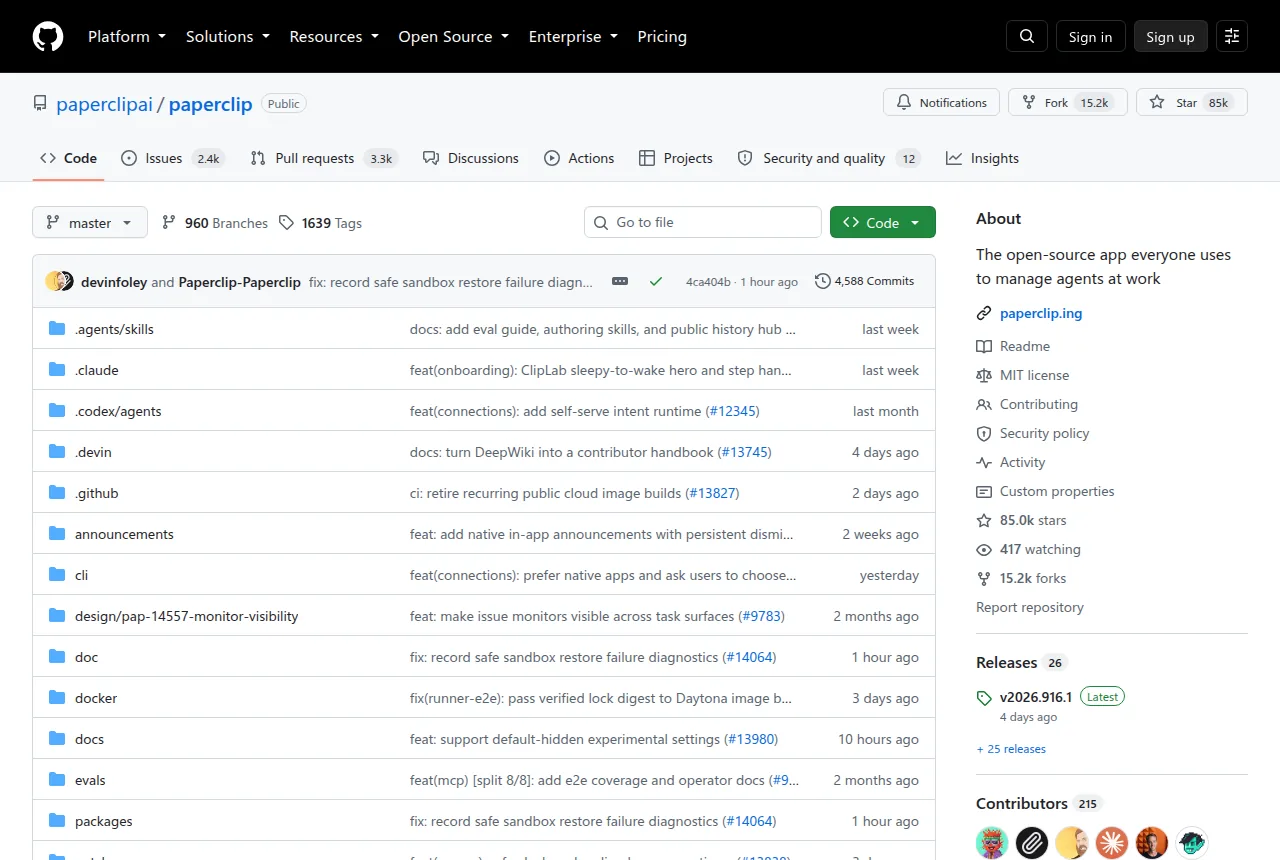
The repo homepage numbers back up the hype: 85k stars, 15.2k forks, 960 branches, 4,588 commits, latest release v2026.916.1. A project that turned “managing AI employees” into a real product shape has long left the toy stage.
It Doesn’t Create Agents — It Manages Them
Once AI genuinely takes on business roles, it stops being a single coding assistant and becomes an “employee” in an organization. Paperclip’s positioning is sharp: it doesn’t create agents, it manages them. Any agent that responds to API requests can be brought into the org chart — OpenClaw, Claude Code, Bash scripts, your own model, even a plain HTTP service. If it can receive a heartbeat, it can be hired.
The core features aren’t complicated, but they dismantle the pain points of AI collaboration one by one:
- Tasks as tickets: every goal has a traceable work item, every conversation is recorded as a thread, and the invisible chain of reasoning is preserved in an immutable audit log.
- The org as architecture: you design roles, reporting lines and permission boundaries for your AI, like drawing an org chart for a real team. A CEO agent can veto the CTO’s strategy; the CTO can assign work to engineer agents.
- Budget as a switch: each agent gets a monthly budget; hit the limit and it stops. Cost becomes a hard constraint set in advance, not an after-the-fact regret.
You may have guessed it already: this is essentially an agent orchestration and governance layer, not another agent runtime. Its sharpness is that it avoids technical showing-off and instead answers a more basic question first: as AI starts participating in work at scale, what’s the best unit of human-machine collaboration? The answer is “organization”, not “individual agent”.
Getting Started: Three Ways to Install
Getting started isn’t hard.
| |
Once running, the API server is at http://localhost:3100, with an embedded PostgreSQL created automatically — no setup needed. Requirements are Node.js 24.11+ and pnpm 9.15+. It’s written in TypeScript: a Node.js server and a React single-page app. You can add new AI employees, set budgets, assign tasks. To get a feel first, npx paperclipai test-drive runs a demo round.
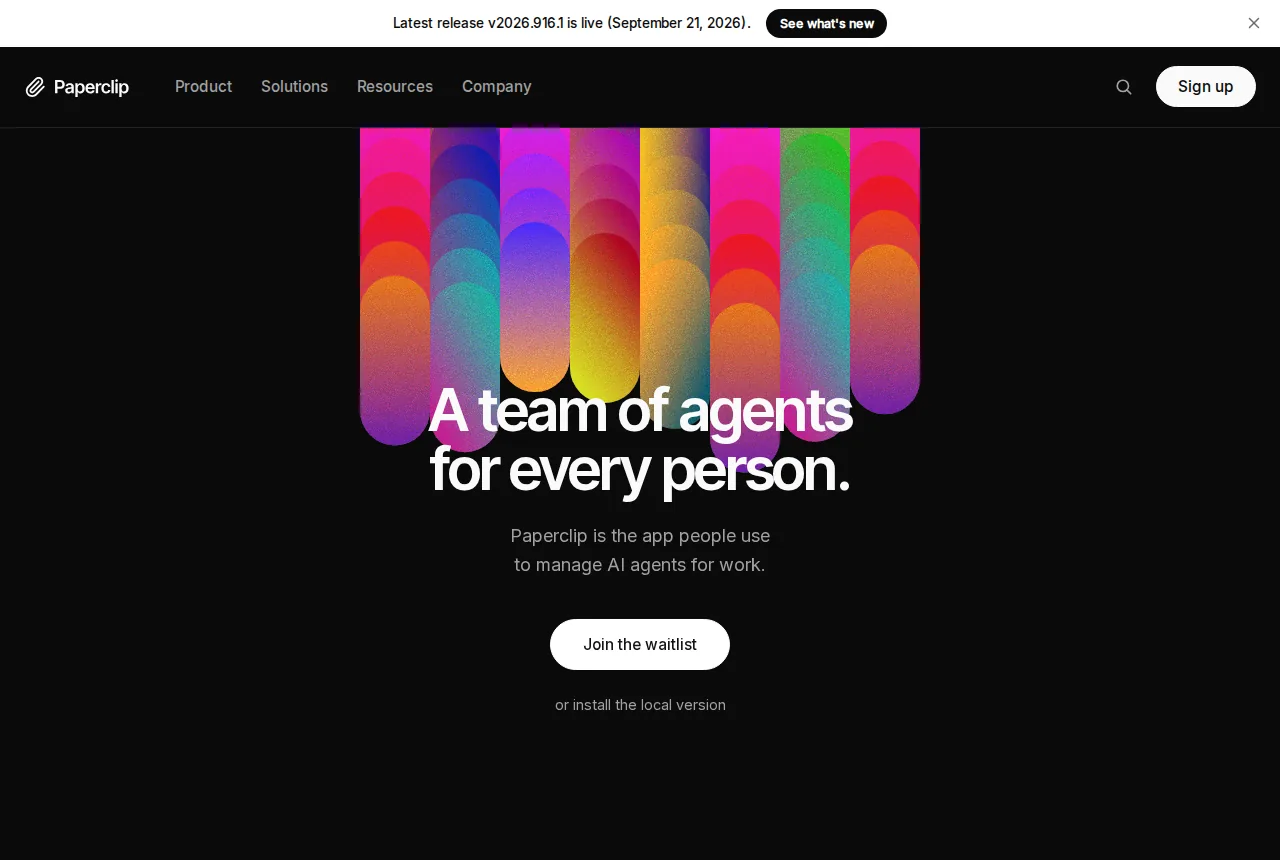
“A Team of Agents for Every Person”
The homepage tagline states its ambition in one line: “A team of agents for every person.” The example goal in the README is telling — “Build the #1 AI note-taking app to $1M MRR.” A company-scale goal like that gets decomposed into an executable agent workflow: the CEO sets strategy, the CTO breaks down the technical roadmap, engineers build, designers deliver prototypes, marketing runs growth channels — all sharing one context and aligning priorities to the same organizational goal.
Three Technical Tradeoffs Worth Digging Into
Technically, there are several tradeoffs worth digging into.
First, every conversation and decision leaves an immutable audit log, with full tool-call tracing. That makes failure reproduction easy — you don’t have to guess what an agent was doing; you replay the execution stream. On storage it defaults to an embedded PostgreSQL that a single local process can spin up with zero config; in production you can point it at your own Postgres and deploy however you like.
Second, it’s built as a cross-provider runtime. A unified agent protocol interface lets you switch seamlessly between OpenAI, Anthropic and local open-source models. That means you can run evals with a cheap model in CI/CD and a pricier, steadier model in production. The cost is a little scheduling latency from the abstraction layer — unfriendly to high-frequency small tasks, fine for minute-scale business flows.
Third, heartbeat is the core scheduling primitive. Each agent gets a fixed wake-up cycle: it wakes on schedule, checks its queue, acts and reports back. This avoids the resource drain and state drift of long-lived connections, at the cost of some responsiveness. Agents aren’t required to stay online; a “wake on schedule” offline mode is allowed — friendly to solo developers. But a 24/7 customer-service agent needs an extra always-on instance.
Who Is It For
So who is it for?
- Tech leads: coordinating many different AI tools toward a complex project, especially across models and teams;
- Founders: building AI-first products who want autonomous business flows fast — auto-support, content studios, data-collection loops;
- Researchers: reproducing experimental flows, where a traceable agent decision chain slashes debugging cost;
- Teams already running a fleet of agents: with OpenClaw, Claude Code, Codex and Cursor all in play, wanting a lightweight governance layer to bring them under one framework.
Ecosystem Position: OpenClaw Is the Employee, Paperclip Is the Company
So where does it sit in the ecosystem? The README’s own line is the sharpest positioning: “If OpenClaw is an employee, Paperclip is the company.” In other words, other tools answer “how does a single agent get work done” — Claude Code, Codex and Cursor each go deep on single-agent capability. Paperclip doesn’t repeat that; it fills the layer above: once you have twenty agents online, who reports to whom, who controls the budget, and where do you look when something goes wrong.
One last contrast: Paperclip doesn’t promise “agents out of the box”. It gives you a stage and rules. What role an agent plays and what strategy it runs are still yours to design. That makes it more flexible than “pre-installed agent” bundles — and more dependent on your organizational design skill.
If you’ve been stuck with twenty AI terminals running at once, woken up by a cost bill, and needed to trace how some agent reached a conclusion, Paperclip offers a systematic answer: it doesn’t chase smarter AI, it makes AI work in better order.
Final Thoughts
The visible value of open-source projects is often not dazzling algorithms but settling messy practice into reusable structure. That’s exactly what Paperclip does: it turns developers’ private agent-wrangling experience into organizational contracts, task flows and audit mechanisms as standard patterns. It’s no longer just a pile of tools — it’s defining a new standard interface for AI collaboration.