
Bottom line first: it can’t replace them 100%, but it’s much closer than you’d think. Open source + AI can take over 80–90% of what an accounting firm does (bookkeeping, reconciliation, invoice collection and parsing, draft journal entries), but there’s one loop software can never close: filing and submission, and compliance liability. For a small-scale taxpayer, the end-to-end replacement rate is roughly 60–75%, at a steady-state cost of 2–4 hours a month. In one sentence: bookkeeping can be open-sourced, filing cannot, and liability can’t be outsourced to software.
I have an accounting firm on retainer. I pay a bit over 200 yuan a month, and what I get in return is having to ask permission every time I want to look at my own books. As someone who self-hosts everything, this question has been nagging me for a long time: can I just do the whole thing myself?
This time I didn’t answer from impressions. I spun up 134 parallel AI agents, split across five research tracks (open-source project audit, hard boundaries of tax compliance, AI tech stack, solution matching), and for every key claim I dispatched 3 adversarial verifiers whose sole job was to try to refute it — 6 claims that sounded perfectly reasonable were killed by that round of refutation, and I’ll get to them below.
Why 100% is impossible: three hard boundaries
One: the channel gate on filing and submission. The official filing entry points available to small businesses are, in practice, the e-tax bureau web portal/app, the individual income tax withholding client, and the business annual report disclosure system — all of which require a real-name tax officer login, with mandatory face verification for invoice-related operations. The e-tax bureau itself is actually highly automated: official figures cite 96 million taxpayers, 97% of tax matters handled online, 86 pre-filled items, and 90% of filings completed within 3 minutes. But this automation dividend belongs to the web portal alone — it is not exposed via API.
There is one exception: the LeQi (乐企) direct-connect API, which already includes filing and payment capability and landed in 2025 (104 companies in Beijing, including 1,000+ JD entities). But admission depends on revenue, invoice volume, and an A/B tax credit rating — at the local-guideline level the threshold is on the order of “prior-year revenue above 50 million yuan, 50,000 invoices issued/received over 12 months, or 500 million yuan in invoiced amount.” There’s a rumor here that got killed during research: the widely circulated claim that “50 million yuan / 50,000 invoices is a unified national hard threshold” was refuted 3:0 — those are tiered provisions in provincial guidelines like Hunan, Beijing, and Shanghai, not a national number. But either way, small businesses are effectively excluded for the foreseeable future, and that point isn’t in dispute.
The so-called “fully automatic tax filing software” on the market boils down to three forms when you dig in: LeQi-connected channels (institutional admission), RPA simulating web operations (gray area, dependent on account holding and face-verification farms), or simply a human clicking submit for you.
Two: centralized control of fully digitalized e-invoices. Nationwide rollout of fully digitalized e-invoices began 2024-12-01, invoicing goes through the free e-tax bureau channel, and quotas are dynamically controlled by the tax system at the start of each month. The invoice verification platform inv-veri.chinatax.gov.cn has no open API, and the relevant open-source verification projects (InvoiceSpider 128★, inv-veri 54★) have all stopped updating — automated verification carries captcha and IP-blocking risks, so I wouldn’t touch it.
Three: the structural asymmetry of liability. Bookkeeping agency is a licensed, regulated business. I actually tested the API of the 12366 tax professional service institution disclosure system (live as of 2026-09): 133,425 bookkeeping agency records, each with a TSC credit rating and credit score. Meanwhile every open-source project I researched explicitly disclaims liability — errors come with no guarantee of tax compliance. Legal responsibility for the truthfulness of a filing always rests with the taxpayer: an agency shares it, open-source software does not. This layer, no software can replace.
Open-source project comparison: who can actually do the books?
| Project | Stars | Accounting depth | Chinese localization | Verdict |
|---|---|---|---|---|
| Odoo (Accounting) | 54,550 | Deep, native invoice OCR | l10n_cn chart of accounts; golden tax / fully digital invoicing depends on paid modules | Most mature, but Chinese tax features cost money |
| ERPNext | 39,510 | Full double-entry bookkeeping + three major statements | erpnext_china plugin (81★, stopped updating 2026-01) | Best for standard books, heaviest ops burden |
| Beancount+Fava | 6,029+2,579 | Most rigorous plain-text double-entry | china_bean_importers (157★) | Best foundation for an AI pipeline |
| Akaunting | 10,134 | Shallow-to-medium | None | BSL 1.1 license, commercial distribution restricted |
| jshERP (管伊佳) | 4,609 | Running account, no vouchers/accounts/general ledger | Native Chinese | Many users, can’t produce proper books |
| JinBooks | 73 | Chinese-style books/vouchers/month-end closing | Native | Concepts fit best, community far too small |
One hardcore detail: I grepped the entire codebase at jshERP’s HEAD commit (the same day, 2026-09-24) for “filing/invoicing/fully digitalized/tax control/e-tax bureau” and got zero hits — it’s inventory management plus income/expense flows. Incidentally, an early research claim that “jshERP stopped updating two years ago” was also refuted 3:0 — they were committing that very day.
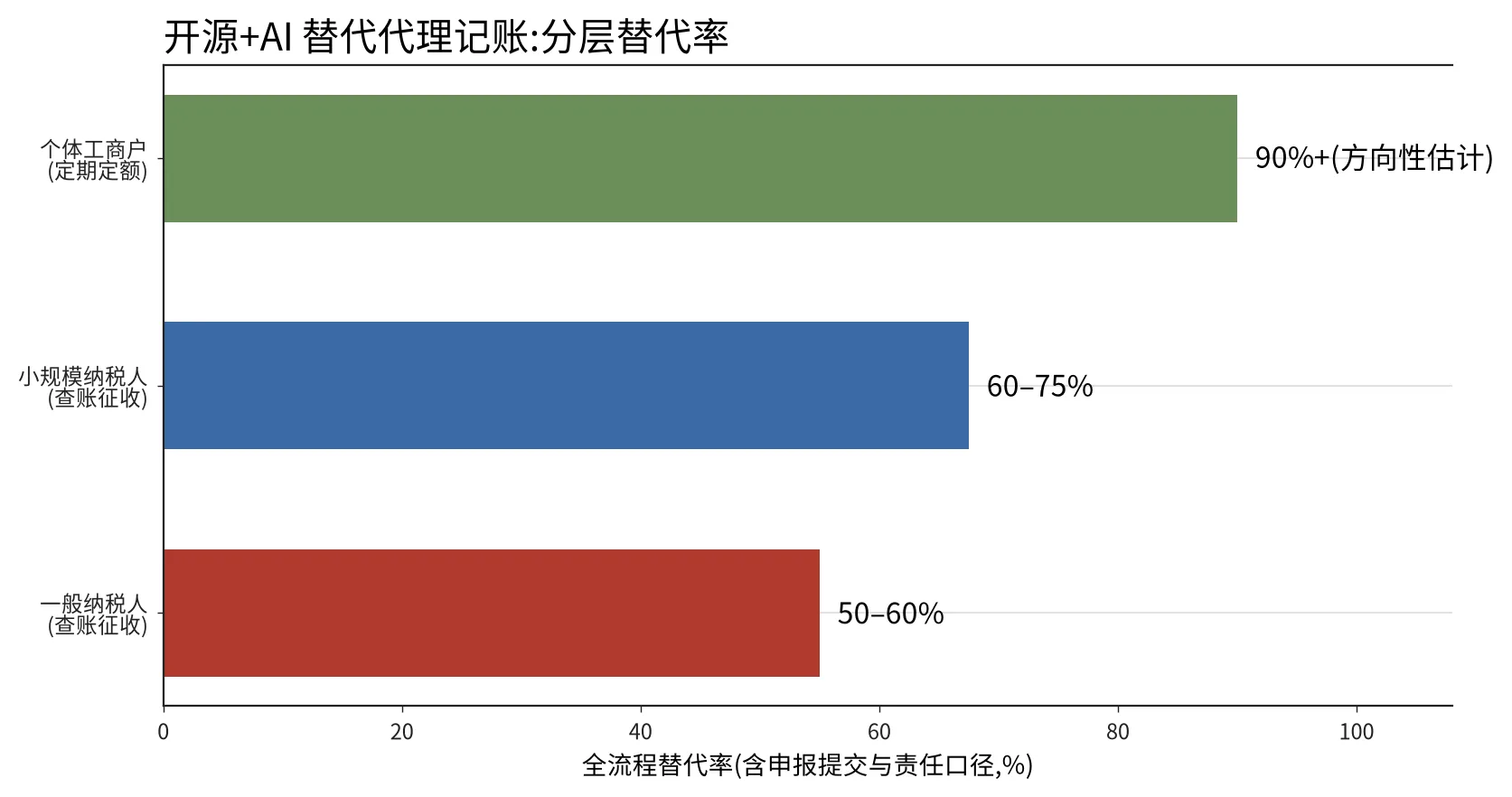
Can AI do the books? Maturity tiers
This part is the most counterintuitive, so let’s start with the data:
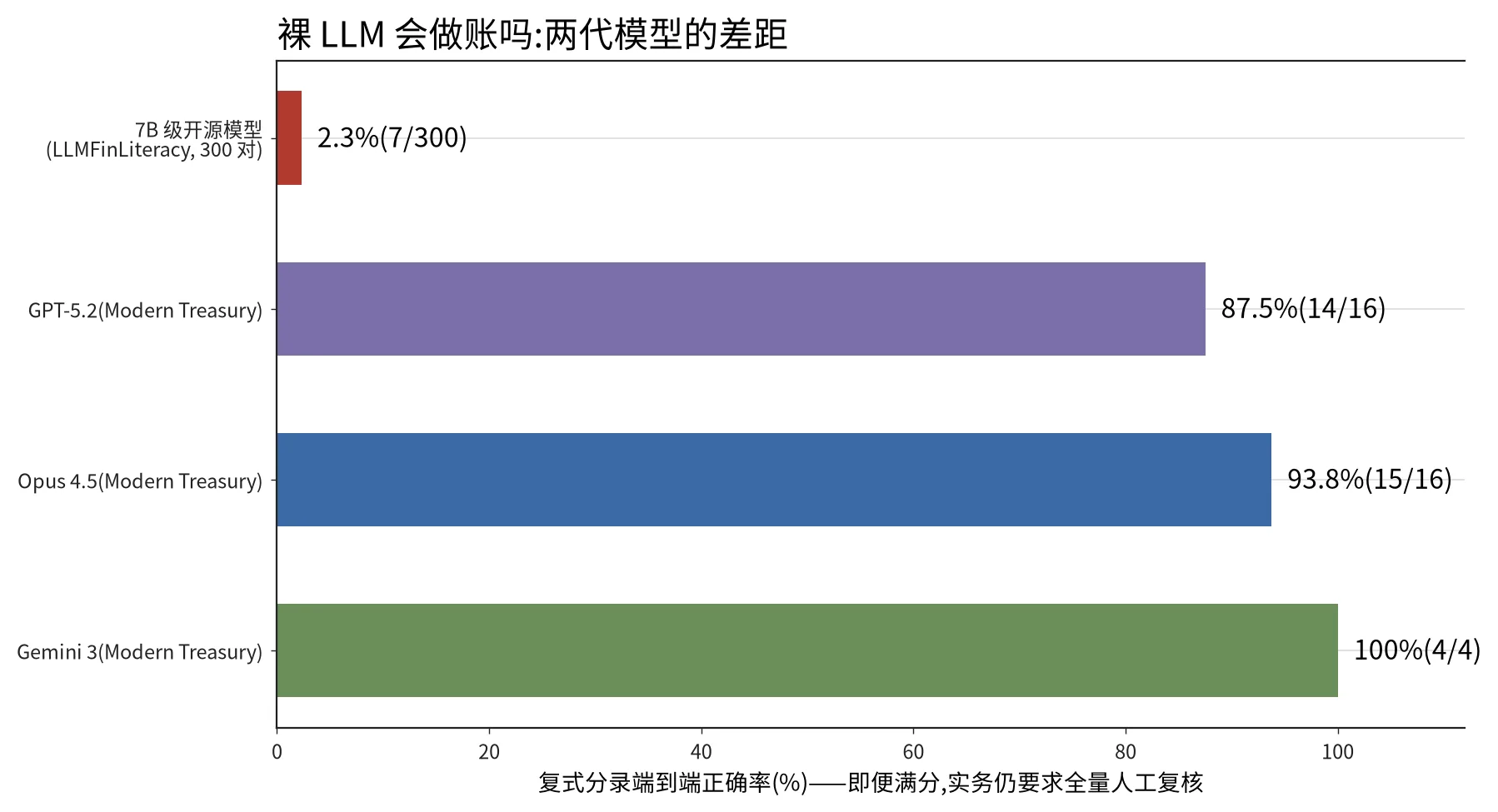
- Raw LLMs generating double-entry entries: unreliable. Beancount’s official LLMFinLiteracy benchmark (2026-06): 7B-class open-source models achieve an end-to-end fully-correct rate of only 2.3% (7 out of 300 pairs) — syntactically perfect, wrong on accounting reasoning. Frontier models do far better in Modern Treasury’s evaluation (Gemini 3 perfect, Opus 4.5 at 15/16), but even the perfect model still requires full human review in practice. “Compiles but semantically wrong” entries are the biggest risk.
- Mature and usable: fully digitalized e-invoice XML parsing (the single biggest dividend in the whole chain, more below), invoice email collection (Invoice-Downloader, 438★), Beancount double-entry ledgers, PaddleOCR (90,140★) infrastructure, Alipay/WeChat statement import (double-entry-generator, 720★).
- Semi-mature, needs building: corporate bank statement parsing (no ready-made templates), reconciliation matching (the highest-starred GitHub project is a 14★ teaching project), LLM Chinese account classification (nearly a blank — both a risk and an opportunity).
Why e-invoice XML is the biggest dividend: the native data form of a fully digitalized e-invoice is XML with a tax digital signature; PDF/OFD are just layout files. GB/T 44554.2-2025 explicitly permits XML for bookkeeping and archiving, and email delivery is an officially supported method. This means the old OCR-era headache of “recognizing invoices” turns directly into “parsing XML” — zero recognition error, plus local signature verification. Unify your invoicing inbox into one dedicated email address, and your invoice pool forms itself.
Recommended architecture: AI drafts, human signs
Putting it all together, for a software/services small business like mine with tiny invoice volume, the component-level design looks like this:
- Ledger core: Beancount (plain text, git-versioned) + self-hosted Fava as the review interface
- Invoice collection: all invoicing goes to a dedicated company email, IMAP script pulls PDF/OFD/XML
- Parsing: read XML directly (zero error + signature verification); OFD via ofdrw (1,877★); only pure images go through RapidOCR → VLM structured extraction
- Entry generation: the LLM only outputs account suggestions + descriptions + tax rate judgments; entries are assembled by deterministic code templates (special VAT invoice input → debit expense + taxes payable-input VAT / credit accounts payable), and the LLM never touches amount calculations; bean-check performs a hard debit-credit balance validation, rejecting anything unbalanced; invoices are archived and deduplicated by sha256
- Bank statements: online banking CSV → rule-based matching (amount + date ±3 days + account name), long-tail fuzzy matches suggested by LLM, month-end balance assertion reconciles the balance
- Scheduling: Windmill collects invoices daily + closes the books on the 1st of each month, pushes the pending diff to Telegram, human review then posts to the ledger
- Filing endpoint: manual self-filing on the e-tax bureau web portal — the only link in the whole chain that can’t be API-ified, about 10 minutes for a zero filing
Head-to-head on the alternatives: Odoo Community vs ERPNext (data source-verified at code level as of 2026-09-24)
| Dimension | Odoo 18 Community + l10n_cn | ERPNext v16 + China fork |
|---|---|---|
| Chinese chart of accounts | Officially included, two sets (small business standards ~30 accounts / enterprise standards 100+ accounts, installed automatically with the accounting package) | Built-in Chinese COA unusable (82 accounts with no codes, officially marked unverified); most complete patch = NolanZONG fork (190 coded accounts, single maintainer, 0 stars) |
| VAT templates | Officially included (13% / small-scale templates) | NolanZONG fork (13%/9%/3%/1%/0%, special invoices tax-inclusive/exclusive, general/small-scale) |
| Three major statements in Chinese format | None (even Enterprise statements aren’t in Chinese format); workaround = OCA account_financial_report + mis_builder self-configuration, or buy the CLuedoo China reporting module for $251 | None natively; the NolanZONG fork has a reference implementation of balance sheet / income statement (account number cross-check + omission checks) / cash flow statement using the direct method |
| Accounting vouchers | Native QWeb voucher PDF, including RMB amounts in uppercase Chinese numerals (cn2an), account.move ships with a fapiao field | 19 voucher types (Journal/Bank/Contra/Opening etc.), no Chinese voucher format |
| E-invoice / golden tax integration | Zero (searching the official app store for “e-invoice / e-tax bureau / golden tax” yields 0 hits) | Zero (GitHub search for “e-invoice + erpnext” yields 0 hits; ERPNext e-invoicing integration covers Malaysia/EU/Saudi Arabia, China is the only blank) |
| Invoice OCR | Not in Community (locked to Enterprise IAP); free third-party apps exist, OCA/ai can connect to Ollama | invoice2erpnext (37★) is European format + paid API, not applicable to Chinese invoices |
| Multi-company / multi-ledger | Basic multi-ledger works, consolidated statements/intercompany transactions locked to Enterprise Custom tier ($40.90/user/month ≈ 3,900 yuan/year) | Natively the strongest: multiple fully isolated sites per bench + multi-company per site + consolidated statements + cost centers, no plugins needed |
| Deployment resources | ~0.5–1.5GB RAM + PG, official Docker mature | Production minimum 4GB RAM (8GB recommended), roughly 3–8x Odoo |
| Major version upgrades | Official upgrade service not open to Community, relies on OCA OpenUpgrade to muscle through, medium-high difficulty | One major version per year, patch migrations carry failure risk, requires downtime + rollback plan |
| Customization learning curve | Studio low-code, relatively quick to pick up, but ORM + inheritance + module conflicts are deep water | DocType system is steeper (full-stack Python + Jinja + JS), but for rule-clear scenarios like bookkeeping, once learned the changes are predictable |
| License | LGPL-3, self-developed modules can stay closed, light commercial distribution obligations | GPL-3, distributing the whole system externally requires open-sourcing |
| China community ecosystem | OCA l10n-china branches 12.0–19.0 are all empty shells (effectively dormant), GoodERP stopped updating in 2020 | The saoxia fork (81★) is CRM/HR localization, not finance, and dormant; the most complete finance one, NolanZONG, is one person with 11 commits |
Once you’ve assembled the puzzle on both sides, the conclusion is more interesting than “which is better”: the Chinese tax compliance layer is incomplete in both ecosystems; the only difference is the shape of the incompleteness. Odoo is “the official side gave you half a foundation (chart of accounts + tax + vouchers), with the entire superstructure empty”; ERPNext is “the strongest financial core (double-entry / multi-company / multi-ledger, all native), but even the foundation has to be scavenged from a single-person community fork.”
So the decision rules become clear:
- If within 2 years you need to issue special VAT invoices to large clients, raise funding with due diligence, or face external audit → Odoo Community + l10n_cn: the officially maintained Chinese chart of accounts + voucher printing are the only part where “someone has your back,” and accounting firms can read it
- If one person manages several small businesses and needs fully isolated ledgers → ERPNext’s multi-site/multi-company is native and plugin-free; but you must accept forking NolanZONG’s single-maintainer fork and maintaining it yourself
- If it’s purely for managing your own money with tiny invoice volume → the main plan, Beancount, is still the most economical (resource usage is a fraction of either, and its git-based audit trail is naturally friendly)
E-invoice entry is zero on both sides and must be built in-house — but shared components already exist: erma0/fapiao-print (160★, MIT, active) can parse the <EInvoice> XML and OFD of fully digitalized e-invoices, and this layer works across both foundations. The deeper foundational comparison (jshERP’s 35 CVEs, Odoo’s marketing modules, etc.) I’ve written up in another piece, “The Open-Source Bookkeeping Foundation” — the two complement each other.
Four steps to roll it out (switch at the end of an accounting period, year-end is best)
- Handover period (1 week): request in writing the period-end account balance table, general ledger detail, historical filings, ledger backups, and unsettled items (accruals / uncredited input VAT / outstanding receivables and payables), and sign a handover confirmation
- Initialization (1–2 weekends): convert account balances into Beancount opening assertions, park the difference in “receivables/payables pending investigation” and clear it item by item; historical vouchers need not be migrated one by one, just archived in git
- Parallel period (1 quarter): downgrade the agency to filing only, and verify yourself that the filed numbers match your own books
- Steady-state takeover: terminate the contract, take back the tax officer permissions; double-insure the filing calendar with Windmill + phone calendar — once you drop the agency there’s no safety net, and late filing means fines plus abnormal-taxpayer status, and even a zero filing still has to be filed
When you should give up and build it yourself
Six deal-breaker signals — any one of them means retreat to outsourcing: upgrading to general taxpayer status (mandatory conversion once 12-month sales exceed 5 million yuan, complexity jumps sharply); monthly invoice volume above 50 (manual review grows linearly); needing external audit/due diligence; hiring employees (individual income tax withholding + social insurance become a monthly hard process); a tax warning or audit appears; your own hourly rate exceeds the agency fee.
There are also two red lines, independent of whether you build it yourself: under Golden Tax Phase IV’s “governance by data,” two sets of books, hiding income in personal accounts, and divergence between filings and invoicing flows all trigger automatic warnings (case in point: a car reviewer who hid tens of millions in income was fined 2.47 million yuan); and on the LLM side, “compiles but semantically wrong” entries must pass three deterministic gates — debit-credit balance, tax rate legality, and invoice authenticity verification — with human confirmation records retained.
The cost math
Agency market rates (secondary sources, directional reference only): 150–300 yuan/month for small-scale taxpayers, 400–600 yuan/month for general taxpayers. Self-hosting: software cost is roughly zero; the real cost is labor — 2–4 hours/month steady state, 2–3x that in the first year of磨合, plus 0.5–1 day for the annual comprehensive income settlement. Purely on economics, if an hour of your time is worth more than 300 yuan, outsourcing still pays; what self-hosting buys isn’t just savings, it’s data sovereignty — a ledger you can check anytime, a git-based audit trail, instead of having to ask every single time.
A hybrid model is the safe way to start: downgrade the agency to filing only, use the open-source stack for internal books and the invoice pool, keep the books yourself, outsource the filing liability, and your monthly cost approaches zero in software fees.
Research methodology and the claims that got killed
Full disclosure: this round of research ran five tracks in parallel plus adversarial verification, and the following claims were refuted by a 3-vote margin and removed from the conclusions — “there are only three official filing entry points” (LeQi is a fourth channel); “LeQi is the only direct-connect channel and its threshold is uniform nationwide” (those are local guideline provisions); “2400 yuan/year and up for Gongsi Bao is the market price baseline” (price anchors are unreliable, so the agency rates in this article are directional only); “jshERP stopped updating two years ago” (there were commits that day). The 90%+ replacement rate for sole proprietors under fixed-rate assessment is a directional estimate with no independent research backing; e-tax bureau operational data is government self-reported and not independently audited.
This isn’t an article telling you to fire your accountant. It’s more like a map: where the ground is already flat (XML parsing, plain-text ledgers), where the walls are (filing APIs, verification interfaces), and the one door in the wall that’s open to big companies (LeQi). The wall won’t be there forever — LeQi thresholds are dropping, e-invoices are spreading, and LLM accounting reasoning is climbing up from 2.3%.
2–4 hours a month, in exchange for a ledger that’s always in your own hands. For me, that math works out.
Research methodology: 134 parallel AI agents (grok-deep-research deep research + four specialized tracks + 18 three-perspective adversarial verifications), open-source project data verified via gh CLI on 2026-09-24, 12366 bookkeeping agency data was a live API test that day. Details of the key claim verifications are in the “claims that got killed” section above.