
Open-Source Agent Routing Engine Released: Dynamic Decisions Cut Model Invocation Costs by Over 44%
openJiuwen, an open-source AI Agent platform jointly built by Huawei 2012 Labs, Huawei Cloud, Huawei Device, the Computing and Compute Power Vanguard Team, universities, and developers, has officially released X-Router, a self-evolving model routing technology. The technology is designed to let Agents dynamically choose the most suitable model based on task complexity—ensuring every request selects the right model and every piece of feedback informs a better, more cost-effective choice next time.
Key facts:
- Release date: Officially launched in October 2026
- Open-source platform: openJiuwen as a whole is an open-source AI Agent platform
- Routing algorithm: The x-router algorithm is already in production and can also support multiple approaches, including a lightweight lookahead router implemented in Rust
- Five-tier model pool: Five levels from SIMPLE to REASONING, with local and cloud models deployed in a hybrid lineup
- Classifier deployment: X-Router uses a locally deployed Qwen3-0.6B classifier that runs in-process without requiring a standalone service
A Three-Layer Capability Architecture: See Accurately, Choose Correctly, Improve with Use
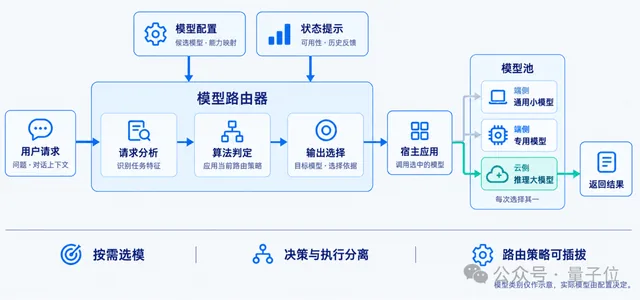
The X-Router system consists of three layers of capabilities that together form a complete routing system:
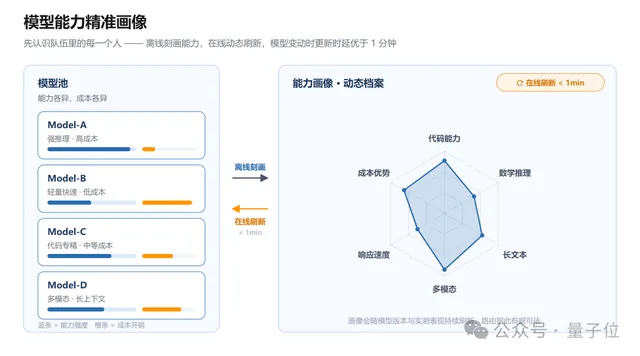
Layer 1: Accurate Profiling Model capabilities are not static labels. openJiuwen creates offline model capability profiles based on historical data and dynamically refreshes them online, with update latency under 1 minute. The profiles include granular metrics such as performance across different task types and difficulty levels, latency and power characteristics, and cost magnitude—rather than vague scores like “coding ability: 8, math ability: 7.”
Layer 2: Dynamic Decision-Making The decision logic considers both the request itself and system state: at the request level, it looks at task complexity and conversation trajectory; at the system level, it comprehensively evaluates KV cache affinity, real-time load, target availability, and more. Through heuristic optimization, the algorithm balances quality, cost, latency, and context compatibility to select the “optimal” model rather than the “strongest” one.
Layer 3: Self-Evolving Mechanism Decoupling the algorithm from state is key. The algorithm is a pure function, while state is externalized in a separate layer. A feedback loop turns execution results—success or failure, latency, cost, quality score—into experiential data. This design delivers important properties: if state is lost, routing merely degrades to “cold routing” rather than failing; and the