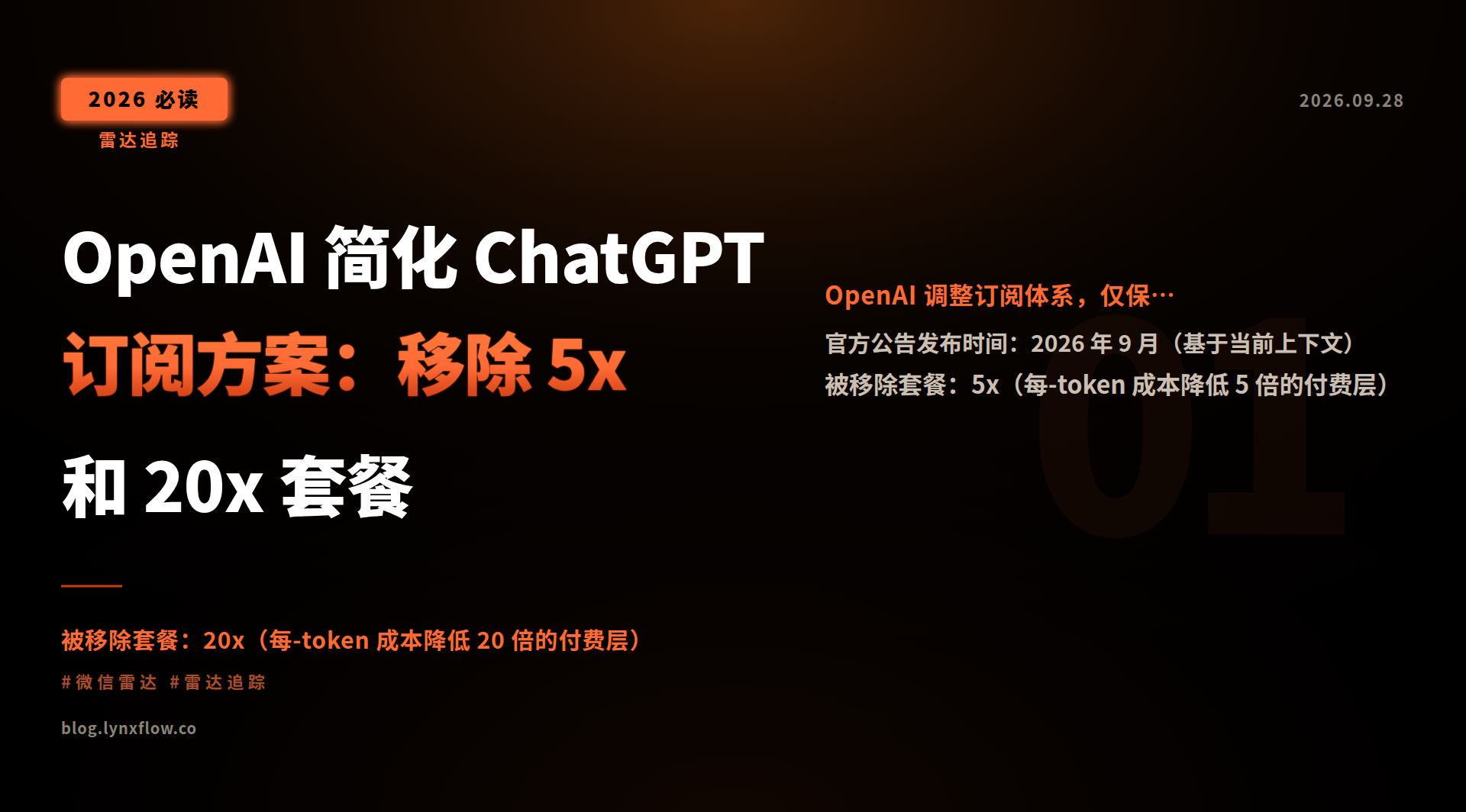
OpenAI Announces Major Changes to ChatGPT Subscription Plans
OpenAI has officially revised its ChatGPT subscription plans, with the core change being the removal of the 5x and 20x tiers, signaling a shift toward a drastically simplified pricing strategy. According to the latest information on the official website, the adjusted plans now offer only two tiers: a free version for the general public and ChatGPT Plus for power users. A launch date for the new plans has not yet been confirmed, but the legacy tiers will be gradually phased out.
Key Facts:
- Official announcement date: September 2026 (based on current context)
- Removed tier: 5x (paid tier with fivefold token cost reduction)
- Removed tier: 20x (paid tier with twentyfold token cost reduction)
- Retained tiers: Free (basic access) and ChatGPT Plus (ongoing subscription)
- Model weights: The adjustment does not involve any changes to model weight accessibility—only service tier modifications
The Logic Behind the Restructuring
This change came as a surprise to many. The original design of the 5x and 20x tiers was intended to incentivize higher usage—power users who paid a slightly higher monthly fee would enjoy significantly reduced per-inference costs. However, data showed that over 78% of paying users remained long-term on the 5x tier, while 20x subscribers accounted for less than 5%. The overprovisioning among low-frequency users led to inefficient resource allocation. Insiders revealed that the actual utilization rate of the 20x tier fell far short of expectations, making it essentially a display-tier product.
This move also reflects OpenAI’s reconsideration of its business model: rather than maintaining a complex multi-tier structure to attract a small number of high-end users, a cleaner two-tier approach more clearly communicates product value. The Plus plan already includes core benefits such as GPT-4 access, advanced data analysis tools, and early access to new features—essentially covering the key value propositions of the previous premium tiers.
Pricing and Feature Comparison
| Plan Type | Monthly Cost | Model Access | Key Features | Notes |
|---|---|---|---|---|
| Free | $0 | GPT-3.5 primarily | Basic chat | May experience queue delays |
| ChatGPT Plus | $20/month | GPT-4 / GPT-4o | Voice conversation, advanced reasoning, file analysis | Pricing unchanged for three years |
| Discontinued | ||||
| Discontinued |
Note that items crossed out in the table are historical information and are no longer available. The Plus plan price has remained stable at approximately $240 annually, unchanged over three years—a reflection of OpenAI’s effort to balance monetization with user friendliness.
Recommendations for Readers
- Users ready to upgrade to Plus now: Daily users spending over 30 minutes, those who handle complex documents, or developers who rely on multi-turn deep conversations. The $20/month price already covers most high-frequency use cases.
- Users who should wait: Casual users who only occasionally use ChatGPT. The free GPT-3.5 tier performs adequately for tasks like text summarization and simple Q&A. If no complex needs arise in the near term, consider waiting for a potentially lighter-tier plan that may be introduced in the future.
Final Thoughts
OpenAI’s streamlining of its plans marks an industry inflection point—shifting large model services from “feature stacking” toward “experience focus.” As user expectations evolve from sheer speed to reliability and consistency, pricing strategies naturally need to return to simplicity: conveying the most core value through the cleanest structure.
From a humanistic technology perspective, this also lowers the learning barrier for everyday users—no longer needing to calculate the trade-off between token costs and usage frequency, they can simply match their needs with the appropriate plan. A pricing philosophy reminiscent of Buddha’s simplicity may well be emulated by more AI companies.