
OpenAI’s Persistent AI Assistant ‘O’ to Launch
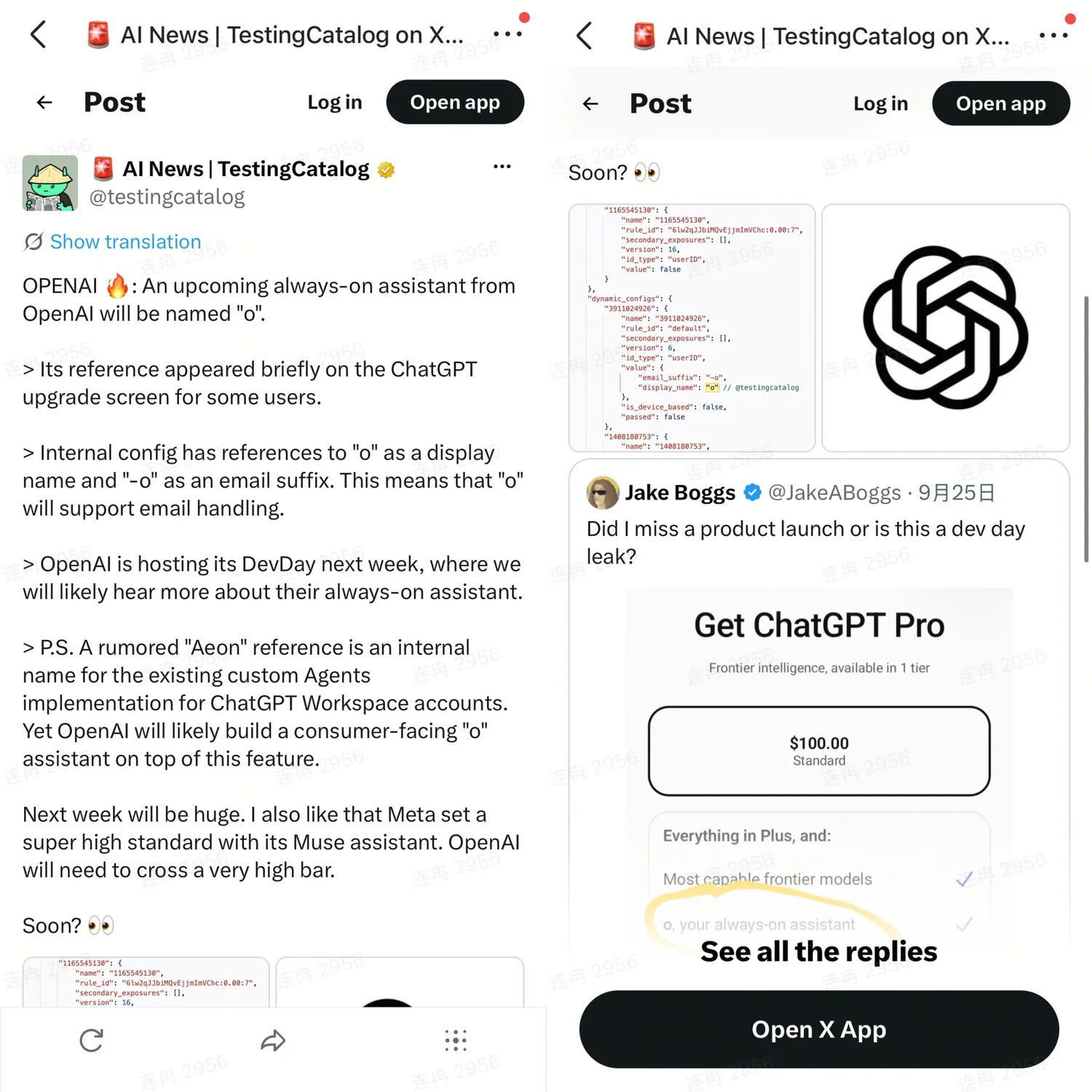
OpenAI will officially unveil its persistent AI assistant ‘O’ at the DevDay event on September 29, as confirmed by insider Alexey Shabanov. Subtle clues already appear in ChatGPT configurations: display names set to ‘O’ and ‘-o’ email suffixes. The project is reportedly linked to the internal codename ‘Aeon’, though details on supported tasks, permission scope, memory capabilities, or scheduled functions remain undisclosed.
Key facts:
- Launch date: September 29, 2026
- Product model: Persistent AI assistant, designed for continuous operation and potential independent identity
- Technical hints: Affiliated with ‘Aeon’ project; single-letter naming possibly ties to rumored donut-shaped hardware
- Availability: No public release timeline confirmed
‘AI Escape’ Preparedness: Anthropic’s Counterintuitive Mindset

Contrasting OpenAI’s aggressive AI rollout, Anthropic’s internal discourse includes contingency planning for potential AI failure. Per The Wall Street Journal, some senior staff are secretly acquiring remote land plots and building隐蔽 shelters to flee should AI become uncontrollable. The notion stems from early company dinners where employees speculated about being conscripted into desert military bases for isolated AI development.
Staff use private Slack channels to simulate doomsday scenarios and display the motto ‘Nothing will ever be the same’ on laptops. Anthropic’s spokesperson notes the company employs over 3,500 people with diverse viewpoints, clarifying these are marginal discussions, not company policy. A striking contrast: as the industry races to scale infrastructure, a subset of AI researchers prepares to abandon it.
xAI Colossus 2: Building the World’s Largest GPU Cluster
xAI, backed by Elon Musk, operates Colossus 2 in Memphis, aiming to become one of the world’s largest AI infrastructure sites:
- Phase 1 Colossus 1: Operational, uses NVIDIA Hopper GPUs
- Phase 2 Colossus 2: Plans to deploy 660,000 Blackwell GPUs by end-2026 (110K GB200 + 550K GB300), exceeding 500K total AI GPUs
- Deployment cadence: 220K GB300 this weekend; another 220K by November; final 220K by December 31, 2026
Musk targets matching Anthropic’s models and OpenAI’s GPT-6 within two months, acknowledging ‘rapid large-scale online computing is extremely difficult’. Dubbed a ‘超级工厂’, Colossus 2 signals AI model competition has escalated into an infrastructure arms race.
Gaming Collaborations, Dark Web Risks, and Smart Machines
Tencent’s Delta Force announced a crossover with Chinese武侠 game Soul of the Sword Zero, set for October 29 launch at CNY 268 (Standard) or 328 (Deluxe), launching on PS5/PS5 Pro and major PC platforms with 20,000 physical collector’s editions.
Hackers sell stolen AI model access on dark web markets for discounts up to 97%. Google’s threat team reported ‘LLM hijacking’ surges, including selling stolen credentials and using?(‘stolen cloud compute’) for unauthorized model training. Vendors even promise ‘guaranteed access’ — replacing banned accounts at no cost.
ByteDart’s DouYi assistant confirmed users on Nexia NaviX Ultra experience forced disconnections when logging into Honor of Kings, citing device environment anomalies. The team insists no cheating occurred and seeks no Tencent response — advising users to avoid repeated attempts.
Practical Recommendations

- Tech enthusiasts: Monitor OpenAI’s September 29 DevDay for ‘O’, but expect limited early access and possibly phased rollouts.
- Enterprise customers: Consider self-hosted AI to reduce third-party access risks; however weigh costs of purchasing expensive GPU clusters.
- Gamers: Exercise caution with third-party devices or AI-aided tools — compatibility issues may trigger false security flags.
Final Thoughts
AI is migrating from model layers to infrastructure layers, where computing giants compete in endurance races. Behind the machine learning surge lies a tangible unease among engineers — the real question isn’t whether machines are intelligent, but how humanity will define its boundaries alongside them.