
The Chip Makes Its Official Debut: Release Date, Specs, and Availability at a Glance
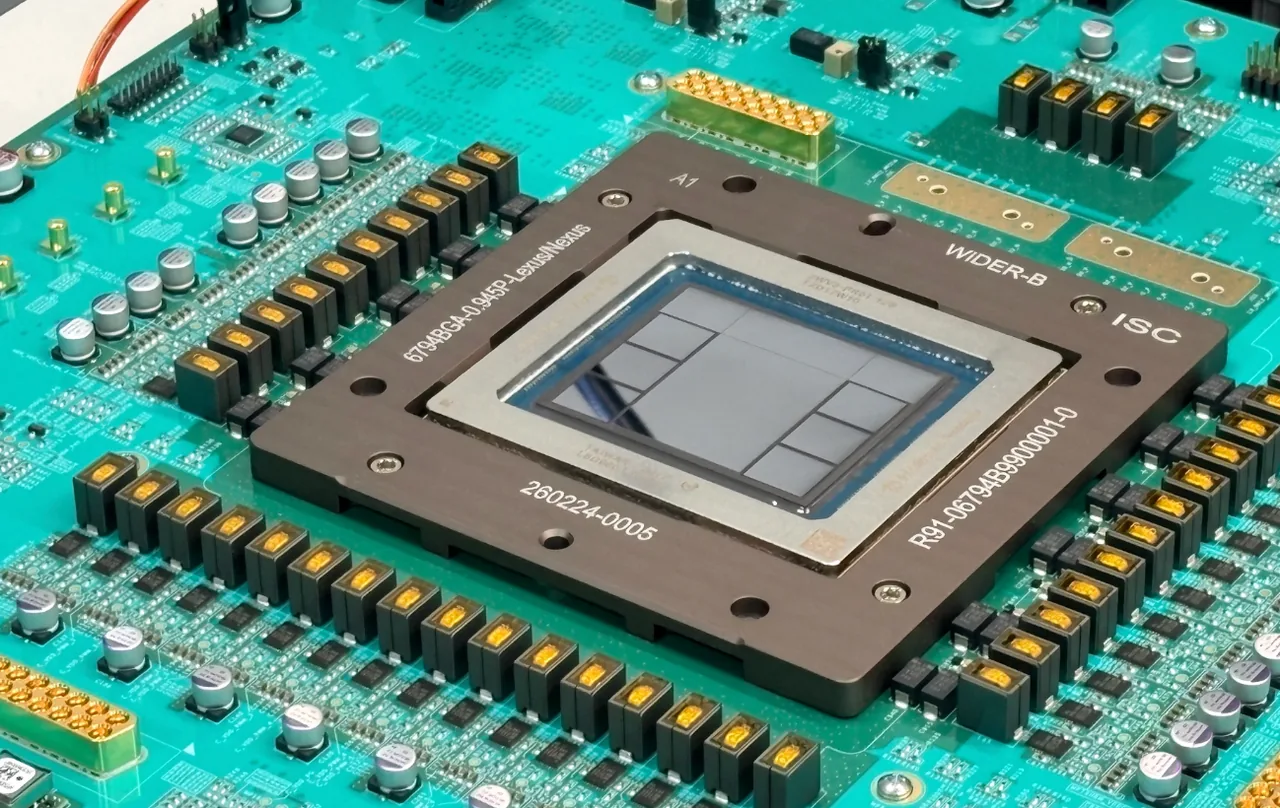
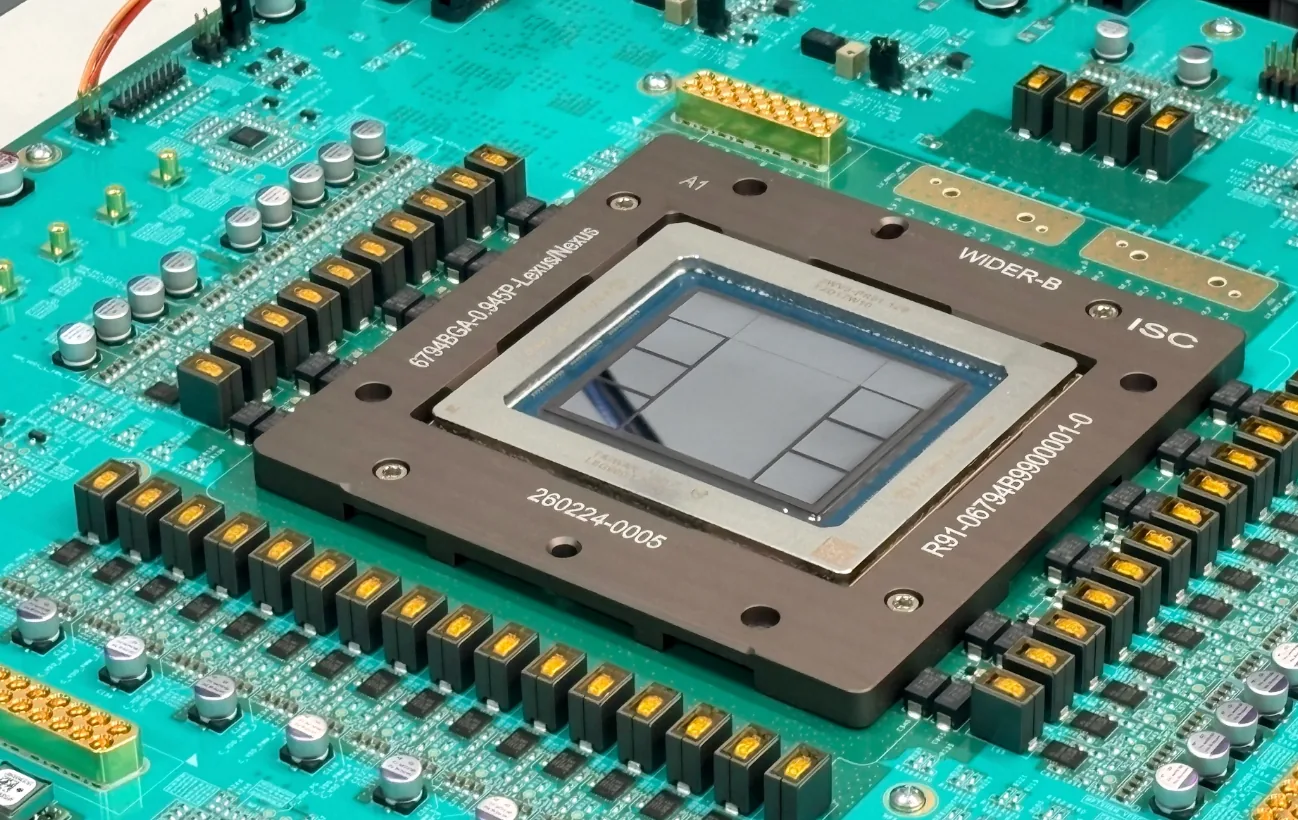
On August 25, 2026, at the Hot Chips conference, OpenAI publicly unveiled third-party-witnessed benchmark results for Jalapeño, its first in-house inference chip. The core hard facts are as follows:
- Release date: August 25, 2026 (Hot Chips)
- Partners: OpenAI led architecture design, Broadcom contributed implementation, networking, and connectivity, and Celestica handled board and rack integration
- Rated power: 700W
- Memory configuration: HBM4, with roughly 15.4TB/s of memory bandwidth per package
- Compute spec: B0 version theoretical MXFP4 compute of 13.4 PFLOPS
- Process version: A0 engineering silicon has already been used for benchmarking; B0 has entered TSMC N3P manufacturing
- Deployment plan: Extremely small-scale deployment by the end of 2026, with true volume ramp expected in 2027
- Test models: GPT-OSS 120B, DeepSeek R1 670B, and Kimi K2.5 1T, three public large models
Benchmark Performance: Energy Efficiency Doubled, With an Even Bigger Edge in Low-Latency Scenarios
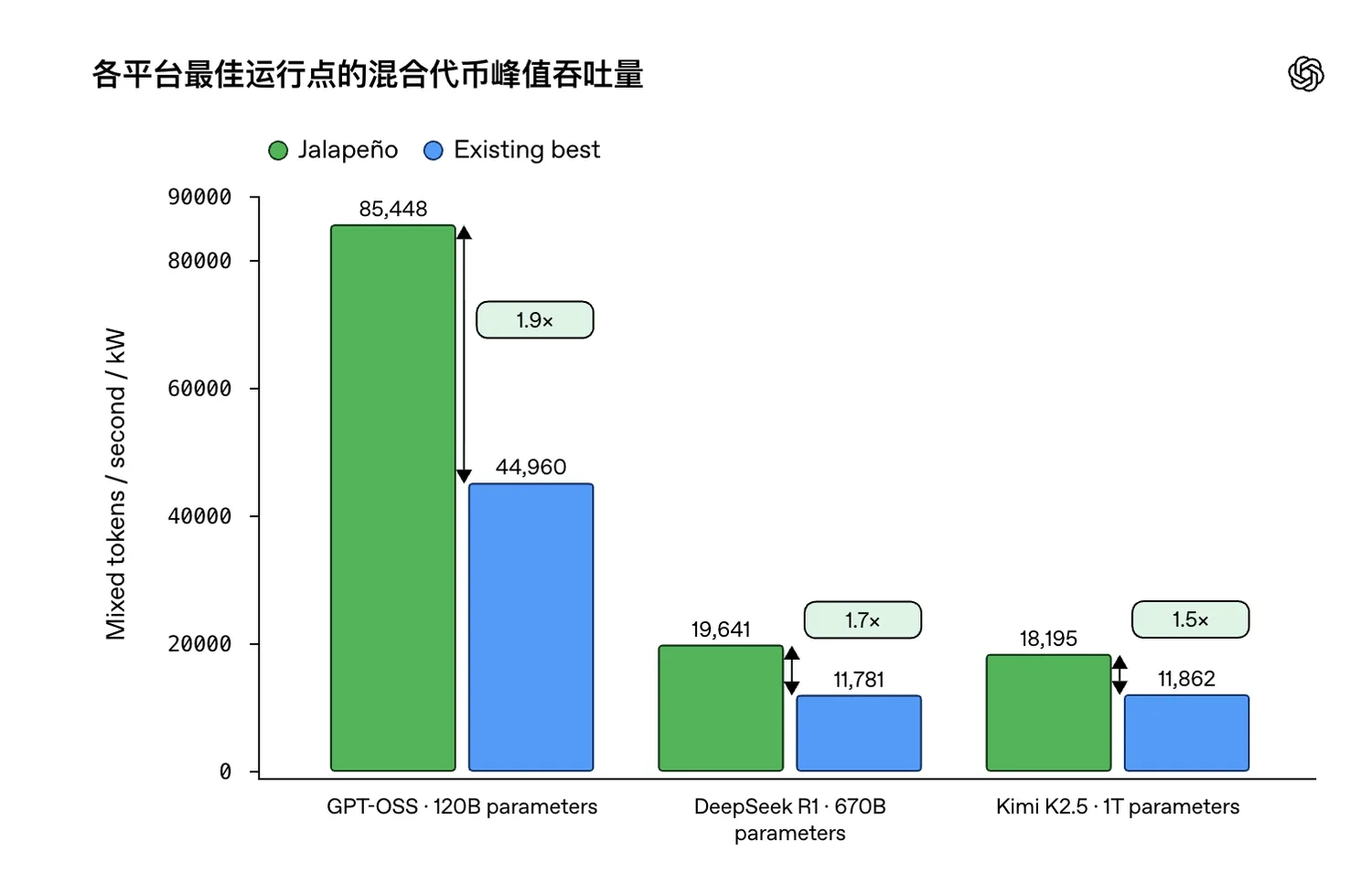
Jalapeño was benchmarked against NVIDIA’s Blackwell system (GB300) in SemiAnalysis’s InferenceX benchmark, with the following results:
- Throughput per kilowatt: Across the three models, it reached 1.5x to 1.9x that of NVIDIA’s system, meaning nearly twice the work for the same amount of power
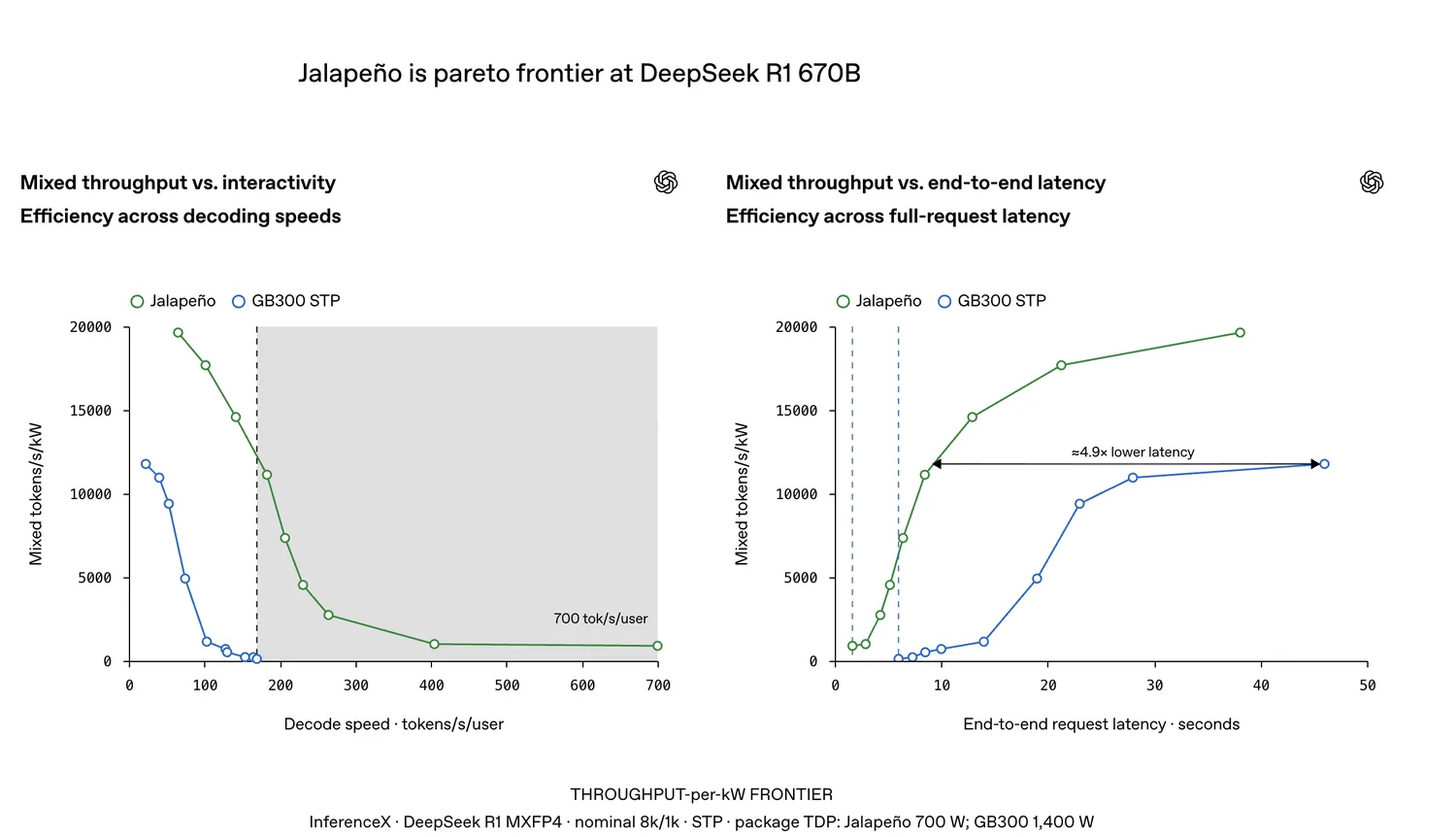
- Low-latency performance: On DeepSeek R1, single-user generation speed peaked at about 700 token/s, versus only about 169 token/s for NVIDIA GB300—nearly 5x faster, cutting user wait time by about three-quarters
- Single-user peak generation speed (GPT-OSS 120B): Jalapeño at 1,459 token/s, NVIDIA at 535 token/s
- Trillion-parameter model latency optimization: On Kimi K2.5, minimum latency was 1.56 seconds, versus 5.31 seconds for NVIDIA
The most surprising contrast appeared in the fixed-speed scenario: when quality of service was fixed at 100 token/s per user, Jalapeño’s throughput running Kimi K2.5 reached more than 9x that of NVIDIA GB300, meaning it could serve 9x the number of users at the same service level. This highlights the enormous impact of chip architecture on real-world business capacity.
Design Philosophy: Keep Data in Place, Built for Shifting Model Traffic
Jalapeño’s core design principle is to reduce data movement—an industry consensus holds that “compute is nearly free, but moving data is what’s expensive.” Its key architectural choices include:
- Compute-memory partitioning: Compute cores and HBM4 memory are divided into matched slices, creating low-latency direct channels and avoiding frequent data fetches from a shared memory pool
- Unified accelerator architecture: Prefill (processing input) and decode (generating token by token) are handled by the same accelerator, rather than split across a dedicated CPX chip as in NVIDIA’s Rubin approach. The rationale is that real traffic ratios keep changing with application type (chat, reasoning, agents), and a fixed division of labor tends to leave resources idle
- Memory bandwidth optimization: 15.4TB/s of bandwidth per package ensures the local data pool is large enough and fast enough to access
Notably, Jalapeño took only 9 months from initial design to tape-out, far shorter than the typical 18–24 month cycle for ASIC chips. According to the presentation, in some attention and MoE modules of GPT-OSS, AI-generated kernels were 1.5–1.8x faster than versions previously written by human experts; using Codex and GPT-Astra, OpenAI completed porting and optimization for DeepSeek R1 and Kimi K2.5 in only about two months.
Chip Comparison Table (Based on Public Benchmarks)
| Metric | Jalapeño | NVIDIA GB300 | Advantage Factor |
|---|---|---|---|
| DeepSeek R1 single-user generation speed | ~700 token/s | ~169 token/s | 4.9x |
| GPT-OSS 120B throughput per kilowatt | ~85,400 token/s | ~45,000 token/s | 1.9x |
| GPT-OSS 120B single-user peak | 1,459 token/s | 535 token/s | 2.73x |
| Kimi K2.5 minimum latency | 1.56 seconds | 5.31 seconds | 3.4x |
| Kimi K2.5 fixed-rate throughput (100 token/s/user) | 1 unit | ~0.11 units | >9x |
Usage Recommendations

- Who it’s for: LLM service providers that are extremely sensitive to inference costs; cloud service providers that need to support models across multiple architectures (including third-party models such as DeepSeek and Kimi) and are pursuing throughput per unit of power; early adopters planning to build their own inference infrastructure and willing to accept a 2027 volume ramp
- Who should wait: The current benchmarks are all single-turn inference scenarios with roughly 8k input and 1k output, and lack measured data for multi-turn interaction and long-context agent tasks; if your business relies heavily on complex routing and prefix caching, it is worth waiting for validation in real production environments; enterprises that are less demanding on low latency and place more value on compatibility with the existing ecosystem can keep watching how mature the GB300 ecosystem becomes
Final Thoughts

The “build chips for models” paradigm behind Jalapeño marks a shift in the compute race from adapting general-purpose chips to models toward chips and models co-evolving. Apple, NVIDIA, and OpenAI announced or unveiled chip developments in quick succession within 48 hours, each betting on one of three technology paths—“on-device process technology,” “general-purpose systems,” and “vertical specialization”—and the pricing power of chips in the AI era is being reshaped through a more diversified contest.