
Core Announcement: 28-Day Countdown Policy Launched

Tibo (Thibault Ottiaux), head of OpenAI’s Codex division, recently announced a limited-time policy: for the next 28 days, Codex/Work users must receive either a meaningful improvement or a full account reset each day. The policy went into effect and will run for 28 consecutive days.
Key details:
- Launch date: Recently (exact date not disclosed)
- Duration: 28-day continuous period
- Improvement criterion: “明显 useful to most Codex/Work users”—includes new features or simple bug fixes
- Reset scope: Full account quota reset
- Applicable users: Codex and Work subscriber base
- Model weight availability: Not mentioned
Background and Top User Pain Points

Before this announcement, Tibo sought community feedback on Codex improvements, identifying four focus areas: product simplification, efficiency gains, breakthrough features, and new models. User pain points fell into three categories:
First, feature overload without clear priorities. DevDay introduced 20+ updates at once, overwhelming users; the highly anticipated Agent Dot personal assistant reportedly underperformed expectations.
Second, unpredictable reset frequency disrupting workflows. Quota resets were designed to ensure uninterrupted work sessions, but now chaotic reset schedules complicate planning. New $500-tier plans are prohibitively expensive, while existing quotas shrink, creating a double-bind.
Third, models that fail mid-task. Connection drops persist regardless of quota resets—fixing the “quota” issue doesn’t solve model instability. “It’s like having infinite bullets but jamed every time,” users complained.
Unexpected contrast: OpenAI’s reliance on frequent resets to satisfy users highlights unresolved foundational model issues, creating dependency rather than trust.
Cross-Company Engagement and Community Reaction
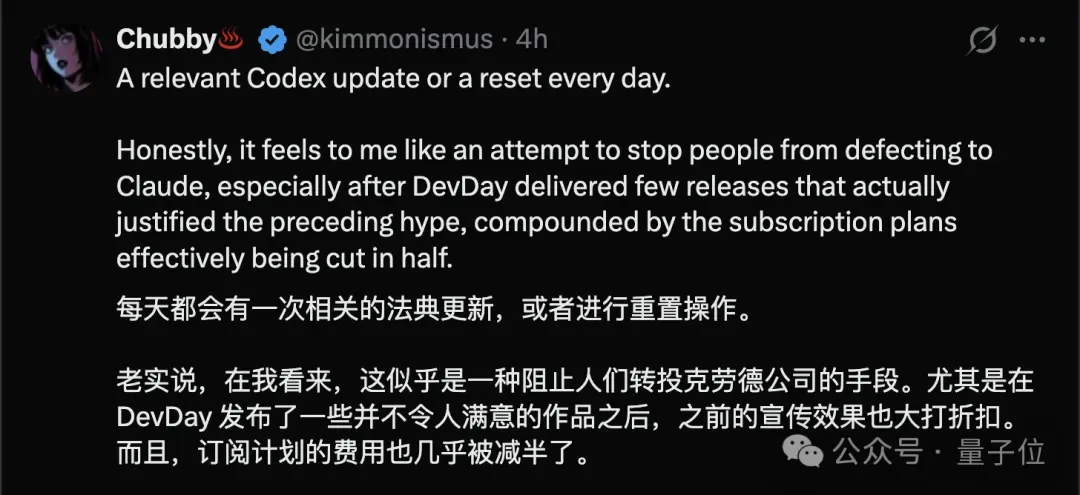
Tibo’s community-focused approach attracted industry attention. Grok Bot’s Lauren Tan criticized OpenAI for relying on resets as a “marketing crutch”, accusing it of prioritizing hype over substance. Tibo retorted tersely: “You do it better, then.”
Though partly performative, this exchange reflects AI product competition’s intensifying nature. What users truly want is practical, noticeable improvement—a single bug fix, interface simplification, or workflow reduction may qualify as meaningful change.
Implementation Guidance for Users

Best for immediate adoption:
- Codex/Work power users willing to iteratively adopt daily improvements
- Practical users who value frequent, incremental upgrades over monolithic releases
Best to wait for:
- Teams requiring production-grade stability with zero tolerance for mid-task failures
- Users focused exclusively on frontier model capabilities, indifferent to UX refinements
Final Thoughts
As competition matures, user power shifts from passive acceptance to active negotiation. Innovation must now bridge not just capability ceilings but experience floors—those who deliver tangible efficiency gains first will build lasting credibility.