
The launch: Decisions API opens to all customers

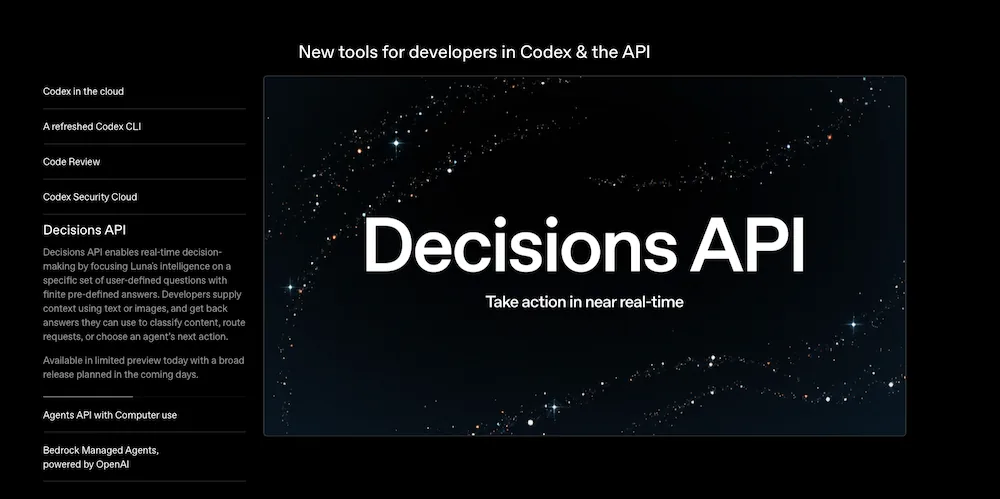
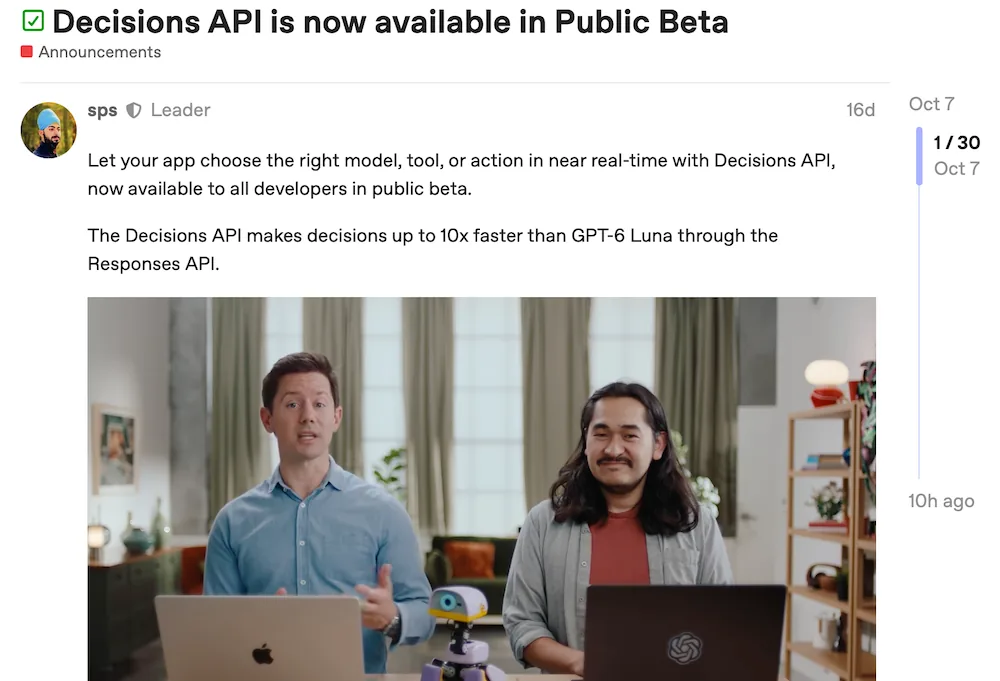
On Oct 22, OpenAI said its Decisions API is now generally available to all customers. Built on the reasoning model GPT-6 Luna, the interface is designed for fast, low-cost choices rather than long-form generation.
- Timeline: announced at OpenAI’s developer event on Sept 29, opened for public beta on Oct 6, and became generally available on Oct 22.
- Model: OpenAI did not train a dedicated decision model from scratch; it adjusted GPT-6 Luna’s reasoning approach to cut latency and cost.
- Access: available to all customers as an API, not as open weights.
- Inputs and scale: accepts text, images and structured data; each request can handle up to 400 questions, double the beta limit.
- Use cases: developers predefine a question and answer options; the model returns probabilities, choices or scores for content classification, request routing and deciding an AI agent’s next action.
- Pricing: no standalone pricing was disclosed in the source material.
The product sits between classification and agent control. It is not meant to write essays; it is meant to turn bounded questions into decisions that software can act on.
The speed pitch: 100 ms and customer numbers

Nikunj Handa, OpenAI’s API product lead, said the team saw TypeSafe’s Jev model and realized decision models had many potential applications. OpenAI then chose to adapt GPT-6 Luna instead of building a new model. Handa said the biggest improvement is speed: some tasks drop from 1–3 seconds to 100 ms, 120 ms or 180 ms.
Customer examples:
- Datadog uses the API to assess the risk of commands generated by AI agents. Its P95 latency is about 40x faster than available frontier models. P95 latency is the cutoff for the slowest 5% of requests.
- Ramp attributes AI call costs to specific work tasks and reports 4x faster processing and 30% lower cost.
- Speak cut waiting time between user actions in GPT-Live from 1.4 seconds to 0.13 seconds, a drop of more than 90%.
- Box showed the API classifying business documents and routing them to the right processing step.
The surprise: OpenAI’s speed story does not translate into top third-party decision rankings. In AIMultiple’s System One Index, the latest Jev ranks 7th and OpenAI’s Decisions API ranks 14th. In Artificial Analysis’s Decision Index, Jev ranks 2nd and Decisions API 11th. Opper AI’s JevMan benchmark, which has models play Pac-Man, puts Jev 1.14 first with an average 3,597 points; GPT-6 Luna ranks 8th with 2,568. TypeSafe’s internal test says Jev reached 68% accuracy across eight workflow tests, tied for 3rd with OpenAI’s Tera. Different benchmarks measure different things, but the contrast shows speed alone is not the same as better decisions.
TypeSafe was co-founded by Diogo Almeida, a former OpenAI researcher. It launched Jev, its first System One model, on Sept 15, and released Jev 1.14.0 on Oct 14 with image-input support. Handa stressed OpenAI’s multimodal image-classification and confidence-calibration strengths. Confidence calibration means whether the model’s stated probability matches its real accuracy. Handa also said that if latency fell to about 60 ms, developers could call the API on every video frame.
Comparison table (source-material data only)
| Item | OpenAI Decisions API | TypeSafe Jev |
|---|---|---|
| Base/version | Built on GPT-6 Luna | Sept 15 first System One; Oct 14 1.14.0 adds image input |
| Response/positioning | Some tasks cut from 1–3 s to 100/120/180 ms | Returns preset choices and probabilities for software |
| Request limit | Up to 400 questions per request, 2x beta | — |
| AIMultiple System One Index | 14th | 7th |
| Artificial Analysis Decision Index | 11th | 2nd |
| JevMan Pac-Man average | GPT-6 Luna 2,568, 8th | Jev 1.14 3,597, 1st |
| Customer examples | Datadog ~40x faster P95; Ramp 4x speed, 30% lower cost; Speak 1.4 s to 0.13 s | — |
Who should try it, who should wait
Teams with bounded, enumerable choices and tight latency or cost budgets should test it first: content classification, ticket or request routing, rule checks, and an AI agent’s next-action selection. If an existing LLM chain has nodes that are essentially multiple-choice calls, isolate those nodes and compare latency, accuracy and cost on your own samples. The Datadog, Ramp and Speak examples suggest watching P95 latency, cost per task and waiting time, not just average response.
Teams should wait if their tasks are open-ended, need long-chain reasoning or generative output, or require very high accuracy and confidence calibration without an internal evaluation set. Relying only on public leaderboards is also risky: Jev and Decisions API trade places across different evaluations. A small A/B test in the real workflow is the safer path.
Final word
The decision-API race is pushing models from ‘better at generating’ toward ‘faster and cheaper at judging.’ Speed gets a model into the workflow, but accuracy, confidence calibration and cost per task determine whether it stays in production. OpenAI’s entry gives developers more choices and brings market scrutiny to decision models sooner.