
Quick Summary
On September 23, 2026, OpenAI officially launched two new members of the GPT-6 family—GPT-6 Sol and GPT-6 Luna. The models are trained using methods similar to GPT-6 Astra, bringing Astra’s advanced capabilities in professional tasks, factual accuracy, coding, computer use, and alignment into faster, more economical models.
Key facts:
- Release date: September 23, 2026
- New models: GPT-6 Sol, GPT-6 Luna
- API pricing: 50% lower than GPT-5.6 promo price
- Availability: Immediately available via ChatGPT Work and Codex for Plus/Pro/Business/Enterprise/Edu users; GPT-6 Luna accessible to free and Go users on desktop; not yet available in Chat
- Model IDs:
gpt-6-solandgpt-6-lunafor API - Weight release: Not mentioned—no open-weight information
Performance: Closing the Gap to Astra
GPT-6 Sol and Luna are not simplified versions—they deliver near旗舰 (flagship) quality across multiple professional benchmarks.
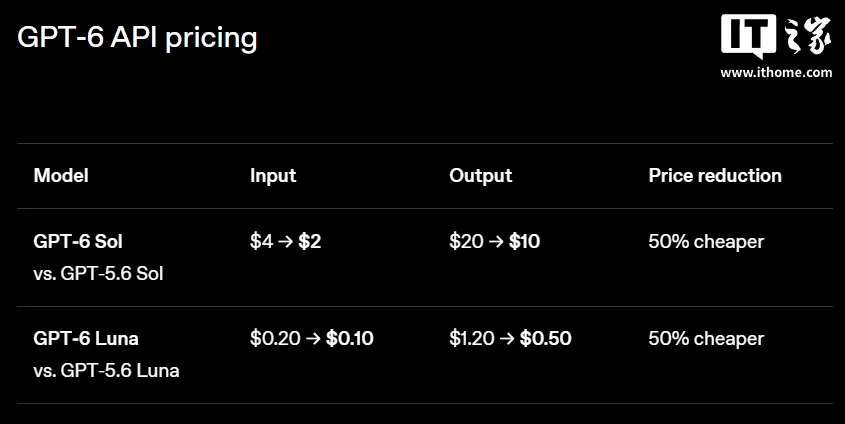
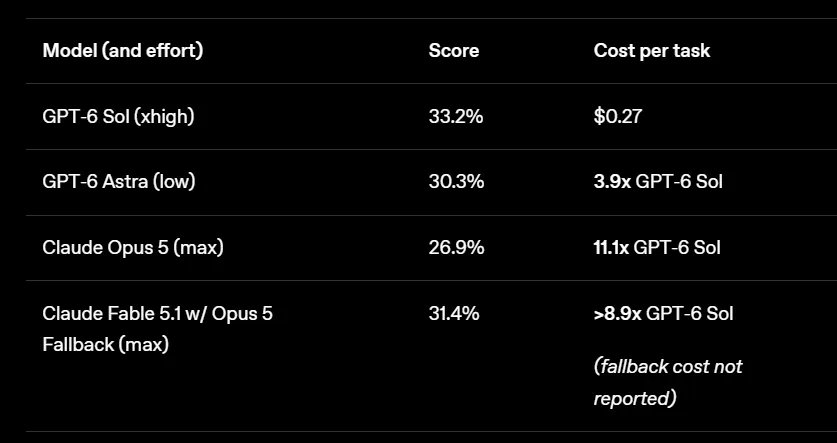
In AutomationBench cross-application workflow testing, GPT-6 Sol at xhigh intensity outperforms Claude Opus 5 at just 9% of Opus 5’s per-task cost. GPT-6 Luna achieves a 5.4% improvement over its predecessor at high intensity while reducing per-task cost by 58%.
The most surprising data appears in the Last Exam agent evaluation: GPT-6 Sol reaches 56.4% at max effort, exceeding Claude Opus 5’s prior peak score, while cutting cost by 60%.
Computer operation reveals a key contradiction: though OpenAI explicitly states Astra remains the strongest for this capability, GPT-6 Luna achieves 60.5% at max effort on OSWorld 2.0 offline, nearly matching Claude Opus 5’s medium effort score (60.3%) at roughly one-tenth the cost. GPT-6 Sol also reaches 60.5% at xhigh effort, approaching Opus 5 medium effort with about 80% lower cost.
Coding and Reliability Upgrades
Both models are optimized for AI Coding Agent workloads, delivering clearer, more concise responses with fewer technical jargons and superfluous details.
Coding performance highlights:
- FrontierCode 1.1 Main: GPT-6 Sol significantly exceeds GPT-5.6 Sol, achieving Fable 5.1 xhigh-level results at lower cost
- DeepSWE v1.1: GPT-6 Sol scores 68.8% at max effort, just 1.1 points below Fable 5’s peak (69.9%), at ~80% lower per-task cost; GPT-6 Luna achieves 66.6% at mid-tier effort level, with cost reductions of ~93% vs Opus 5 and ~96% vs Fable 5
Factual reliability sees material gains: GPT-6 Sol halves error rates vs predecessor in real conversation assessments, approaching Astra-level accuracy. Luna also improves factual consistency while reducing cost.
OpenAI enhanced prompt caching by default, yielding higher cache hit rates to help agents reuse context more efficiently and accelerate responses.
Pricing and Version Comparison
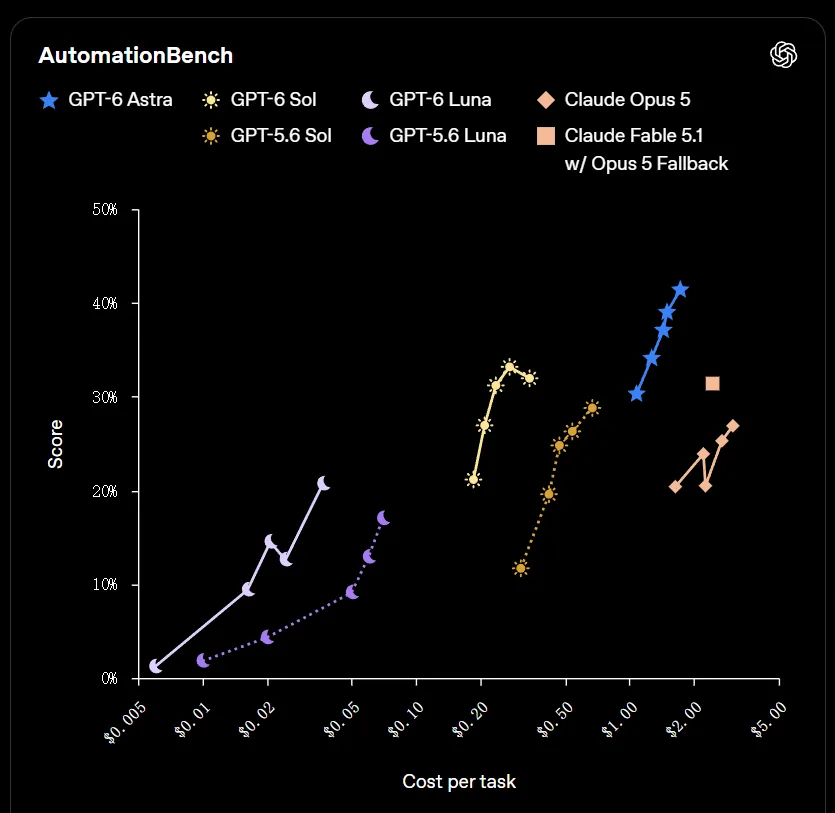
Table: Key pricing and performance metrics (source-validated):
| Scenario | Model | Performance vs Competitor | Cost vs Competitor |
|---|---|---|---|
| API price baseline | GPT-6 Sol/Luna | — | -50% vs GPT-5.6 promo |
| AutomationBench xhigh | GPT-6 Sol vs Opus 5 | Superior | 9% of Opus 5 cost |
| Last Exam max effort | GPT-6 Sol vs Opus 5 | Higher than Opus 5 peak | 40% of Opus 5 cost (-60%) |
| OSWorld 2.0 Luna max effort | vs Opus 5 medium effort | 60.5% vs 60.3% | ~10% of Opus 5 cost |
| DeepSWE v1.1 Sol max effort | vs Fable 5 peak | -1.1 points | ~20% of Fable 5 cost (-80%) |
| DeepSWE v1.1 Luna max effort | vs Opus 5/Fable 5 medium effort | Comparable | ~7% of Opus 5 cost (-93%); ~4% of Fable 5 cost (-96%) |
Practical Recommendations
- Adopt now: Developers and enterprises prioritizing cost-efficiency for agent workloads—especially coding and cross-application automation—should adopt Sol/Luna. Luna, accessible to free/Go users, serves well for lightweight testing.
- Wait or stick with Astra: For missions demanding maximum computer operation stability (complex UI interaction, multi-software orchestration), Astra remains the recommended choice; users seeking “no-compromise” experiences should continue using Astra.
Final Words
The Sol and Luna launch signals OpenAI’s shift toward tiered model offerings, using aggressive pricing to unlock scalable deployment of medium-intensity agents. When cost drops an order of magnitude while performance degrades only marginally, the inflection point for enterprise adoption draws ever closer.