
Watermark Policy Implementation: Timeline, Scope, and Availability
OpenAI announced on October 5, 2026, that it will implement an invisible watermark for text generated by ChatGPT and Codex in the European Union to comply with the EU AI Act’s transparency requirements. The Act’s Transparency Rules took effect on August 2, 2024, mandating that AI-generated content be marked in detectable ways.
Key facts:
- Launch date: October 5, 2026 (blog post date)
- EU rollout timing: Gradual deployment over the coming weeks
- Applicable users: All ChatGPT and Codex users in the EU across all subscription tiers
- Global API users: Can toggle watermark on for select models starting today (off by default)
- Global default at launch: No, only EU users will have it enabled by default
Technical Mechanism: Hidden Patterns in Word Selection
The watermark is not a visible symbol but works by subtly reshaping the model’s token prediction distribution. Using a secret key, the system ranks next-word probabilities and nudges generation toward higher-probability candidates, creating a statistical fingerprint imperceptible to readers but detectable by specialized tools. Since the pattern is embedded in the text itself, it survives copy-paste operations.
OpenAI, in collaboration with researchers from the University of Pennsylvania and Yale, published the technical report introducing textGrain. The method demonstrates how cumulative small biases—induced by key-based sorting—enable detectors to identify AI-generated content using only the text and the key. OpenAI stated no meaningful performance degradation occurs when watermarking is active, and user identity is not embedded.
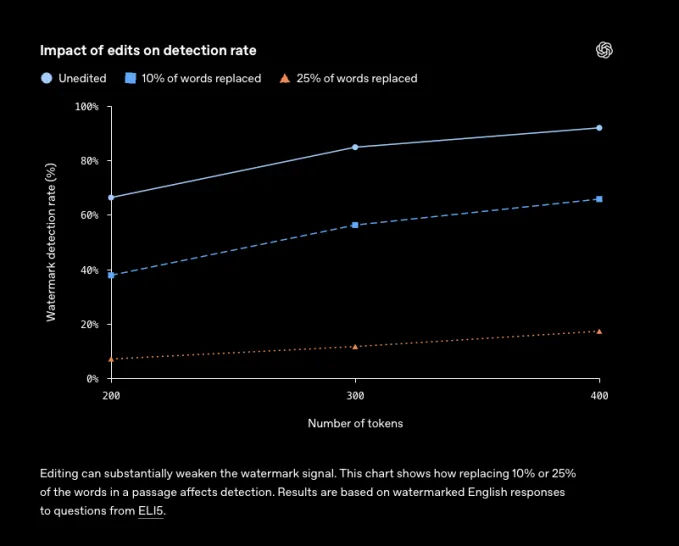
The anti-tampering capability remains limited. OpenAI’s internal tests show:
- Initial detection accuracy: ~92%
- After replacing 10% of words with synonyms: Detection rate drops to ~66%
- Other low-detection scenarios: short passages, math answers, translated text
Detector access is restricted: Only approved researchers and expert organizations have received initial access to help evaluate reliability and appropriate use cases.
Verification Boundaries and Liability Clarifications

OpenAI explicitly clarified what the watermark does and does not indicate:
- Missing watermark ≠ human authorship (text may be too short, heavily edited, or from another provider)
- Presence of watermark ≠ full AI authorship (only signals that part of the passage was generated or processed by an OpenAI system)
- Does not measure human contribution (e.g., editing, judgment, or creative input)
Industry Context and Regulatory Alignment
Anthropic announced global watermarking for Claude in August 2026, a decision that drew backlash from some users who argued human input—not the AI—drove the final output.
The Wall Street Journal reported in 2024 that OpenAI had previously built a text watermark but withheld its release, partly over concerns that users would switch to rivals that didn’t watermark.
Under the EU framework, OpenAI joins Anthropic, Google, Meta, and Microsoft in committing to the Code of Practice on AI-Generated Content.
Practical Recommendations for Users
- EU content creators and moderators: Monitor for detector tool availability after mid-October, but acknowledge edited content may evade detection
- API developers outside the EU: Watermarking is off by default; evaluate if your use case tolerates heavily edited AI output before enabling
- Research institutions: Access to detectors requires formal application; prepare compliance documentation and use-case justification in advance
In Closing
Watermarks are traceability aids, not foolproof tags. OpenAI’s regional rollout—EU-only by default, global API toggle—reflects a calibration between regulatory compliance and commercial flexibility: technology deploys first, execution rolls out layer by layer, defining the current pace of AI governance.