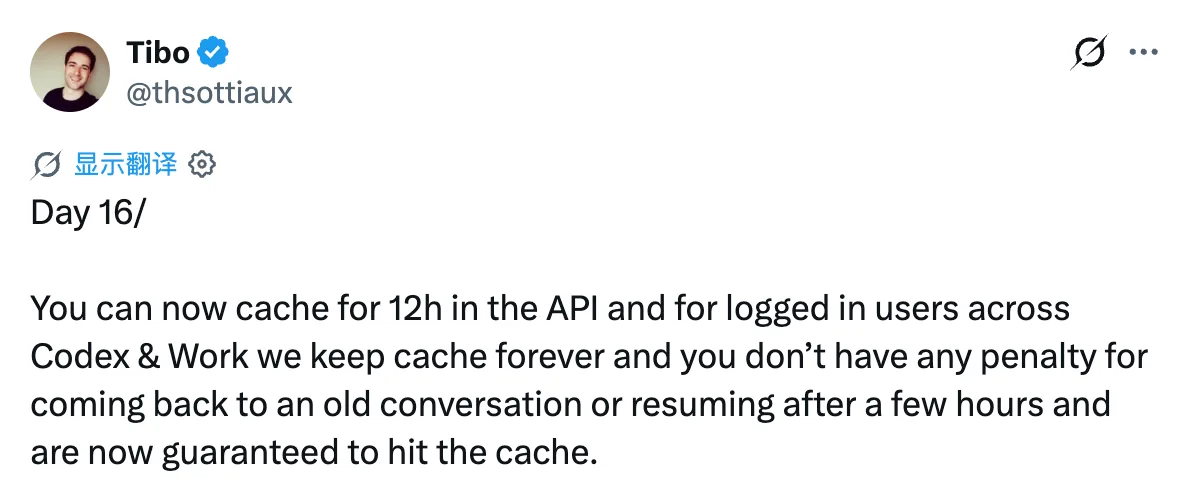
On October 21, Tibo, who leads ChatGPT and Codex at OpenAI, announced that the company’s API service will offer a 12-hour cache retention option, while caches for signed-in Codex and Work users will be retained permanently. The update is a major item in Tibo’s “28-day plan.”
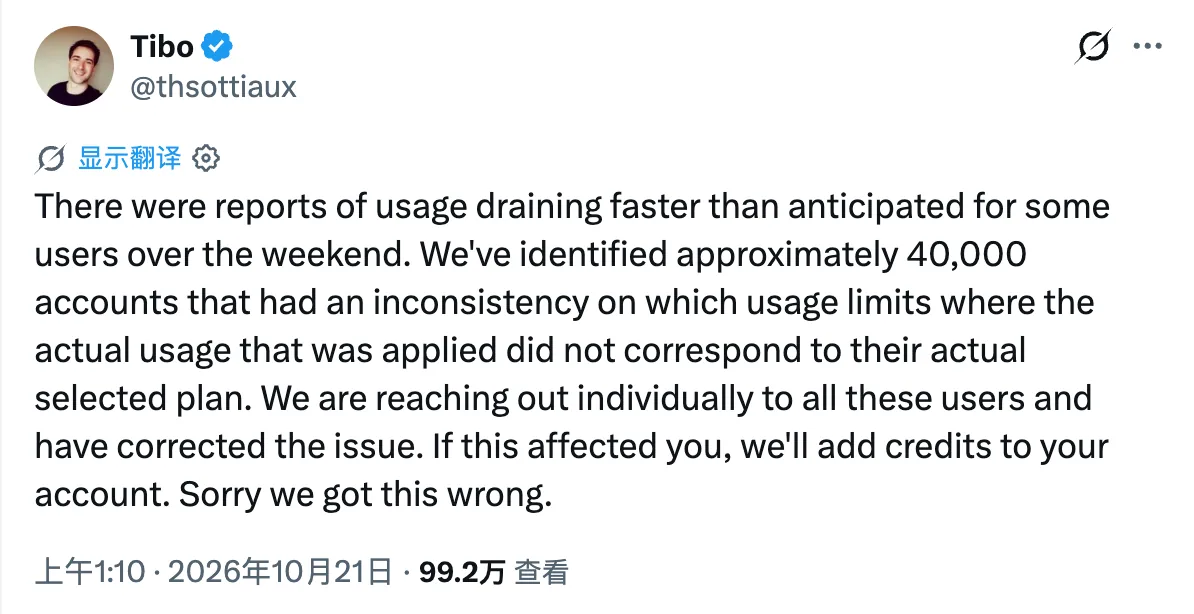
Before the announcement, Tibo said OpenAI had observed abnormal rates of credit consumption among some users and had refunded credits to roughly 40,000 accounts.
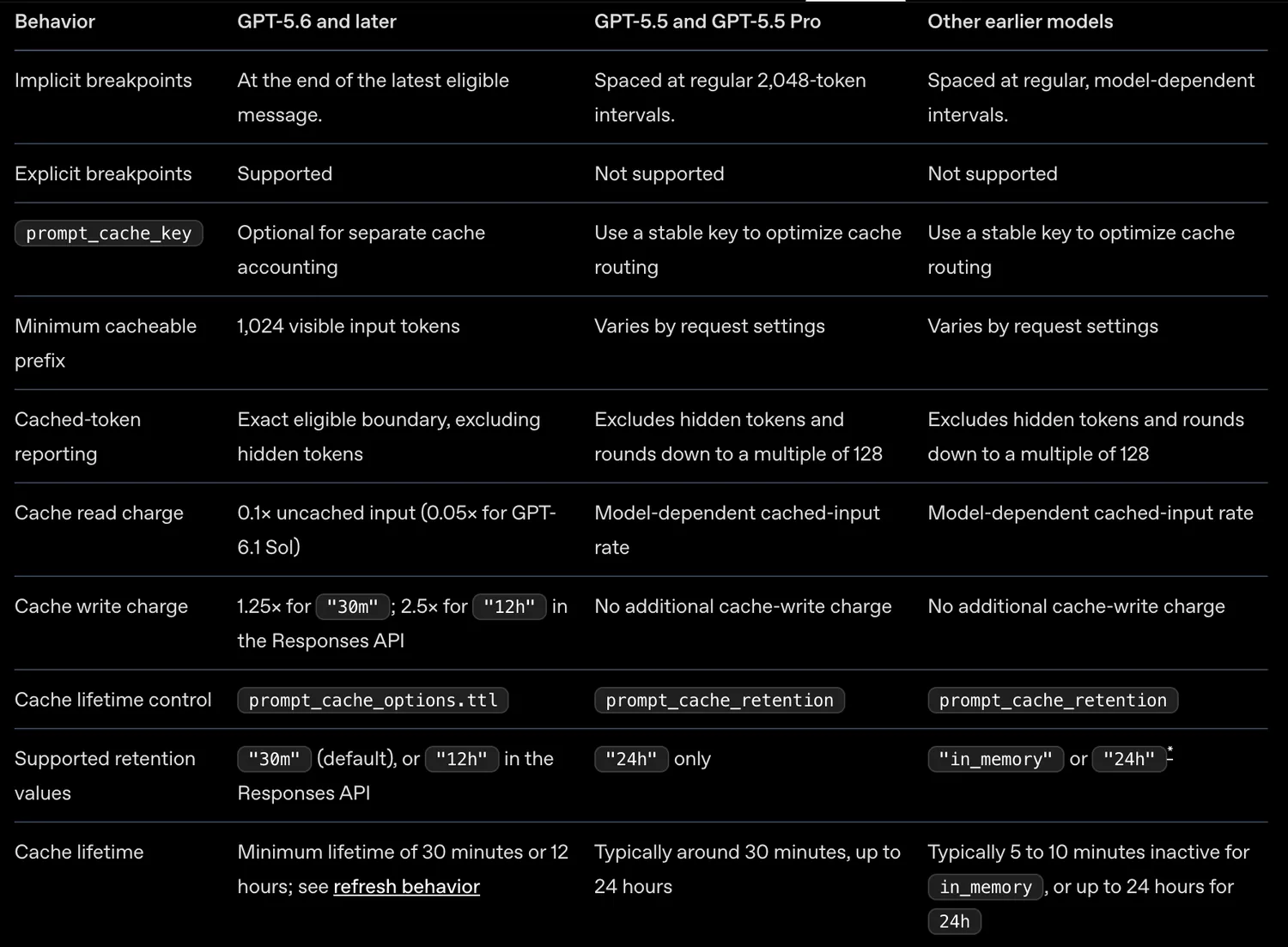
According to the documentation, the API-side cache retention option applies to GPT-5.6 and later models. OpenAI offers a default 30-minute retention period and an optional 12-hour period. No announcement has yet been made about the permanent cache for Codex and Work.
The 12-hour option is not simply a longer retention window. Per OpenAI’s API documentation, choosing 12-hour retention raises the cache-write price from 1.25x the price of uncached input tokens to 2.5x, while the cache-read price remains unchanged.
The “permanent cache” for signed-in Codex and Work users still needs clarification. It is unclear whether it refers to a retention policy for cached state, a billing arrangement for cache hits, or a user-facing entitlement; the answer depends on OpenAI’s specific explanation. Mechanistically, it is likely not true permanent cache retention—keeping caches forever is unrealistic—but rather not charging when the cache is recomputed.
OpenAI’s official API documentation explicitly states that the 12-hour setting defines the minimum lifetime for eligibility for cache-read billing. It does not guarantee that stored KV tensors will be reused on every request, nor does it guarantee lower latency. In other words, cache validity, actual hit rate, and request latency are three distinct concepts; the 12-hour limit is only the criterion for whether a request is billed as a cache hit.
Judging from the API side, the update looks more like a cache “subsidy” to reduce users’ credit consumption than genuine permanent cache retention.
The timing is also notable: just the day before, DeepSeek open-sourced an inference framework that includes cache retention with a design target of up to three days—far longer than OpenAI’s previous 30-minute default.