Origin Story: I Want to Make AI Comics, but I Don’t Want to Build a Platform from Scratch
I already have a working model backend: an OpenAI-compatible image/video gateway, plus Alibaba Cloud Bailian (Wanxiang for images, wan2.x for video). What’s missing is the upper layer — a director’s workbench that can manage “script → character → storyboard → image generation → video generation → composition.”
Building a platform like this from scratch would take at least a few months. Happily, a batch of open-source AI comic/drama projects emerged on GitHub in the first half of 2026. So the question became: which one is worth forking?
I spent two days doing a source-code-level due diligence. Here’s my conclusion up front: fork alibaba/lumenx; the most工程-complete dramaclaw is second choice only because Elastic License 2.0 prohibits SaaS; and all the top projects’ claims of “pluggable multi-model support” are completely debunked once you look at the source code.
Methodology: Skipping the README, Reading the Code Directly
The process had four steps:
- Scan: Five parallel threads of Chinese and English keywords plus community roundup articles, deduplicated down to 29 candidates, individually verified via the GitHub API — 28 were confirmed live.
- Deep read: I shallow-cloned 12 projects and read through their provider layer, generation pipeline, data structures, task queues, FFmpeg invocations, and LICENSE texts, scoring each on 15 dimensions. Every conclusion requires a source file path as evidence.
- Adversarial verification: For the top three projects by total score, I assigned two “disprovers” each — their job was to read the source code and find counterexamples that would overturn the deep-read conclusions.
- Revision: Verification results directly rewrote the final ranking.
Step 3 was the most valuable design in this due diligence — you’ll see why shortly.
Landscape: Only Five Projects Have True Full-Stack Capability
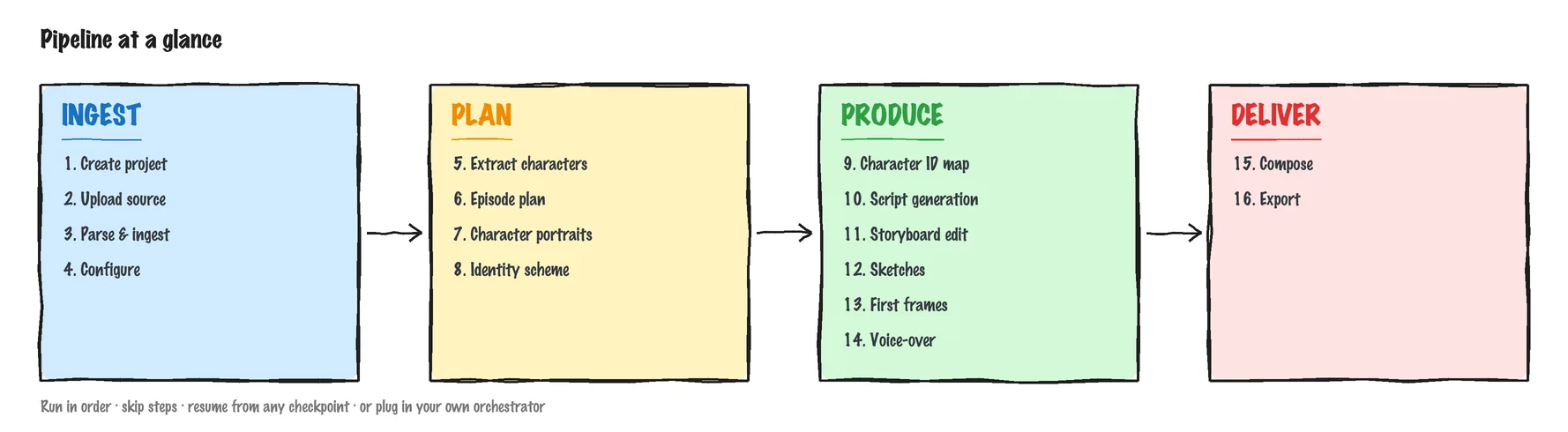
Of the 28 candidates, only five have the complete “novel/script → storyboard → image → video → final cut” pipeline:
| Project | Stars | Positioning | License |
|---|---|---|---|
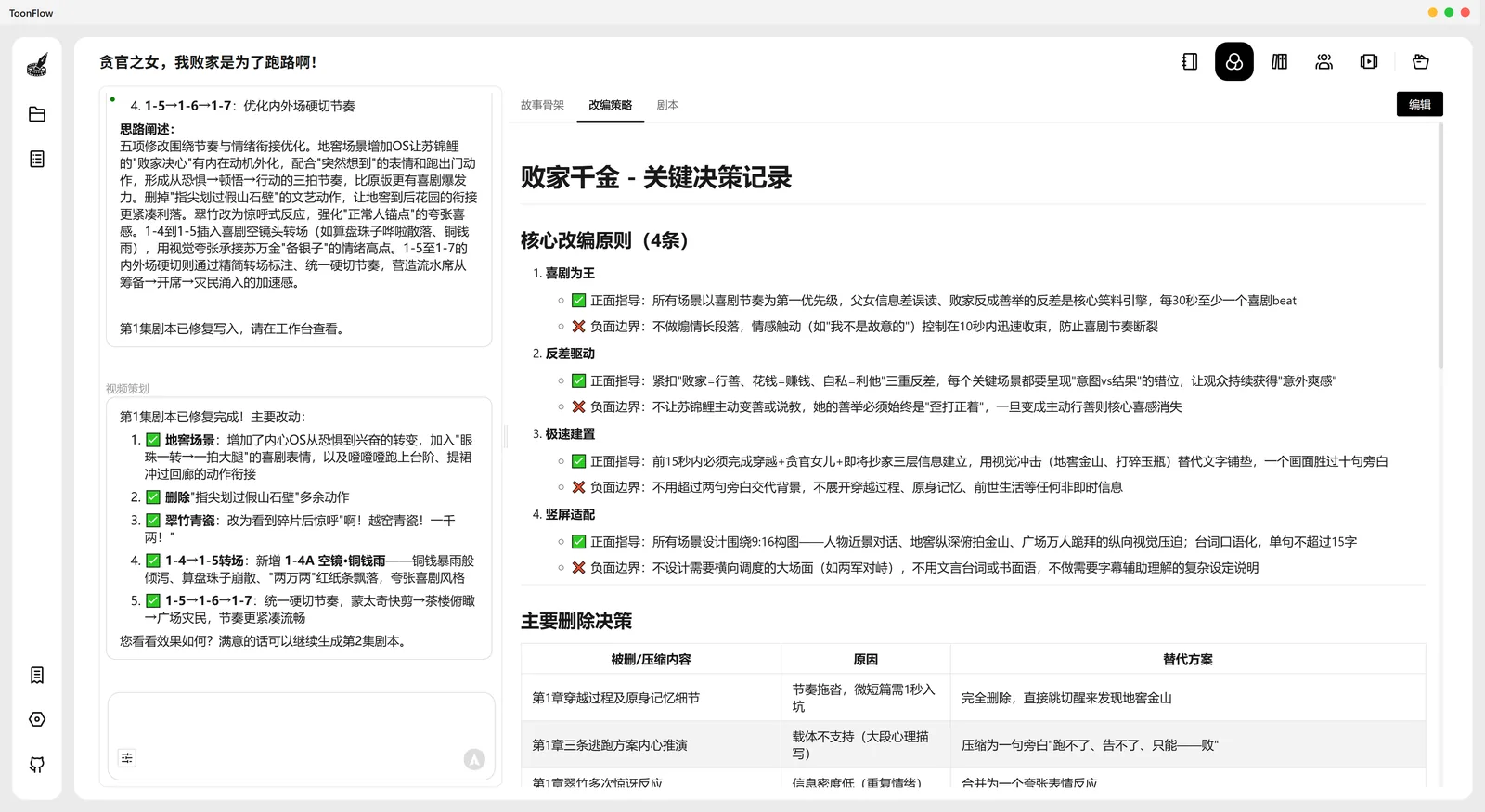
| Toonflow-app | 13,939 | Novel-to-drama one-stop, Electron | Apache-2.0 + supplemental agreement |
| dramaclaw | 3,690 | General AIGC video engine | Elastic-2.0 |
| printfilm | 3,488 | Drama SaaS, DramaForge pipeline | No LICENSE |
| lingguo-drama | 1,377 | Go drama backend workbench | No file (claims MIT) |
| lumenx | 1,074 | Alibaba open-source comic/video creation platform | MIT |
The rest are either ComfyUI plugins, pure front-end toys, model training pipelines, or have gone closed-source (e.g., bigbanana-ai-director at 1,753★ now only ships Docker images and is CC BY-NC-SA, which prohibits commercial use).
Finding 1: “Pluggable Providers” Is All Talk
My core requirement was to integrate my own two backends, so I examined each project’s provider layer closely. During deep reading, three top projects all claimed “clean architecture, pluggable,” and the adversarial verification dismantled every one of them:
- dramaclaw: The video generator hard-codes Volcano Engine’s API endpoints, model names, and polling logic. The LLM goes through a gateway and is reasonably flexible, but swapping video providers means modifying several modules — it’s not a matter of changing a config file. Interestingly, it has a built-in Grok video generator, which suggests the author has been down this exact road before.
- lumenx: The provider layer uses “class-level abstraction” — a factory class with if/else branches per vendor name, each vendor gets its own Model class, and the image module directly imports vendor SDKs. Adding a new vendor requires touching roughly 4 modules. Bounded, sure, but absolutely not configuration-level.
- Toonflow-app: The advertised “programmable provider system” only holds for text models; images and video still require per-vendor customization.
The harsh conclusion: at the image/video generation layer, switching any foundation requires writing code — the only difference is whether you rewrite 4 modules or half the codebase. True configuration-level integration only exists at the LLM layer.
The only genuinely standard OpenAI-compatible adapter came from a little-known enterprise agent platform (buildingai)’s createOpenAICompatible implementation — it has no video pipeline, but that adapter code alone is worth copying wholesale.
Finding 2: License Is More Fatal Than Architecture
This was the deadliest filter in the screening, and high-star projects fell by the dozen:
- dramaclaw (3,690★): Elastic License 2.0 — the text explicitly prohibits providing hosted/management services to third parties. Self-hosting, modifying code, and delivering finished works to clients are all fine, but offering it as an external SaaS requires a commercial license.
- Toonflow-app (13,939★): Apache-2.0 with a supplemental agreement — distributing your product to two or more independent third parties requires written authorization.
- printfilm (3,488★): The architecture is a hidden gem (auto episode-splitting for novels, FFmpeg tail-frame-to-head-frame shot衔接, a task system with idempotent keys) — but the repo has no LICENSE file at all. Legally, you shouldn’t even fork it.
- moyin-creator (4,363★): AGPL-3.0; the similar openframe is also AGPL.
- director_ai (1,705★), ai_story (1,345★): Also no LICENSE.
After tallying it up, among the 28 candidates, the only one with a clean license (MIT/Apache-2.0 with no附加条款) and full-stack capability is lumenx, alone.
Finding 3: Comic Production Needs a Pipeline, Not Autonomous Agents
I also looked at each project’s orchestration architecture: there’s open-director with LangGraph and nine agents (but its video generation code is commented out — it was never finished); there’s Toonflow with a three-tier self-built agent system (decision layer + execution layer + supervision layer, beautifully designed); there’s dramaclaw using PydanticAI.
My judgment: comic production is long-running, high-unit-cost, must-be-resumable batch processing — an episode has nine shots, each shot costs a couple of dollars, and if it crashes on the seventh shot, what you need is to resume from shot seven, not for an agent to “rethink its life.” So pipeline + persistent task table beats multi-agent autonomous decision-making. dramaclaw’s task system (state machine / cancel / retry / resume / audit) is the benchmark across all projects — that design is worth far more than its provider layer.

Final Decision: Fork lumenx
The decision chain was short:
- The goal is commercial use → eliminate Elastic-2.0, AGPL, no LICENSE, and already-closed-source projects;
- Among the remaining MIT/Apache camp, the only full-stack candidates are lumenx, Toonflow, and localminidrama;
- Toonflow has multi-customer distribution restrictions, and its image/video providers still require per-vendor coding, plus its dubbing module is a shell; localminidrama is an excellent Electron desktop app (its provider config layer is another model for the entire field), but its “data never leaves the machine” positioning conflicts with a platform strategy;
- lumenx: MIT with zero risk, full pipeline, Bailian as its native path, and a bounded provider modification surface (~4 modules).
It also has shortcomings: a weaker task system, no auto episode-splitting for novels, no “last-frame-of-prev-shot → first-frame-of-next-shot"衔接. But all three gaps have existing designs to borrow from — the task system from dramaclaw, novel episode-splitting from printfilm’s three-stage import, and tail-head frame衔接 from lingguo-drama’s first/last frame parameters. The approach is to borrow designs, not copy code (dramaclaw’s EL-2.0 wouldn’t let you copy anyway).
Second choice is dramaclaw: If you can accept a commercial license, or reposition your product as a self-hosted production tool + delivering finished works to clients (which Elastic-2.0 explicitly permits), it’s the most ready-to-use out of the box.
Three Methodology Lessons
- Discount README claims of “multi-model support” — and halve whatever you discount for “pluggable” claims. Grep for vendor endpoint URLs and hard-coded model names; five minutes will tell you the truth.
- Check the license before the architecture. No matter how good the architecture is, EL-2.0 / AGPL / no LICENSE can tank your commercial plan on the spot. Fewer than half of the 28 candidates had clean licenses this time.
- Adversarial verification beats正面评估. One agent can list twenty strengths of a project; it takes another agent trying to tear it down to uncover the life-or-death details hiding in, say, line 18 of the LICENSE.
The full report (15-dimension scoring table, per-project source code evidence, adapter interface design, 13-phase transformation plan) lives in my private repo — this post is the public condensed version. If you’re also choosing an open-source foundation for comics or short drama, I hope this saves you two days.