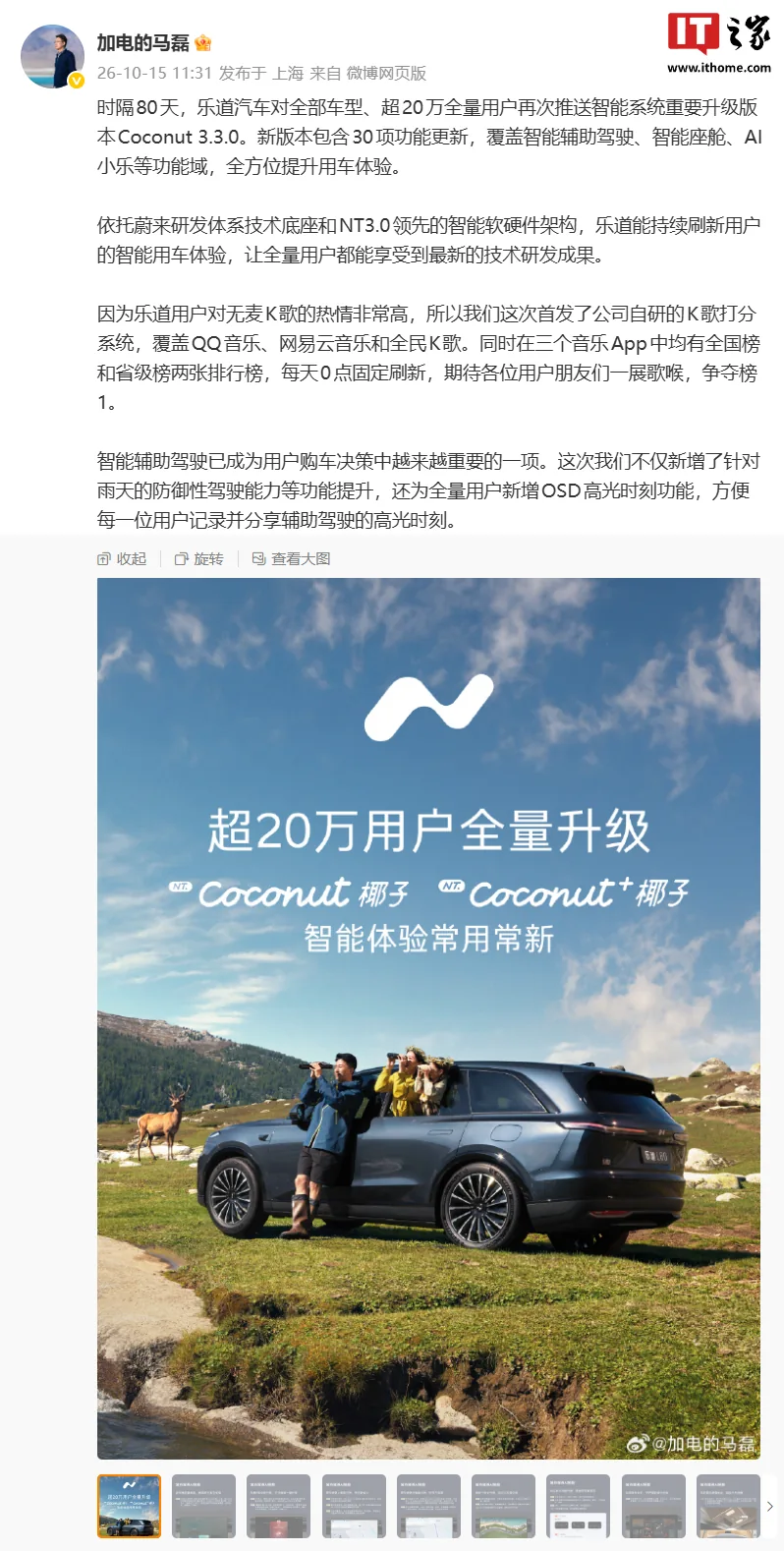
乐道汽车 announced on October 15 that it is rolling out a major intelligent-system upgrade, Coconut 3.3.0, to all of its models and its full user base of more than 200,000. The news was announced externally by 马磊, head of brand marketing communications for 乐道.
- Rollout date: October 15
- Version number: Coconut 3.3.0, officially described as a “major upgrade”
- Scope of update: 30 feature updates
- Coverage: all 乐道 models, the full user base of more than 200,000
- Feature areas covered: intelligent driver assistance, smart cockpit, AI 小乐
- Rollout interval: 80 days since the last major upgrade
- Pricing and access: The source material does not mention any charging or access-opening information; this is an OTA (Over-The-Air, software delivered remotely over a wireless network, so owners do not need to visit a store) aimed at existing owners.
30 updates, an 80-day interval: three numbers worth noting
Let’s explain a few terms first. Intelligent driver assistance means the vehicle helps with acceleration, deceleration, steering, and other actions in certain scenarios, but the driver must still be ready to take over at any time. Smart cockpit is the collective term for the screens, interaction, and entertainment systems inside the car. AI 小乐 is 乐道’s in-car voice assistant. Defensive driving means anticipating risks in advance and adopting more conservative driving strategies.
When “all models,” “the full user base,” and “more than 200,000” are put together, it means this rollout does not distinguish between new and old models, nor is it a small-scale gray release. The 80-day interval, however, is the contrast most easily overlooked in this announcement—major-version OTAs in the smart-car industry are usually measured in quarters, while 乐道 has compressed the cadence to around two and a half months.
The second contrast lies in the makeup of the features. The official line is 30 updates, but only two were singled out for introduction: a defensive-driving capability for rainy conditions, and the OSD Highlight Moments feature newly added for the entire user base. The former is a conservative strategy adjustment on the driving-safety side; the latter leans more toward recording and presentation. 马磊 also said that intelligent driver assistance has become an increasingly important factor in users’ car-purchase decisions—but judging from the features singled out this time, the upgrade’s focus has not been placed entirely on high-level driving capabilities.
It should be noted that in the IT之家 original text, after “The contents of this 乐道 update are as follows,” the reposted text visible this time does not expand on the itemized list of those 30 updates. Therefore, the specifics of the remaining 28 items, as well as the product form of OSD Highlight Moments, cannot currently be confirmed. Also because the source material does not provide pricing, hardware specifications, or version-comparison data, no side-by-side table comparison is made here.
Who should upgrade, and who can hold off

Those advised to upgrade as soon as possible: existing 乐道 owners, especially those who often drive in rainy regions and lack confidence in rainy-weather driving—the newly added rainy-weather defensive driving addresses exactly this scenario; as well as owners who are sensitive to the everyday experience of the infotainment system and voice assistant and are willing to trade an OTA for new features. From the official wording, this is a rollout to the entire existing owner base, and the source material does not mention any charge; the upgrade cost is basically just time.
Those who can wait and see: people who treat intelligent driver assistance as a core reason to buy and expect a major leap in capability. The currently public information only confirms a defensive strategy for rainy scenarios; a single OTA can hardly change the overall capability ceiling of driver assistance. In addition, an update package containing 30 changes is relatively large, and the source material does not disclose the staged-rollout cadence or rollback mechanism; users who prioritize absolute stability may want to wait for feedback from the first batch of owners before acting.
Closing thoughts
A major version every 80 days and full coverage of 200,000 users show that 乐道’s OTA has shifted from “shipping new features” to “maintaining a cadence.” When upgrade frequency itself becomes a competitive item, what sets players apart is no longer the number of update entries, but how many of them can be genuinely perceived during a single commute. This time, rainy-weather defensive driving happens to be exactly the kind of feature that doesn’t show off but will be remembered in specific weather.