
Key Event Overview

On October 1, 2026, market research firm Omdia released its “India PC and Tablet Market Quarterly Report.” The key facts are as follows:
- Release date: October 1, 2026 (London time)
- Coverage period: Q2 2026 (2Q26) and full-year outlook
- Key data: PC shipments of 4.1 million units (+14% YoY), notebooks at 3 million units (+13%), desktops at 954,000 units (+15%), tablets at 1.3 million units (+11%)
- Full-year forecast: PC market at 15.4 million units (-2.6% YoY), tablet market at 5.1 million units (+4.2% YoY)
Market Performance: Strong Q2 Growth, Weaker H2 Outlook
In Q2 2026, the India PC market grew 14% year over year, with shipments reaching 4.1 million units. Notebooks accounted for 3 million units (+13% YoY), desktops for 954,000 units (+15% YoY), and tablets for 1.3 million units (+11% YoY). This growth was partly driven by forward buying by channel partners—retailers and enterprises stockpiled inventory ahead of anticipated price increases.
Ashweej Aithal, senior analyst at Omdia, noted: “The Q2 growth looks strong on the surface, but it largely reflects early purchasing by end customers and channel partners to lock in lower prices.”
Surprising contrast: Although the full-year PC market is expected to decline 2.6%, education procurement performed exceptionally well in Q2—notebook shipments in the education segment surged 191%, becoming a growth engine; meanwhile, commercial PCs grew 19%, outpacing the consumer segment’s 8%, reflecting solid enterprise upgrade demand.
Similarly, in the tablet market, both Apple and Lenovo saw significant shipment increases: Apple grew 35% and Lenovo grew 89.9%, together regaining market share. Omdia noted that the tablet market is shifting toward higher-value devices: consumer growth of 12% (driven by premium new products), commercial growth of 11% (active SMB procurement), while the enterprise segment remained stable.
Sales Mix and Pricing Pressure
AI capabilities are becoming standard on new products: the share of notebooks with AI features rose from 28% to 44%, indicating a rapid market shift toward new configurations.
Pricing pressure is mainly evident in the entry-level PC segment. Omdia forecasts that higher component costs will particularly hit low-priced models, and Indian consumers are especially sensitive to price changes. Vendors’ strategies include adjusting configuration mixes to maintain key price anchors and reduce pass-through to end customers.
A clear stratification trend is emerging across segments:
- High-end and gaming PCs: Better able to absorb costs, with relatively stable demand
- Enterprise procurement: Continued necessary device refreshes, upgrading to higher-spec notebooks
- Small and medium-sized businesses (SMBs): Actively buying ahead, anticipating H2 price increases
- Entry-level consumers: May postpone upgrades or shift to lower-spec models
Notably, Apple PC (MacBook) shipments are expected to see the smallest decline, thanks to its premium positioning, tightly integrated hardware and software, and strong existing user loyalty.
Challenges in the tablet segment are concentrated in the education market: a pause in government tenders combined with rising component costs led to a 12% decline in shipments in this segment. This structural fluctuation also explains the uncertainty over whether Q2’s overall high growth can be sustained.
2026 Full-Year Outlook and Long-Term Trends
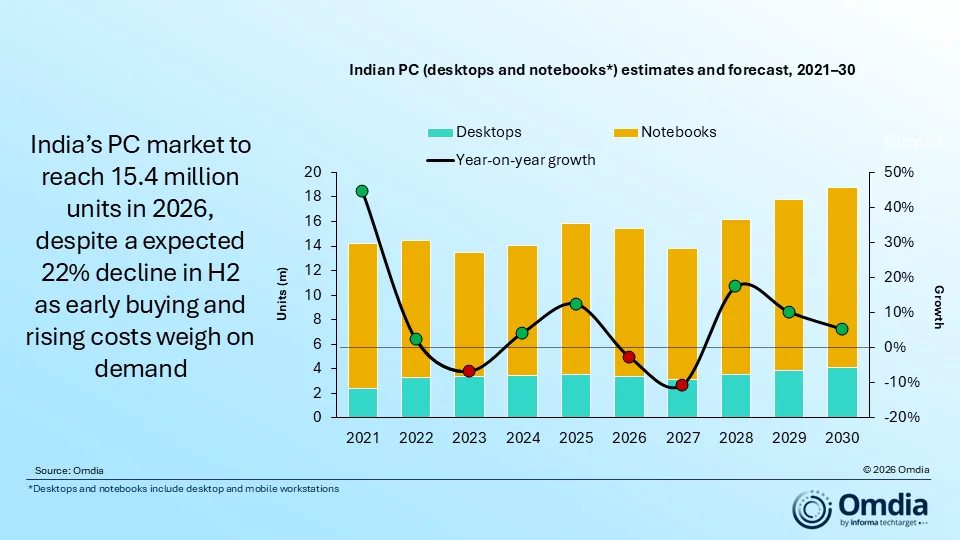
| Metric | 2026 Full-Year Forecast | YoY Change | 2Q26 Reference |
|---|---|---|---|
| Total PC shipments | 15.4 million units | -2.6% | 4.1 million units (+14%) |
| Consumer shipments | - | -6% | 8% growth |
| Commercial shipments | - | -5% | 19% growth |
| Education shipments | 918,000 units | +63% | 191% growth |
| Total tablet shipments | 5.1 million units | +4.2% | 1.3 million units (+11%) |
The full-year outlook still has structural bright spots: education device procurement is expected to reach 918,000 units, up 63%; although H2 procurement will slow (as government project cycles end), the Q2 base has laid a positive baseline for the full year.
In the long term, the India tablet market outlook is more optimistic. Omdia believes that with larger screens, improved performance, and broader productivity use cases, tablets are gradually approaching the user experience of entry-level PCs. Manufacturing is also evolving: Samsung and Lenovo have already used local production to serve overseas export markets, and other brands are expanding their manufacturing footprints; this helps vendors flexibly adjust supply chains and costs during cycles when domestic demand is more price-sensitive