
2024年4月下旬,商业明星Kevin O’Leary高调宣布将在犹他州建设代号"Wonder Valley"(又称Stratos)的巨型AI数据中心项目,承诺打造全球最大数据中心——占地4万英亩、装机功率达9千兆瓦(超犹他州平均用电量两倍)。然而仅数月后,该项目因民众抗议、官僚程序缺陷及言论风波而实质搁浅,成为科技基础设施狂热遭遇地方民主阻力的典型案例。
核心事件与硬信息
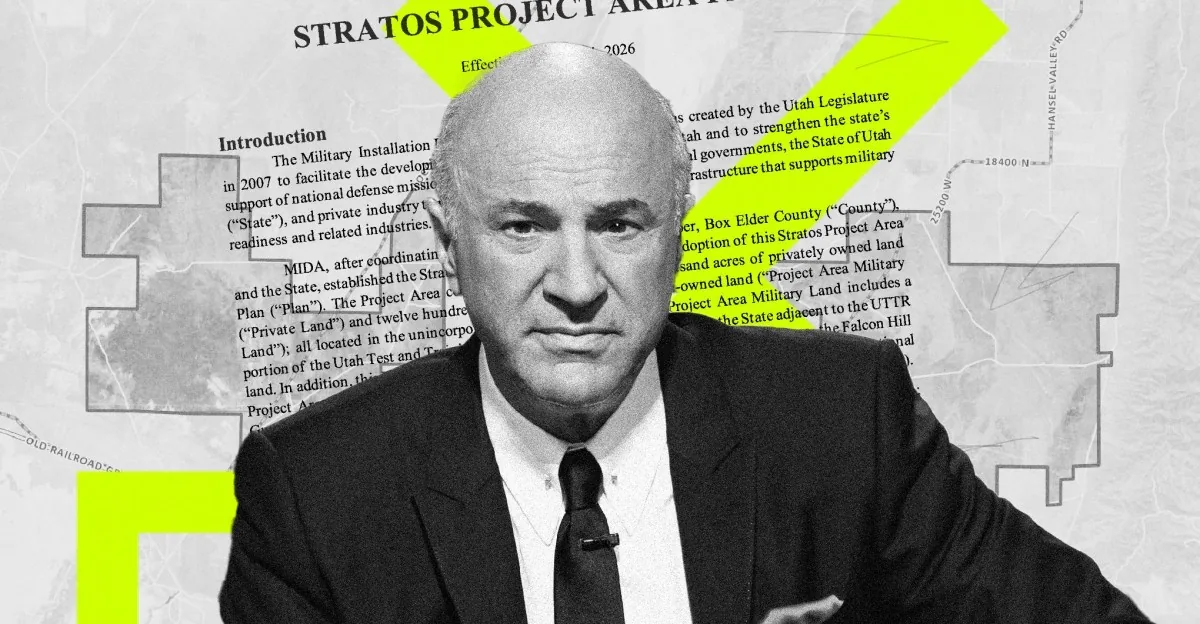
- Announcement: Late April 2024, O’Leary first publicly disclosed it on Fox News
- Project names: Stratos (official), Wonder Valley (common name)
- Location: A remote valley in Utah, USA
- Planned capacity: 40,000 acres of land, 9 gigawatts of power (more than twice Utah’s average electricity consumption)
- Approving bodies: Utah Military Installation Development Authority (MIDA) approved it; no permit at the county level
- Current status: The project is stalled; O’Leary called critics “Chinese spies” on Fox News, sparking a diplomatic apology controversy
- Key contrast: The 9 GW installed capacity was meant to support the world’s largest data center, yet the project was rejected while still only at the planning stage; during MIDA’s approval process, the county government was not notified until one month before the project became public, completely bypassing the normal local government approval process
Project Origins: Controversy Over Abuse of the State-Level “Special District” Mechanism
The project was advanced through Utah’s MIDA (Military Installation Development Authority). MIDA was originally established to revitalize idle military land and has the power to override local land-use planning and approval. Once MIDA designates a project area, it temporarily replaces local government in exercising planning authority, accelerating the permitting process. Under the rules, MIDA must obtain both the consent of all landowners within the area and approval from the county government before it can establish a project area.
Investigations found that O’Leary’s team began lobbying the state government to land the project in early January 2024, moving through an internal “Governor’s Office–MIDA” channel. Its operating model closely resembles the Foxconn LCD factory project in Wisconsin: state governments engaged in a subsidy race, promising tax breaks and permitting convenience. O’Leary chose Utah precisely because it offered the best incentive package.
Public Awakening and Political Firestorm
The project first came to light through O’Leary’s public announcement in late April. Before that, apart from roughly a dozen landowners, a handful of people inside MIDA, a few state officials, and a small number of real estate developers, the entire state of Utah, except for a single county, was unaware. When 40,000 acres (about 160 square kilometers) were quietly penciled into the plan, local residents discovered—before the project had even obtained county approval—that their community had already been “reserved.”
Residents quickly organized resistance, with objections spanning three major dimensions: water consumption (AI data centers consume about 2 million gallons of water per megawatt per year), grid load, and lack of community involvement. The wave of opposition drew attention from both Republicans and Democrats—O’Leary’s remark on Fox News calling opponents “Chinese spies” forced Fox officials to apologize on air, highlighting that the issue transcends partisan divisions.
Lessons: Local Democracy Cannot Be Bought with Capital
The MIDA mechanism was originally intended to promote economic development, but its strong authority, when lacking transparency, can easily trigger a collapse of trust. The juxtaposition of this incident with the Foxconn project is especially telling: both promised huge numbers of jobs (Foxconn claimed 13,000 positions) and economic transformation, and both ultimately faltered because “the public was not included in decision-making.” The difference is that AI data centers are physically feasible in themselves, whereas Foxconn’s manufacturing plant was never built for techno-economic reasons; Wonder Valley’s current stall is mainly due to procedural flaws and lack of trust, not a rejection of its business logic.
Advice for Readers
- If you follow AI infrastructure investment: tracking projects like this that “promote before permitting” is risky; MIDA-style special district approvals require close scrutiny of county-level acceptance
- If you are a Utah resident: this matter has prompted the state legislature to re-examine MIDA’s power boundaries; subsequent 2024 legislation will strengthen local veto power
- If you work in the tech industry: the AI race has shifted from chip compute power to competition for electricity and water rights; strategically paying premiums for power contracts is becoming a new competitive dimension
A final note: The whole world is paving the way for AI frenzy, but the heaviest roadbed is often local residents’ right to decide the future of their own communities. If tech capitalism continues to bypass democratic processes, Error 403: Community Not Found will become the norm rather than the exception.