
NVIDIA Slips a 12,000-Line Kernel Into Upstream vLLM
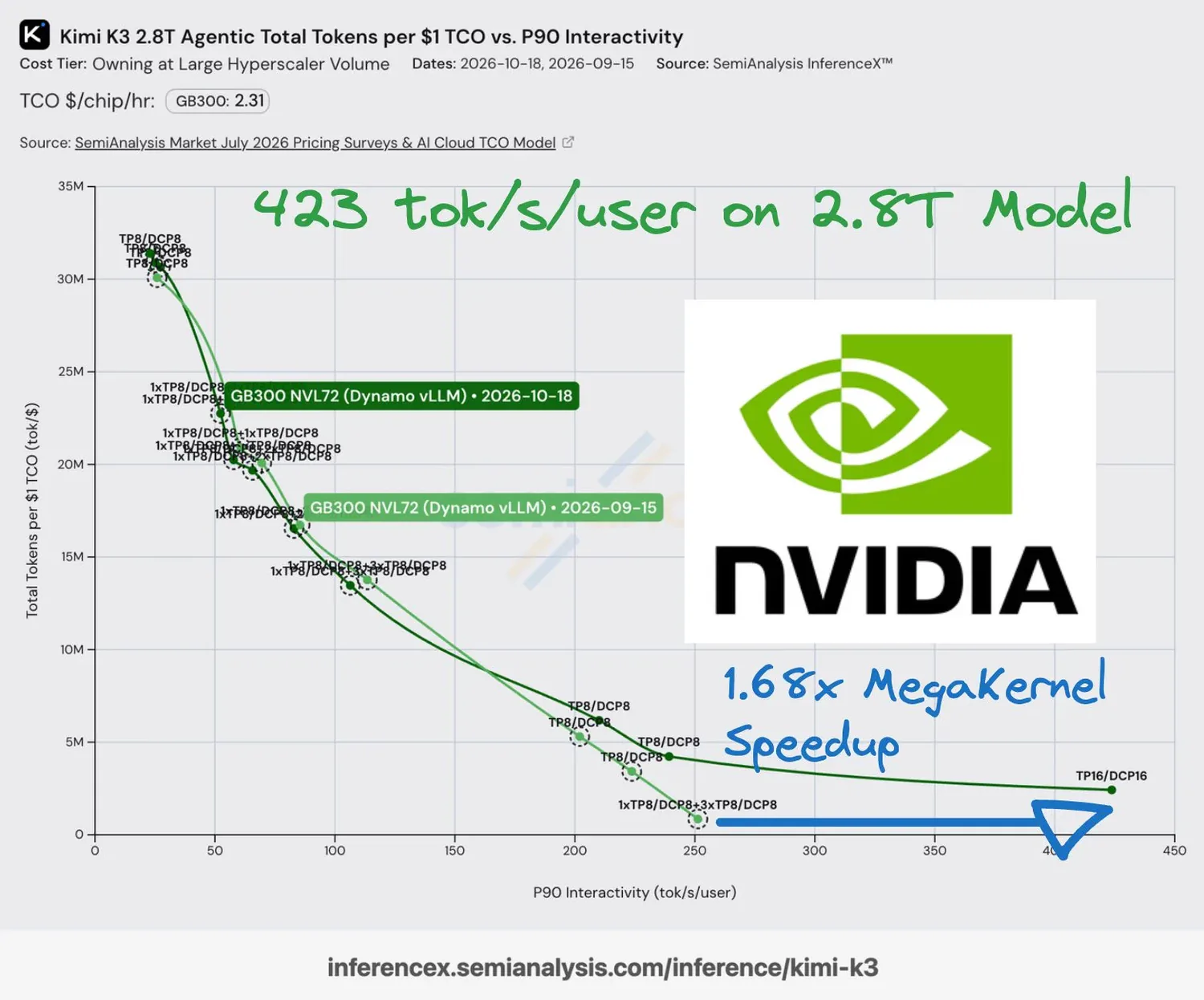
SemiAnalysis posted on X early on October 18 that NVIDIA, through an upstream vLLM optimization, got the 2.8-trillion-parameter Kimi K3 to a single-user output speed of 423 tokens per second (a token is the smallest unit of text a model processes; one Chinese character usually takes 1 to 2 tokens), 1.68× faster than before on the same hardware.
The post doesn’t offer much hard information, but every item is specific:
- What was done: a GPU kernel written specifically for the decode phase, taking the “upstream” route—that is, merged into the main vLLM repo, so ordinary users may get it just by upgrading, without waiting for a vendor’s proprietary fork
- Who did it: Benjamin at NVIDIA CentML
- How it was done: written with Cute DSL, using aggressive Megakernel fusion; the whole kernel is about 12,000 lines of code
- What’s next: NVIDIA is already adapting vLLM for models such as DeepSeek v4.1
- What wasn’t said: the exact merged version number, launch timing, pricing, and whether Kimi K3’s weights will be open—none of these were mentioned in the post
To be clear up front: this news currently comes from only two sources, SemiAnalysis’s tweet and its comment section. There is no NVIDIA official announcement or third-party benchmark report corroborating it. As of publication, the post showed about 72,700 views, 989 likes, and 75 reposts.
What Does 423 token/s Mean?
Let’s clarify two terms first.
decode vs. prefill: LLM inference broadly splits into two stages. prefill reads the user’s entire prompt in one pass, while decode computes and emits tokens one at a time. From the user’s perspective, whether the AI feels fast at typing is mostly determined by decode speed, so this optimization targets decode.
tok/s/user: tokens per second per user, a single-user metric. It is not the same as the “aggregate throughput” commonly used in production—a system can post impressive aggregate throughput while each user still gets tokens dribbling out one by one. 423 is a very high tier.
Megakernel: fusing multiple previously separate GPU compute steps into a single kernel to reduce repeated kernel launches and intermediate data movement overhead. The tradeoff is a sharp jump in code complexity—which is why 12,000 lines deserves to be called out on its own. Cute DSL, meanwhile, is a C++ template library in the CUDA ecosystem for writing high-performance operators.
The most easily overlooked contrast in the post is this: the 1.68× comes from identical hardware. No new cards, no new cluster—just a kernel rewrite at the software layer. The poster joked that NVIDIA should give this 10x engineer a raise.
Another notable detail is where the optimization landed. It went into upstream vLLM, not an NVIDIA inference product or proprietary fork. In the comments, Misha Goin linked to a vllm.ai article, “Hyper Optimizing Kimi K3 in vLLM: Moving Fast and Responsibly”; the “Responsibly” in the title hints that this aggressive approach is also being debated within the community. Another commenter said there’s “so much more juice to squeeze”—meaning there’s still room for optimization on the same hardware.
Before and After Optimization
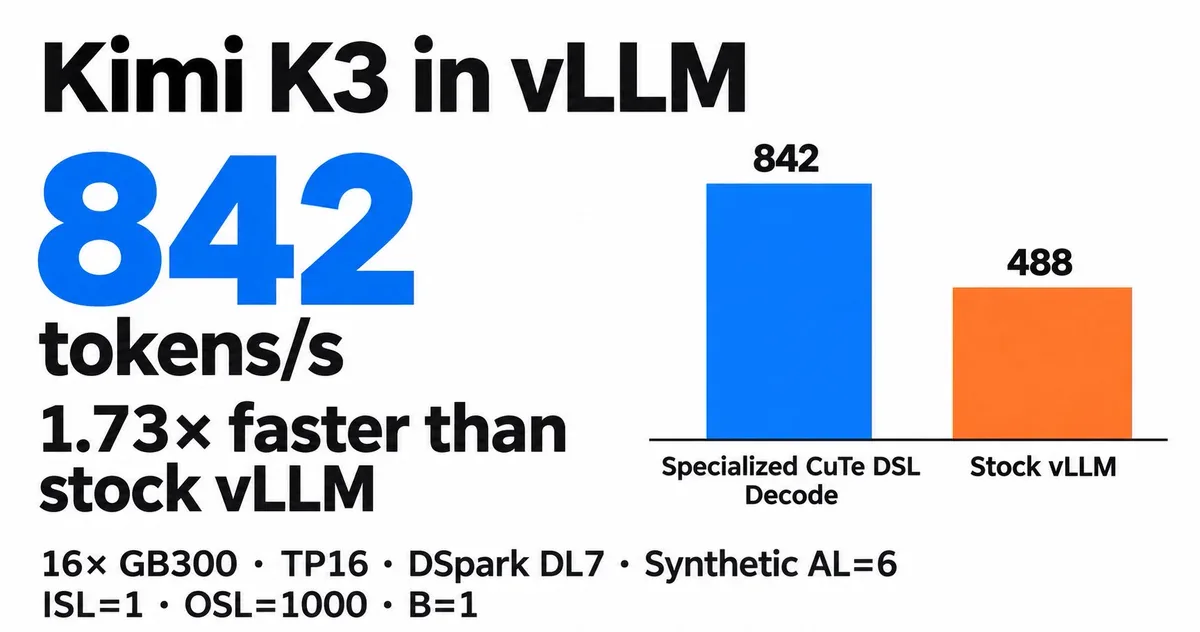
| Item | Before optimization (back-calculated) | After optimization |
|---|---|---|
| Single-user token output speed | ~252 token/s | 423 token/s |
| Speedup | 1× | 1.68× |
| Hardware | Same | Same |
| Model size | 2.8 trillion parameters | 2.8 trillion parameters |
| Kernel form | Standard decode kernel | ~12,000-line Megakernel |
The “Before optimization” column is back-calculated as 423 ÷ 1.68; the source material does not give this figure directly, so it is for reference only.
Who Should Follow Suit, and Who Can Wait
Who should follow suit: teams running online inference services with vLLM where single-user response speed is a selling point. The value of this optimization is that it takes the upstream route—there’s no need to wait for a vendor-specific fork; just following version updates may deliver the benefit directly. The exact version it landed in needs to be checked in the vLLM repo yourself; the discussion thread doesn’t say.
Who should wait: teams where single-user speed isn’t the bottleneck and the pain points center on VRAM usage or unit cost—this kind of kernel-level optimization won’t help much; teams with high version-stability requirements in production also don’t need to rush to switch. It’s more prudent to wait for the upstream version to mature and for third-party reproduction data before evaluating.
Final Thoughts
Getting 12,000 lines of kernel code into the mainline of an open-source inference engine carries more weight than just posting a pretty benchmark number in your own product. Inference costs for very large models are still the dominant expense. As for how much of this 1.68× eventually makes it onto users’ bills, that depends on whether service providers pass the efficiency gains on.