Flapping Airplanes, an AI startup founded roughly a year ago, has raised $1 billion at a $6 billion valuation without having released a commercial product, Bloomberg reported. The company aims to train AI models with less data and less compute.
The Series A round was co-led by Index Ventures and Lux Capital, with participation from Sequoia Capital, Alphabet’s GV, Kleiner Perkins, Valor, Atreides and Nvidia. The previous seed round valued the company at $1.5 billion, meaning the valuation has quadrupled.
Headquartered in San Francisco, Flapping Airplanes positions itself as an “AI neolab” that prioritizes research over shipping products. The company is developing its own software to drive Nvidia GPUs, claiming it can improve chip efficiency and lower the cost of training and running AI models. However, its technical capabilities so far come mainly from the founders’ own descriptions; independent tests, customer case studies and commercialization progress have not been made public.
- $1 billion raised in a year, valuation climbs to about $6 billion
Flapping Airplanes is based in San Francisco and was founded in late 2025. Its name comes from the ancient concept of the ornithopter, an aircraft that flies by flapping its wings. Co-founder Spector describes it as a metaphor for building technology that combines the strengths of natural and artificial intelligence.
Flapping Airplanes is what is known as an AI “neolab.” Such companies prefer to spend their energy on research rather than rushing out AI products and revenue. Despite having no product, the company has drawn backing from top-tier investors.
According to Bloomberg, the $1 billion round was co-led by Index Ventures and Lux Capital, with Sequoia Capital, Alphabet’s GV, Kleiner Perkins, Valor, Atreides and Nvidia participating.
TechCrunch filled in the earlier funding history: the company launched nine months ago with a $180 million seed round from GV, Sequoia Capital and Index at a $1.5 billion valuation. From seed to this Series A, the valuation rose from $1.5 billion to $6 billion.
- A young founding team focused on “less data, less compute”
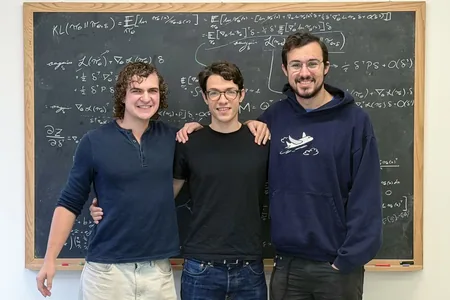
The company was founded by three people: Aidan Smith, Asher Spector and Ben Spector.
Smith is a Thiel Fellow who worked at brain-computer interface company Neuralink during college. Asher Spector is a PhD student in statistics at Stanford. Ben Spector is a PhD student in computer science at Stanford and founded Prod while at MIT.
Prod is a five-year-old student-run startup accelerator that Sequoia partner David Cahn called “one of the most powerful talent incubators in Silicon Valley.”
Cahn also described the founders as building “a young people’s AGI lab.”
On the technical front, Asher Spector said in an interview that the company is researching how to train AI models with less data and less compute while making the chips that develop and run models more efficient.
He argued that “AI demand will exceed the supply of chips and data. The companies that succeed most and create the most value for the world will be those that squeeze the most output from their inputs.” He added that the current AI boom is spending too much on infrastructure, and that if every chip delivered 10% more performance, the economic value would be enormous.
Smith said the company has been developing software to drive Nvidia GPUs. GPUs are the core hardware for training and running AI models and excel at parallel computing. With this software, Flapping Airplanes says it can make chips more efficient and invoke them in flexible new ways.
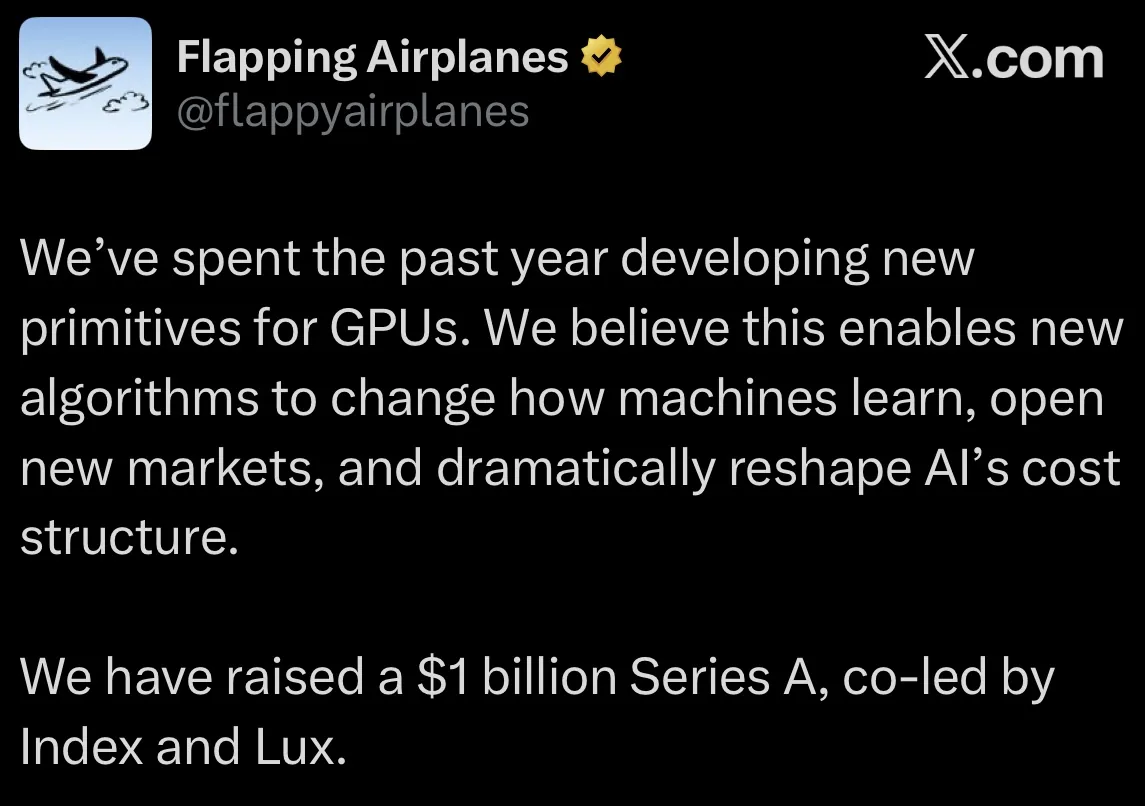
As the team put it in a post on X: “For the past year, we’ve been developing new primitives for GPUs. We believe this will let new algorithms change how machines learn, open up new markets and dramatically reshape the cost structure of AI.”
TechCrunch reported that the founders describe the work as “the world’s most complete megakernel framework.” A kernel is a program that runs on a GPU; a megakernel packs many tasks into a single program.
The founders claim the framework can run a full training pipeline, serve inference, play video games and even do all three simultaneously within a single kernel. It can also overlap “memory-bound inference” and “compute-bound training” — the former spends most of its time waiting for data, the latter most of its time doing math — so that chips idle as little as possible.
- Nvidia and Sequoia are in, but commercialization remains unproven
Nvidia, the main supplier of AI chips, appears on the investor list. Lux partner Brandon Reeves said that as AI development moves to the “next frontier,” getting more output from existing resources will be critical. He believes Flapping Airplanes “may be the company best positioned to do this.”
Sequoia partner David Cahn has known Spector and his brother Ben for years. He said the latest round shows investors’ high regard for the founding team. “There are so many of these AI labs that it’s easy to drown in the noise,” Cahn said. “But this company isn’t ‘one of many’ — it’s ‘one of one.’”
Still, capital backing does not mean the technology has been proven. Spector hopes the company’s work will make AI more accessible to other businesses, and the company plans to commercialize the technology eventually. TechCrunch reported that Flapping Airplanes now has $1 billion in new funding to hire and try to turn its goals into reality.
But judging from both reports, the company’s megakernel framework and its ability to overlap training and inference currently come mainly from the founders’ descriptions. Neither report disclosed independent benchmarks, customer cases, revenue or a product timeline, so both the technical capability and commercialization progress remain to be seen.
Conclusion: the compute-saving story needs products to prove it
As the marginal returns of simply stacking more compute come into question, directions like using GPUs more fully and training usable models with less data are drawing focus from a growing number of AI startups.
Nvidia’s investment suggests the chipmaker recognizes Flapping Airplanes’ research direction on GPU efficiency.
But whether the megakernel framework can remain stable at larger scale, and whether gains in data efficiency can translate into products customers will pay for, still lack public verification.
Sources: Bloomberg, TechCrunch