Key Event Snapshot

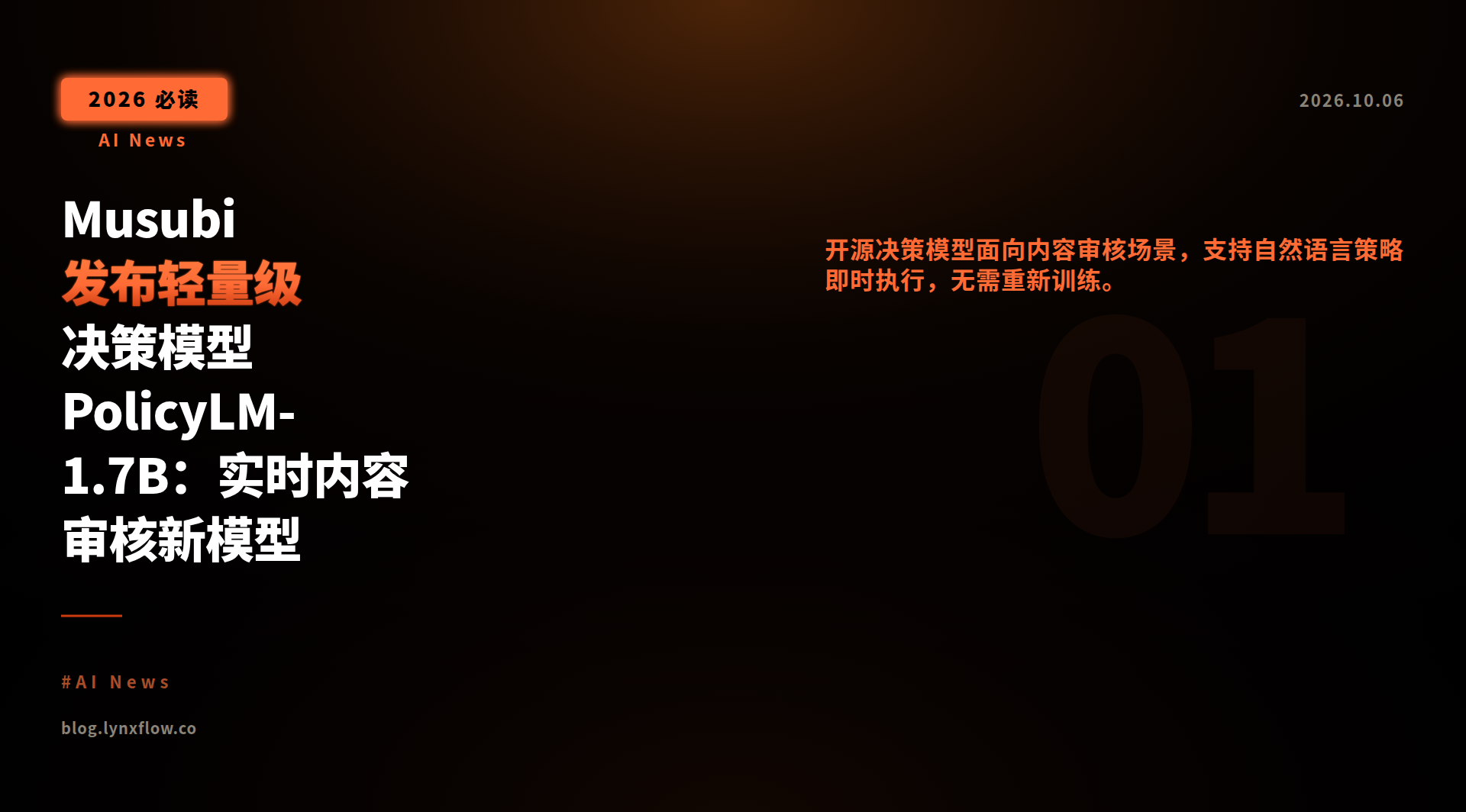
On October 6, 2026, startup Musubi officially released PolicyLM-1.7B, a lightweight decision model designed for real-time content moderation. The model is being released with open weights for the community to use and deploy freely.
- Release date: October 6, 2026 (Tuesday)
- Model size: 1.7 billion parameters (1.7B)
- Purpose: Real-time content classification based on natural-language policies
- Latency target: Under 50 milliseconds per inference
- Open weights: Yes
- Training status: No retraining required for new policies
How Decision Models Are Changing the Moderation Paradigm
A decision model is an AI system that outputs probabilities for predefined decisions rather than free-form text. Compared with large language models, it has a constrained output space, making it lighter to run and cheaper while still retaining the generalization ability of the underlying Transformer architecture. This characteristic gives it a natural advantage in latency-sensitive scenarios.
PolicyLM-1.7B’s core innovation is that it lets operations teams write content policies in natural language, and the model can immediately determine whether content complies. For example, a policy such as “Reject comments containing racially discriminatory language” can be applied directly by the model to produce a binary decision (pass/reject) without additional labeled data or model fine-tuning. This addresses the pain point of traditional classifiers needing frequent retraining when policies change.
Musubi co-founder and Chief AI Officer Filip Jankovic notes that as platform content grows exponentially, product teams urgently need a scalable, customizable labeling mechanism—and PolicyLM is designed to provide exactly that.
Counterintuitive Parameter: High Flexibility at a Lightweight Scale

A key contrast is that a 1.7B-scale model significantly reduces inference costs while preserving the flexibility of LLM-based policy expression. Traditional content moderation systems rely on collecting labeled data item by item and retraining models to adapt to new policies, whereas decision models completely avoid this process by feeding policies in as context. In fact, Jankovic says his interest in decision models dates back to the 2024 GLiNER project, which had already used a similar technique for named entity recognition.
Who Should Pay Attention to This Development?
- Social platforms seeking efficient moderation solutions: If your team struggles with frequent classifier retraining, PolicyLM’s policy-as-context design could greatly reduce operational complexity.
- AI safety researchers: The model offers a practical reference for building low-overhead decision architectures.
- Organizations defining custom content standards: Teams that update policies frequently will benefit most from the no-retraining guarantee.
Readers can deprioritize this if: you need multilingual output beyond the model’s documented scope, or expect out-of-the-box integration with human review workflows (the announcement focuses on the classification layer itself).
Summary
With PolicyLM-1.7B, Musubi positions decision models as production-ready tools rather than conceptual demos. The open-weights release encourages broader experimentation—potentially driving adoption among small and midsize platforms and breaking down the technical barrier that currently leaves only top-tier companies able to build their own moderation systems.