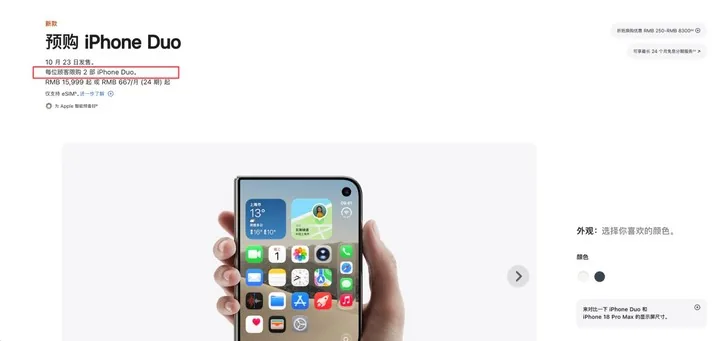
📱 iPhone Duo goes on a global purchase limit of two per customer
Apple’s website shows that the iPhone Duo, originally set to go on sale on October 23, is currently limited to two units per customer. Pre-orders opened at 8 p.m. on October 16 through Apple’s online store, the Apple Store app and Apple’s Tmall flagship store, and traffic was heavy enough to cause temporary slowdowns. Reports say in-store pickup inventory for launch day has sold out and some online orders have slipped to late January next year. China pricing starts at 15,999 yuan.
On the secondary market, China News Service’s Jiwei reported that minutes after pre-orders opened, several versions were trading above 20,000 yuan on Poizon. The 1TB black model averaged 28,642 yuan, 7,143 yuan above the official price; the 256GB black model averaged 22,085 yuan, up 6,086 yuan, or roughly 38.0%. Third-party quotes have since fallen sharply, with many scalpers asking only a 3,000 yuan premium and promising delivery on the first sales day.
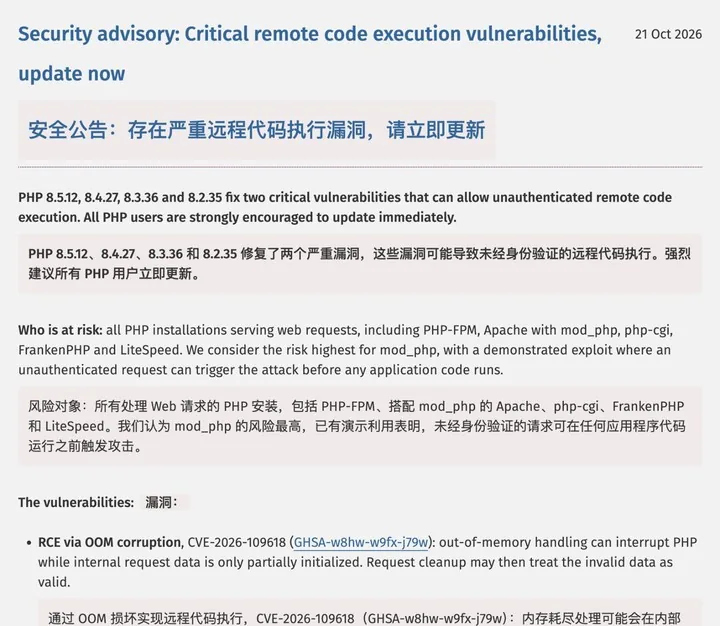
🛡️ PHP rushes out fixes for two critical flaws allowing unauthenticated remote code execution
The PHP development team released an emergency security update fixing two critical vulnerabilities, CVE-2026-109618 and CVE-2026-109619. Attackers could execute code remotely via crafted network requests without authentication; officials confirmed that in Apache mod_php setups the attack can trigger even before application code runs.
The flaws sit in PHP’s core request handling and do not depend on bugs in applications such as WordPress or Drupal. A successful exploit could execute code with the privileges of the PHP worker process, modify sites, or read passwords, authentication tokens and API keys from process memory.
Fixed versions are PHP 8.5.12, 8.4.27, 8.3.36 and 8.2.35. Officials stressed that temporary mitigations only reduce risk on some attack paths and that updating is the complete fix; PHP 8.1 and older no longer receive regular project security updates, so users should check their distribution or long-term-support vendor for patches. OpenAI said Calif found one of the flaws using GPT-5.6 Sol under the Patch the Planet program, while Wiz independently discovered and reported two issues. Maintainers coordinated with researchers, infrastructure providers and security vendors for about two months ahead of disclosure.
🏭 Samsung and SK Hynix upgrade China plants, plan shift to higher-layer NAND
Reuters reports that Samsung and SK Hynix are upgrading their NAND flash plants in China to counter YMTC and meet AI data-center demand. Both companies confirmed they are installing or upgrading equipment and said they are in communication with the U.S. government.
Samsung’s Xi’an plant plans to shift to 286-layer V9 NAND. Sources say the project aims for 5,000 wafers per month in December this year and 40,000 wafers by December 2027. Xi’an accounts for about 40% of Samsung’s global NAND output and currently makes roughly 200-layer products. Samsung stressed this is a technology upgrade, not new capacity or a new fab. SK Hynix plans to move its Dalian plant from 192-layer to 240-layer or above, and may seek approval to develop 300-layer-plus technology locally. Installing U.S. equipment in China requires annual licenses, and the U.S. Commerce Department reiterated that prior policy supports running existing plants but not capacity expansion or technology upgrades.
🚗 Lei Jun: without safety, everything else in the auto industry is zero
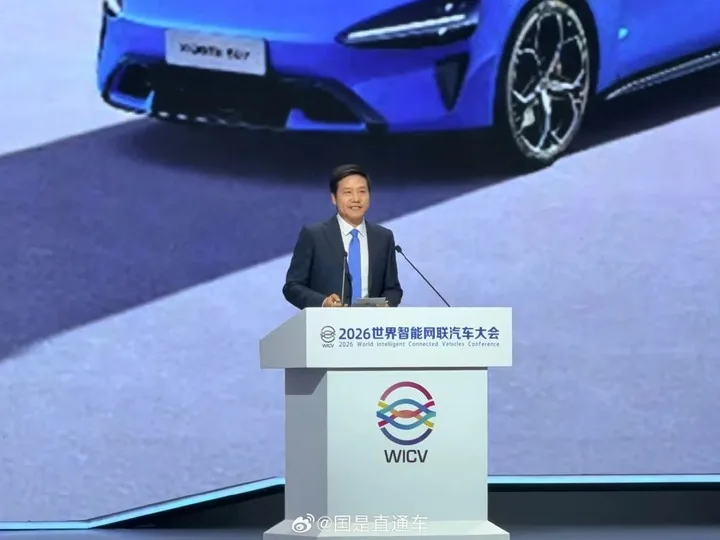
On October 21, Xiaomi’s Beijing automotive design center officially opened. Speaking the same day at the World Intelligent Connected Vehicles Conference, Lei Jun said that without safety, everything else in the auto industry is zero and all intelligent performance and innovative design lose meaning; Xiaomi has prioritized safety since day one of building cars.
Looking at the next phase of intelligent connected vehicles, Lei Jun expects competition to center more on ecosystems. He argued that China’s complete supply chain, active AI innovation and large single market give it a chance to connect the whole smart ecosystem into a Chinese-style innovation path. Citing Xiaomi’s consumer IoT platform, he said connected devices exceeded 1.1 billion by the end of the second quarter. Xiaomi has invested 105.5 billion yuan in hardcore technology research over the past five years and expects to spend more than 200 billion yuan over the next five.
🏢 BMW staff rush to resign and crash the system; some packages exceed 650,000 euros
BMW’s voluntary severance offer was overwhelmed and has stopped accepting new applications early. Germany’s Handelsblatt reported on October 20 that thousands of employees have expressed interest since the program opened on October 8; BMW confirmed the target was reached ahead of schedule and plans to finish processing packages by mid-next month.
Tens of thousands of employees received offers, and a rush of simultaneous logins crashed the internal HR portal for several hours before it recovered the next day. Expressing interest does not mean approval to leave; the program requires mutual consent between employee and employer. Handelsblatt reported individual packages above 650,000 euros, mainly for senior, higher-paid staff, and not representative of the norm. Packages can combine lump sums, installments, pensions and insurance, and some employees keep car purchase discounts after leaving. BMW aims to cut about 8,000 positions by the end of 2027.
💵 Today AI has raised over $200 million cumulatively, with Tencent and Ant among investors
According to Leidi, Today AI announced on October 21 that the team has raised more than $200 million in total, with investors including IDG Capital, Tencent, 5Y Capital, Ant Group, Sequoia China, Transsion, Tongge Ventures and Shanghai Jiao Tong University’s Hanyuan Assets.
Today AI was founded by Qi Junyuan, creator of Teambition and former head of Doubao’s PC client, and focuses on a personalized, proactive AI assistant. The product is live in China and handles scheduling, research, work assistance and on-the-go notes. It supports iOS, Android, Windows, Mac and Linux, and connects to WeCom, WeRead, Baidu Netdisk, Kingsoft Docs and Tencent Meeting. The team hopes continuous interaction will build user memory so it can help before users ask.
🧠 OpenAI models head to Google Cloud, purchasable with cloud commitments
OpenAI and Google Cloud announced a partnership to bring frontier models and Codex agent workflows into Google Cloud’s Model Garden, with full availability planned in the coming weeks. Enterprises can buy the models through Google Cloud Marketplace, and spending counts against existing Google Cloud commitments.
The two will combine model capabilities with Google Cloud’s access controls, centralized data governance and infrastructure for software development and complex agent tasks. OpenAI also said its models will soon arrive in Google Antigravity and Gemini Agent, letting enterprises choose models from different vendors in those tools. Microsoft remains OpenAI’s primary cloud partner.
💾 Nvidia puts an AI factory in a container; DSX POD deployable in as little as 14 days
At GTC Berlin, Nvidia introduced DSX POD: partners build a complete Vera Rubin AI factory inside modular containers, integrated and validated before shipping, with global delivery planned for early 2027.
Nvidia says that with site power, cooling and networking ready, the approach can cut on-site deployment from six months to as little as 14 days. Installation and testing of compute, networking, cabling, rack power and liquid cooling move to the manufacturing plant and run in parallel with site preparation. Partners include Dell, Hewlett Packard Enterprise, Lenovo, Schneider Electric and Vertiv. Jensen Huang said an AI factory starts creating value when it runs model training or production inference and generates tokens, and DSX POD aims to compress the time between delivery and going live.
💼 China’s central offices: fully implement the AI Plus initiative, let enterprises lead commercialization
The General Office of the CPC Central Committee and the General Office of the State Council issued opinions on deepening the integration of technological and industrial innovation, calling for full implementation of the AI Plus initiative so AI empowers every sector.
The document calls for accelerating industrial internet innovation and upgrading traditional industries with advanced technology; exploring technical routes, application scenarios and business models in frontier fields such as quantum technology, brain-computer interfaces, embodied intelligence and 6G, and advancing industrialization and commercialization. On commercialization, national science and technology programs with clear industrial goals should in principle be led by enterprises, and universities and research institutes are encouraged to license results to small and medium-sized enterprises on a pay-after-use basis. It also calls for improving laws and regulations in frontier areas such as AI and biotechnology and exploring sandbox regulation.
💬 Report: DeepSeek’s nearly 100 billion yuan round nears completion
According to Leidi, DeepSeek’s new round of nearly 100 billion yuan is close to completion at a pre-money valuation of about 500 billion yuan. Sources cited by the report say two funds, Lisixing Shen and Shixiang Shangshi, are participating, with Tencent continuing to follow on.
A fund progress announcement from Perfect World showed that Lisixing Shen has finished fundraising with total scale of 7.52 billion yuan, to which the company committed 50 million yuan, while Shixiang Shangshi totals 3.65 billion yuan, with the company committing 100 million yuan. Per Leidi, new investors in this round are mainly industrial capital, including Shixi Capital, SMIC Capital, CPE Yuanfeng, Legend Capital and Geely, while existing shareholders including CATL, Tencent, IDG Capital, Monolith and Shixiang continued to participate.
✨ Codex introduces permanent conversation caching
OpenAI product lead Tibo Sottiaux announced that the API now offers an optional 12-hour prompt cache, and for logged-in Codex and Work users the company will retain caches permanently. Users returning to old conversations or resuming after hours can still hit the cache.
An OpenAI Developers post explained that long-running agents reuse the same context repeatedly over a day. The new option keeps shared instructions, tools and context longer, so even requests hours apart can be billed at the lower cached-input rate. Sottiaux framed the change as a Day 16 update and said resuming old sessions carries no penalty.
📉 Tesla’s Q3 net income falls 43%, free cash flow turns positive
Tesla reported third-quarter 2026 results: revenue of $28.046 billion, roughly flat year over year, and GAAP net income attributable to common shareholders of $787 million, down 43%. Deliveries were 486,532 vehicles, down 2%.
Automotive revenue was $20.560 billion, down 3%; energy revenue $2.881 billion, down 16%; services and other revenue $4.605 billion, up 33%. GAAP operating income was $718 million, down 56%, for a 2.6% operating margin; diluted EPS was $0.22 and non-GAAP diluted EPS $0.48. Capital expenditures were $4.732 billion, below the prior quarter’s $5.789 billion; operating cash flow was $6.263 billion and free cash flow $1.531 billion, turning positive from negative last quarter.
The company said more than three-quarters of North American new-vehicle deliveries include an FSD subscription, with 1.74 million active FSD subscriptions globally, counting one-time purchases and monthly subscriptions but not free trials; FSD still requires active driver supervision. Cybercab joined Robotaxi service in Austin on September 3, and Tesla Semi and Optimus have begun production in Nevada and Fremont respectively.
🏢 IBM software growth rebounds, raises full-year free cash flow outlook
IBM reported third-quarter 2026 revenue of $17.103 billion, up about 5% year over year and 6% at constant currency. GAAP net income from continuing operations was $2.199 billion, up 26%, with diluted EPS of $2.31 and operating non-GAAP EPS of $2.95.
Software revenue was about $7.8 billion, up 8%, with Red Hat up 11%, data up 19% and automation down 3%. Consulting revenue was about $5.3 billion, roughly flat, and infrastructure revenue about $3.7 billion, up 4%, though IBM Z mainframe revenue fell 20%. Operating cash flow was about $4 billion and free cash flow about $3 billion, with $1.6 billion returned to shareholders in dividends; free cash flow totaled about $7.8 billion for the first nine months.
IBM maintained its full-year constant-currency revenue growth outlook of 4% to 5% and raised its full-year free cash flow outlook to growth of more than $1 billion year over year. The board also approved a quarterly cash dividend of $1.69 per share, payable December 10 to shareholders of record on November 10.
💵 Faster code writing drives a testing boom: Blacksmith valued at $1 billion
Fortune reports that code testing infrastructure company Blacksmith raised a $66 million Series C led by Sequoia Capital at a $1 billion valuation. Founded in 2024, the company provides compute and software for automated builds and tests before code is merged and deployed.
Blacksmith says more than 10,000 companies use its platform, with customers including Granola, Handshake, Supabase and LangChain. Weekly verification tasks grew from 5 million at the start of the year to 90 million now, and annual recurring revenue grew 17-fold over the same period. Co-founder and CEO Aditya Jayaprakash said AI tools make writing code easy, shifting the bottleneck to verifying it. The round will mainly fund more compute; the company also faces tight compute and memory supply and competition from model vendors offering their own code verification.
💡 He Xiaopeng: autonomous driving should skip L3, safety still questionable
XPeng chairman He Xiaopeng said at the World Intelligent Connected Vehicles Conference that autonomous driving should skip L3. He argued that L3 shifts safety responsibility to the system without improving the user experience, and whether it improves safety is questionable.
In his view, L3 is essentially an enhanced form of L2, and the better path runs from L2 to L4 and a redefined L5. Regulatory systems should support higher levels of autonomy on the premise of safety and controllability. He also said past L5 definitions were mainly technical and did not fully consider safety and scenario controllability; cars provide passive autonomous service under certain conditions, while robots may need to act proactively around the clock, so the L5 definition should adapt to use cases. On timing, he expects L4 to land technically in the second half of 2028, with regulation and policy following between 2028 and 2032.
🧠 Anthropic launches Claude Duet, which reports back proactively and keeps working in the background
Anthropic released Claude Duet, turning Claude into a personal agent that reaches out to users and keeps working on tasks. The product is opening a research preview waitlist, starting with Claude Pro and Max subscribers in the U.S., via standalone iOS and Android apps and claude.ai.
Duet runs on Claude Opus 5.5 and reuses users’ existing memory, skills and app connections. It summarizes important items from connected apps each morning, keeps watching during the day and messages only when something needs action or a decision; users can also hand it tasks such as scheduling meetings, building forecasts, creating dashboards or developing web apps, and it keeps working after they leave. It uses connected tools from a cloud computer, with the product page claiming support for more than 6,000 connectors and plugins. Sensitive actions such as sending messages or making payments require confirmation; Anthropic says Duet does not directly see passwords or login tokens and adds classifiers to limit outbound transfer of ID documents, credit card data and other sensitive information. The research preview is included in Pro and Max plans and shares usage limits with other Claude usage, with background checks consuming quota; Team and Enterprise are not included yet. Anthropic warns the product may misread conversations, misjudge urgency or miss messages that arrive between checks.
📱 Honor WIN2 series goes on sale from 3,149 yuan with subsidies
Honor launched the WIN2 and WIN RT2 in Hangzhou on October 21 and put them on sale the same day, with first-sale prices after national subsidies starting at 4,999 yuan and 3,149 yuan respectively. The event also brought the WIN Turbo2, WIN tablet and WIN earbuds. The Honor WIN2 runs the sixth-generation Snapdragon 8 Elite, with a dual-fan three-dimensional airflow cooling system rated at 1.19 CFM; a 10,100mAh battery with 100W wired and 80W wireless charging; a 200-megapixel main camera, USB 3.2 and a 3D ultrasonic fingerprint sensor.